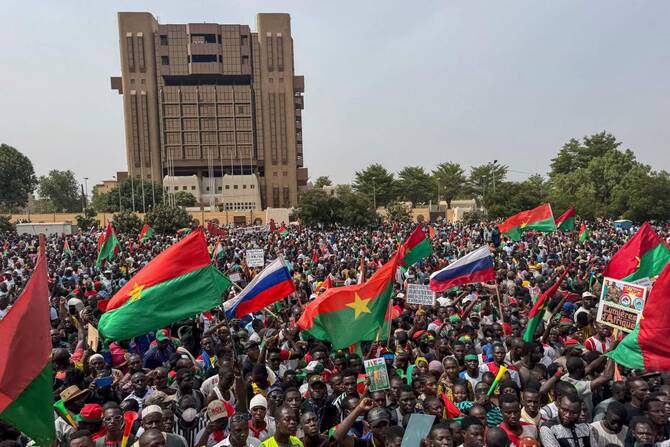
ABIDJAN: Several thousand people rallied in support of Burkina Faso’s ruling junta Wednesday, days after the military authorities said they had uncovered a “plot” to overthrow the government.
Demonstrators carried giant posters of junta leader Captain Ibrahim Traore and Burkinabe and Russian flags.
With placards bearing slogans such as: “Down with imperialism and its local lackeys” and “Full support for President Ibrahim Traore and the people of Burkina Faso,” they gathered in a central square in the capital Ouagadougou.
It was one of the biggest pro-junta demonstrations since Traore seized power in a September 2022 coup in the west African country, which has been battling jihadist attacks for a decade that have killed tens of thousands of people.
On April 21, the junta claimed to have undone a “major plot” planned by masterminds in neighboring Ivory Coast, with the arrests of several top army officials.
Traore has regularly accused Ivory Coast of harboring his opponents, allegations its neighbor rejects.
Over more than a year, the junta has detained several dozen military officers, including former gendarmerie chief of staff Evrard Somda, accusing them of plotting or of attempting to destabilize republican institutions.
Authorities regularly repress dissent, notably within civil society and the media, claiming it as part of the anti-militant battle.
Prime Minister Rimtalba Jean Emmanuel Ouedraogo addressed the rally which was also attended by several ministers and MPs and called by the National Coordination of the Civilian Vigil (CNAVC), a coalition of pro-junta civil society groups.
“We must stand up more than ever because when the people stand up, the imperialists tremble,” the prime minister told the crowd.
Rallies condemning the “hypocrisy” of former colonial powers also took place in Burkina’s second biggest city Bobo Dioulasso and in Boromo.
“We, peoples who love justice and sovereignty, affirm our unwavering solidarity with the heroic struggle of the Burkinabe people for their emancipation,” a CNAVC spokesman said.
“This mobilization is proof that the people are committed to their leaders,” Ghislain Some, CNAVC secretary general, said.
“The people are standing up, mobilized and united behind captain Ibrahim Traore. We will never be able to harm our president or destabilize our country. We are a shield,” Some said.
Adama Kima, one of the organizers, said on national television that the rally was also to denounce remarks attributed to US Africa Command chief General Michael Langley accusing Traore of using the country’s gold reserves for personal protection at the expense of the well-being of the people.
Like its neighbors Niger and Mali, Burkina Faso under Traore has turned away from its former colonial master France and moved closer to Russia.
All three of those Sahel states have been battling violence by militants linked to Al-Qaeda and the Daesh group for a decade.
The three junta-led countries quit the Economic Community of West African States (ECOWAS) at the beginning of the year, accusing the regional bloc of being subservient to France, and have formed the Alliance of Sahel States (AES), originally set up as a defense pact in 2023 but which now seeks closer integration.

Burkina Faso junta rallies supporters after claimed coup ‘plot’
Short Url
https://arab.news/vhkxx
Burkina Faso junta rallies supporters after claimed coup ‘plot’
- On April 21, the junta claimed to have undone a ‘major plot’ planned by masterminds in neighboring Ivory Coast
- Authorities regularly repress dissent, notably within civil society and the media, claiming it as part of the anti-militant battle
Vietnam’s ruling Communist Party re-elects To Lam as general secretary
HANOI: Vietnam’s leader To Lam was re-elected Friday as the general secretary of its ruling Communist Party, securing a new five-year term in the country’s most powerful position and pledging to rev up economic growth in the export powerhouse.
Lam, 68, was reappointed unanimously by the party’s 180-member Central Committee at the conclusion of the National Party Congress, the country’s most important political conclave.
In a speech, he said he wanted to build a system grounded in “integrity, talent, courage, and competence,” with officials to be judged on merit rather than seniority or rhetoric.
No announcement was made about whether Lam will also become president. If he were to get both positions, he would be the country’s most powerful leader in decades, similar to Chinese leader Xi Jinping.
The Congress was framed by Vietnam’s defining national question: whether the country can transform itself into a high-income economy by 2045. During the meeting, Vietnam set a target of average annual GDP growth of 10 percent or more from 2026 to 2030.
The gathering brought together nearly 1,600 delegates to outline Vietnam’s political and economic direction through 2031. It also confirmed a slate of senior appointments, electing 19 members to the Politburo, the country’s top leadership body.
Beyond settling the question of who will lead Vietnam for the coming years, the Congress will also determine how the country’s single-party system responds to world grown increasingly turbulent as China and the United States wrangle over trade and Washington under President Donald Trump challenges a longstanding global order.
Vietnam’s transformation into a global manufacturing hub for electronics, textiles, and footwear has been striking. Poverty has declined and the middle class is growing quickly.
But challenges loom as the country tries to balance rapid growth with reforms, an aging population, climate risks, weak institutions and US pressure over its trade surplus. At the same time it must balance relations with major powers. Vietnam has overlapping territorial claims with China, its largest trading partner, in the South China Sea.
Lam has overseen Vietnam’s most ambitious bureaucratic and economic reforms since the late 1980s, when it liberalized its economy. Under his leadership, the government has cut tens of thousands of public-sector jobs, redrawn administrative boundaries to speed decision-making, and initiated dozens of major infrastructure projects.
Lam spent decades in the Ministry of Public Security before becoming its minister in 2016. He led an anti-corruption campaign championed by his predecessor, Nguyen Phu Trong. During his rise, Vietnam’s Politburo lost six of its 18 members during an anti-graft campaign, including two former presidents and Vietnam’s parliamentary head.
Lam, 68, was reappointed unanimously by the party’s 180-member Central Committee at the conclusion of the National Party Congress, the country’s most important political conclave.
In a speech, he said he wanted to build a system grounded in “integrity, talent, courage, and competence,” with officials to be judged on merit rather than seniority or rhetoric.
No announcement was made about whether Lam will also become president. If he were to get both positions, he would be the country’s most powerful leader in decades, similar to Chinese leader Xi Jinping.
The Congress was framed by Vietnam’s defining national question: whether the country can transform itself into a high-income economy by 2045. During the meeting, Vietnam set a target of average annual GDP growth of 10 percent or more from 2026 to 2030.
The gathering brought together nearly 1,600 delegates to outline Vietnam’s political and economic direction through 2031. It also confirmed a slate of senior appointments, electing 19 members to the Politburo, the country’s top leadership body.
Beyond settling the question of who will lead Vietnam for the coming years, the Congress will also determine how the country’s single-party system responds to world grown increasingly turbulent as China and the United States wrangle over trade and Washington under President Donald Trump challenges a longstanding global order.
Vietnam’s transformation into a global manufacturing hub for electronics, textiles, and footwear has been striking. Poverty has declined and the middle class is growing quickly.
But challenges loom as the country tries to balance rapid growth with reforms, an aging population, climate risks, weak institutions and US pressure over its trade surplus. At the same time it must balance relations with major powers. Vietnam has overlapping territorial claims with China, its largest trading partner, in the South China Sea.
Lam has overseen Vietnam’s most ambitious bureaucratic and economic reforms since the late 1980s, when it liberalized its economy. Under his leadership, the government has cut tens of thousands of public-sector jobs, redrawn administrative boundaries to speed decision-making, and initiated dozens of major infrastructure projects.
Lam spent decades in the Ministry of Public Security before becoming its minister in 2016. He led an anti-corruption campaign championed by his predecessor, Nguyen Phu Trong. During his rise, Vietnam’s Politburo lost six of its 18 members during an anti-graft campaign, including two former presidents and Vietnam’s parliamentary head.
© 2026 SAUDI RESEARCH & PUBLISHING COMPANY, All Rights Reserved And subject to Terms of Use Agreement.



