VATICAN CITY: Catholic cardinals acknowledged Wednesday the definitive word is still out about the Vatican trial that convicted Cardinal Angelo Becciu of financial crimes, in the latest twist to a drama that has dominated conversations leading up to the May 7 conclave to elect Pope Francis’ successor.
Becciu, 76, is the once-powerful Italian cardinal who formally withdrew his participation in the conclave on Tuesday, after days of uncertainty about his status.
The Vatican’s criminal court convicted Becciu in 2023 of embezzlement and other finance-related charges at the end of the so-called “trial of the century.”
But the convictions are being appealed and there are lingering questions about the integrity of the trial, which the College of Cardinals appeared to refer to in a statement Wednesday. As in Italy, convictions in the Vatican criminal court are not considered definitive until all appeals are exhausted.
In their statement Wednesday, the college thanked Becciu for withdrawing and for “contributing to the communion and serenity of the conclave.”
“The Congregation of Cardinals expresses its appreciation for the gesture he has made and hopes that the competent organs of justice will be able to definitively ascertain the facts,” said a statement from the cardinals who are meeting in pre-conclave discussions.
Francis in 2020 forced Becciu’s resignation as head of the Vatican’s saint-making office and forced him to renounce the rights of the cardinalate after receiving allegations of financial misconduct against him.
Becciu denied wrongdoing but said at the time that he wouldn’t be able to vote in a future conclave. After Francis died April 21, Becciu had asserted his right to participate. But he backed down Tuesday after being presented with letters from Francis, penned before his death, saying he couldn’t take part.
Questions around the trial
During the trial, defense lawyers discovered that Francis had secretly issued four decrees during the investigation to benefit prosecutors, allowing them to conduct intercepts and detain suspects without a judge’s warrant. Defense lawyers argued such interference by an absolute monarch in a legal system where the pope exercises supreme legislative, executive and judicial power violated their clients’ fundamental rights and robbed them of a fair trial.
Also during the trial, it emerged that the prosecution’s prime witness against Becciu was coached, threatened and manipulated by outsiders to persuade him to turn on the cardinal.
The tribunal rejected the defense objections at the time and the trial went ahead. But in recent weeks even more evidence has emerged about the outside manipulation of the witness and apparent collusion with Vatican prosecutors and gendarmes to target Becciu. The Domani newspaper has published previously redacted WhatsApp chats and an audio suggesting that Vatican gendarmes and prosecutors were involved indirectly in coaching the witness, Monsignor Alberto Perlasca, to turn on Becciu.
Becciu has responded to the reports with outrage, saying they prove that his prosecution was manipulated from the start.
“From the very first moment I spoke of a machination against me: an investigation built on falsehoods, which five years ago unjustly devastated my life and exposed me to a pillory of worldwide proportions,” he said in a statement April 14, when the first chats were published.
The appeal is scheduled to begin in September.

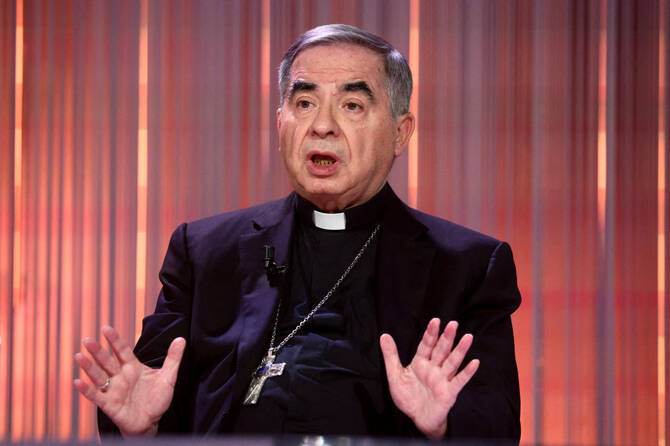
Cardinals thank Cardinal Becciu for stepping back from conclave
Short Url
https://arab.news/76wuy
Cardinals thank Cardinal Becciu for stepping back from conclave
- The Vatican’s criminal court convicted Cardinal Angelo Becciu in 2023 of embezzlement and other finance-related charges
- Pope Francis in 2020 forced his resignation as head of the Vatican’s saint-making office and forced him to renounce the rights of the cardinalate
Japan prepares to restart world’s biggest nuclear plant, 15 years after Fukushima
NIIGATA: Japan took the final step to allow the world’s largest nuclear power plant to resume operations with a regional vote on Monday, a watershed moment in the country’s return to nuclear energy nearly 15 years after the Fukushima disaster. Kashiwazaki-Kariwa, located about 220 km (136 miles) northwest of Tokyo, was among 54 reactors shut after the 2011 earthquake and tsunami crippled the Fukushima Daiichi plant in the worst nuclear disaster since Chernobyl.
Since then, Japan has restarted 14 of the 33 that remain operable, as it tries to wean itself off imported fossil fuels. Kashiwazaki-Kariwa will be the first operated by Tokyo Electric Power Co. (TEPCO), which ran the doomed Fukushima plant. On Monday, Niigata prefecture’s assembly passed a vote of confidence on Niigata Governor Hideyo Hanazumi, who backed the restart last month, effectively allowing for the plant to begin operations again.
“This is a milestone, but this is not the end,” Hanazumi told reporters after the vote. “There is no end in terms of ensuring the safety of Niigata residents.”
While lawmakers voted in support of Hanazumi, the assembly session, the last for the year, exposed the community’s divisions over the restart, despite new jobs and potentially lower electricity bills.
“This is nothing other than a political settlement that does not take into account the will of the Niigata residents,” an assembly member opposed to the restart told fellow lawmakers as the vote was about to begin.
Outside, around 300 protesters stood in the cold holding banners reading ‘No Nukes’, ‘We oppose the restart of Kashiwazaki-Kariwa’ and ‘Support Fukushima’. “I am truly angry from the bottom of my heart,” Kenichiro Ishiyama, a 77-year-old protester from Niigata city, told Reuters after the vote. “If something was to happen at the plant, we would be the ones to suffer the consequences.”
TEPCO is considering reactivating the first of seven reactors at the plant on January 20, public broadcaster NHK reported.
Kashiwazaki-Kariwa’s total capacity is 8.2 GW, enough to power a few million homes. The pending restart would bring one 1.36 GW unit online next year and start another one with the same capacity around 2030.
“We remain firmly committed to never repeating such an accident and ensuring Niigata residents never experience anything similar,” said TEPCO spokesperson Masakatsu Takata. Takata declined to comment on timing. TEPCO shares closed up 2 percent in afternoon trade in Tokyo, higher than the wider Nikkei index, which was up 1.8 percent.
RELUCTANT RESIDENTS WARY OF RESTART
TEPCO earlier this year pledged to inject 100 billion yen ($641 million) into the prefecture over the next 10 years as it sought to win the support of Niigata residents.
But a survey published by the prefecture in October found 60 percent of residents did not think conditions for the restart had been met. Nearly 70 percent were worried about TEPCO operating the plant.
Ayako Oga, 52, settled in Niigata after fleeing the area around the Fukushima plant in 2011 with 160,000 other evacuees. Her old home was inside the 20 km irradiated exclusion zone.
The farmer and anti-nuclear activist has joined the Niigata protests.
“We know firsthand the risk of a nuclear accident and cannot dismiss it,” said Oga, adding that she still struggles with post-traumatic stress-like symptoms from what happened at Fukushima.
Even Niigata Governor Hanazumi hopes that Japan will eventually be able to reduce its reliance on nuclear power. “I want to see an era where we don’t have to rely on energy sources that cause anxiety,” he said last month.
STRENGTHENING ENERGY SECURITY
The Monday vote was seen as the final hurdle before TEPCO restarts the first reactor, which alone could boost electricity supply to the Tokyo area by 2 percent, Japan’s trade ministry has estimated. Prime Minister Sanae Takaichi, who took office two months ago, has backed nuclear restarts to strengthen energy security and to counter the cost of imported fossil fuels, which account for 60 percent to 70 percent of Japan’s electricity generation.
Japan spent 10.7 trillion yen ($68 billion) last year on imported liquefied natural gas and coal, a tenth of its total import costs.
Despite its shrinking population, Japan expects energy demand to rise over the coming decade due to a boom in power-hungry AI data centers. To meet those needs, and its decarbonization commitments, it has set a target of doubling the share of nuclear power in its electricity mix to 20 percent by 2040.
Joshua Ngu, vice chairman for Asia Pacific at consultancy Wood Mackenzie, said public acceptance of the restart of Kashiwazaki-Kariwa would represent “a critical milestone” toward reaching those goals. In July, Kansai Electric Power, Japan’s top nuclear power operator, said it would begin conducting surveys for a reactor in western Japan, the first new unit since the Fukushima disaster.
But for Oga, who was in the crowd outside the assembly on Monday chanting ‘Never forget Fukushima’s lessons!’, the nuclear revival is a terrifying reminder of the potential risks. “At the time (2011), I never thought that TEPCO would operate a nuclear power plant again,” she said.
“As a victim of the Fukushima nuclear accident, I wish that no one, whether in Japan or anywhere in the world, ever again suffers the damage of a nuclear accident.”
Since then, Japan has restarted 14 of the 33 that remain operable, as it tries to wean itself off imported fossil fuels. Kashiwazaki-Kariwa will be the first operated by Tokyo Electric Power Co. (TEPCO), which ran the doomed Fukushima plant. On Monday, Niigata prefecture’s assembly passed a vote of confidence on Niigata Governor Hideyo Hanazumi, who backed the restart last month, effectively allowing for the plant to begin operations again.
“This is a milestone, but this is not the end,” Hanazumi told reporters after the vote. “There is no end in terms of ensuring the safety of Niigata residents.”
While lawmakers voted in support of Hanazumi, the assembly session, the last for the year, exposed the community’s divisions over the restart, despite new jobs and potentially lower electricity bills.
“This is nothing other than a political settlement that does not take into account the will of the Niigata residents,” an assembly member opposed to the restart told fellow lawmakers as the vote was about to begin.
Outside, around 300 protesters stood in the cold holding banners reading ‘No Nukes’, ‘We oppose the restart of Kashiwazaki-Kariwa’ and ‘Support Fukushima’. “I am truly angry from the bottom of my heart,” Kenichiro Ishiyama, a 77-year-old protester from Niigata city, told Reuters after the vote. “If something was to happen at the plant, we would be the ones to suffer the consequences.”
TEPCO is considering reactivating the first of seven reactors at the plant on January 20, public broadcaster NHK reported.
Kashiwazaki-Kariwa’s total capacity is 8.2 GW, enough to power a few million homes. The pending restart would bring one 1.36 GW unit online next year and start another one with the same capacity around 2030.
“We remain firmly committed to never repeating such an accident and ensuring Niigata residents never experience anything similar,” said TEPCO spokesperson Masakatsu Takata. Takata declined to comment on timing. TEPCO shares closed up 2 percent in afternoon trade in Tokyo, higher than the wider Nikkei index, which was up 1.8 percent.
RELUCTANT RESIDENTS WARY OF RESTART
TEPCO earlier this year pledged to inject 100 billion yen ($641 million) into the prefecture over the next 10 years as it sought to win the support of Niigata residents.
But a survey published by the prefecture in October found 60 percent of residents did not think conditions for the restart had been met. Nearly 70 percent were worried about TEPCO operating the plant.
Ayako Oga, 52, settled in Niigata after fleeing the area around the Fukushima plant in 2011 with 160,000 other evacuees. Her old home was inside the 20 km irradiated exclusion zone.
The farmer and anti-nuclear activist has joined the Niigata protests.
“We know firsthand the risk of a nuclear accident and cannot dismiss it,” said Oga, adding that she still struggles with post-traumatic stress-like symptoms from what happened at Fukushima.
Even Niigata Governor Hanazumi hopes that Japan will eventually be able to reduce its reliance on nuclear power. “I want to see an era where we don’t have to rely on energy sources that cause anxiety,” he said last month.
STRENGTHENING ENERGY SECURITY
The Monday vote was seen as the final hurdle before TEPCO restarts the first reactor, which alone could boost electricity supply to the Tokyo area by 2 percent, Japan’s trade ministry has estimated. Prime Minister Sanae Takaichi, who took office two months ago, has backed nuclear restarts to strengthen energy security and to counter the cost of imported fossil fuels, which account for 60 percent to 70 percent of Japan’s electricity generation.
Japan spent 10.7 trillion yen ($68 billion) last year on imported liquefied natural gas and coal, a tenth of its total import costs.
Despite its shrinking population, Japan expects energy demand to rise over the coming decade due to a boom in power-hungry AI data centers. To meet those needs, and its decarbonization commitments, it has set a target of doubling the share of nuclear power in its electricity mix to 20 percent by 2040.
Joshua Ngu, vice chairman for Asia Pacific at consultancy Wood Mackenzie, said public acceptance of the restart of Kashiwazaki-Kariwa would represent “a critical milestone” toward reaching those goals. In July, Kansai Electric Power, Japan’s top nuclear power operator, said it would begin conducting surveys for a reactor in western Japan, the first new unit since the Fukushima disaster.
But for Oga, who was in the crowd outside the assembly on Monday chanting ‘Never forget Fukushima’s lessons!’, the nuclear revival is a terrifying reminder of the potential risks. “At the time (2011), I never thought that TEPCO would operate a nuclear power plant again,” she said.
“As a victim of the Fukushima nuclear accident, I wish that no one, whether in Japan or anywhere in the world, ever again suffers the damage of a nuclear accident.”
© 2025 SAUDI RESEARCH & PUBLISHING COMPANY, All Rights Reserved And subject to Terms of Use Agreement.



