Top cardinal awaits fate as historic Vatican fraud trial ends

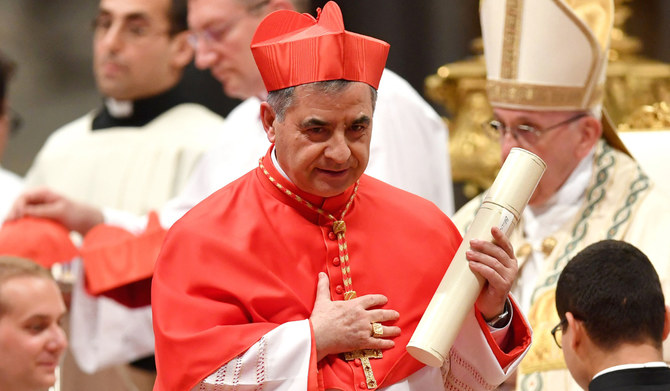
Italian Giovanni Angelo Becciu substitute for General Affairs of the Secretariat of State and special delegate to the Sovereign Military Order of Malta leaves after kneeling before Pope Francis to pledge allegiance and become a cardinal during a consistory for the creation of fourteen new cardinals on June 28, 2018 at St Peter's basilica in Vatican. (AFP)
Short Url
Updated 13 December 2023
Follow

Top cardinal awaits fate as historic Vatican fraud trial ends

  • Becciu faced separate allegations over hundreds of thousands of euros of Church funds paid to his brother’s charity

VATICAN CITY: A landmark Vatican fraud trial involving a top Italian cardinal and a murky London property deal wrapped up Tuesday after more than two years, with a verdict expected Saturday.
Cardinal Angelo Becciu, 75, a former adviser to Pope Francis, became the highest-ranking Catholic Church official to face a Vatican court when proceedings opened in July 2021.
Becciu, who has always strongly proclaimed his innocence, was among 10 defendants facing accusations of embezzlement, fraud, abuse of power, extortion, money laundering and corruption.
Vatican prosecutor Alessandro Diddi in July called for a sentence of seven years and three months behind bars if Becciu is found guilty.
Overall, Diddi requested more than 73 years in prison for all 10 defendants, in addition to fines.
The offenses relate to the Church’s loss-making purchase of a luxury property in London’s upmarket Chelsea district, funded in part by Peter’s Pence donations, money given by churchgoers for the pope’s charities.
Becciu also faced separate allegations over hundreds of thousands of euros of Church funds paid to his brother’s charity.
On Tuesday, the last of more than 80 hearings took place in a dedicated room within the Vatican Museums which housed the court, and where a portrait of a smiling Pope Francis hangs on the wall.
The trial “has shown that in all these investments, the cardinal never took a measure not in accordance with what his office had prepared for him,” Becciu’s lawyer Fabio Viglione told the court on Tuesday, demanding his acquittal.
The verdict will be delivered on Saturday, the judge said.
The trial was unprecedented in taking place before a Vatican tribunal of three lay magistrates rather than a religious court.
Francis — who has made cleaning up the Vatican’s murky finances a priority of his 10-year-old papacy — changed the law to stop cardinals and bishops enjoying legal privileges.
Had he not, Becciu would have been judged by a higher court presided by cardinals.
When the trial opened, prosecutors painted a picture of risky investments with little or no oversight, and double-dealing by outside consultants and insiders.
But the trial was mired by procedural wranglings, raising questions about the efficacy of Vatican justice.


Terror at Friday prayers: Witnesses describe blast rocking Islamabad mosque

Updated 2 sec ago
Follow

Terror at Friday prayers: Witnesses describe blast rocking Islamabad mosque

  • The Daesh group has claimed responsibility for the attack, according to the SITE Intelligence Group, which monitors jihadist communications
ISLAMABAD: A worshipper at the Shiite mosque in Islamabad where dozens of people were killed in a suicide blast on Friday described an “extremely powerful” explosion ripping through the building just after prayers started.
Muhammad Kazim, 52, told AFP he arrived at the Imam Bargah Qasr-e-Khadijatul Kubra mosque shortly after 1:00 p.m. (0800 GMT) on Friday and took up a place around seven or eight rows from the Imam.
“During the first bow of the Namaz (prayer ritual), we heard gunfire,” he told AFP outside the Pakistan Institute of Medical Sciences (PIMS) hospital, where many of the wounded were brought for treatment.
“And while we were still in the bowing position, an explosion occurred,” he said.
Kazim, who is from Gilgit-Baltistan in northern Pakistan and lives in Islamabad, escaped unharmed, but accompanied his wounded friend to the PIMS hospital for treatment.
“It was unclear whether it was a suicide bombing, but the explosion was extremely powerful and caused numerous casualties,” Kazim said.
“Debris fell from the roof, and windows were shattered,” he added. “When I got outside, many bodies were scattered... Many people lost their lives.”
The Daesh group has claimed responsibility for the attack, according to the SITE Intelligence Group, which monitors jihadist communications.
Another worshipper, Imran Mahmood, described a gunfight between the suicide bomber, a possible accomplice and volunteer security personnel at the mosque.
“The suicide attacker was trying to move forward, but one of our injured volunteers fired at him from behind, hitting him in the thigh,” Mahmood, in his fifties, told AFP.
“He fell but got up again. Another man accompanying him opened fire on our volunteers,” he said, adding the attacker “then jumped onto the gate and detonated the explosives.”
As of Saturday morning, the death toll stood at 31, with at least 169 wounded.
The attack was the deadliest in the Pakistani capital since September 2008, when 60 people were killed in a suicide truck bomb blast that destroyed part of the five-star Marriott hotel.

Lax security

Describing the aftermath of the attack, Kazim said unhurt worshippers went to the aid of those wounded.
“People tried to help on their own, carrying two or three bodies in the trunks of their vehicles, while ambulances arrived about 20 to 25 minutes later,” he told AFP.
“No one was allowed near the mosque afterwards.”
Kazim, who has performed Friday prayers at the mosque “for the past three to four weeks,” said security had been lax.
“I have never seen proper security in place,” he told AFP.
“Volunteers manage security on their own, but they lack the necessary equipment to do it effectively,” he said.
“Shiite mosques are always under threat, and the government should take this seriously and provide adequate security,” he added.