China blames US tariffs for halting Boeing plane deliveries

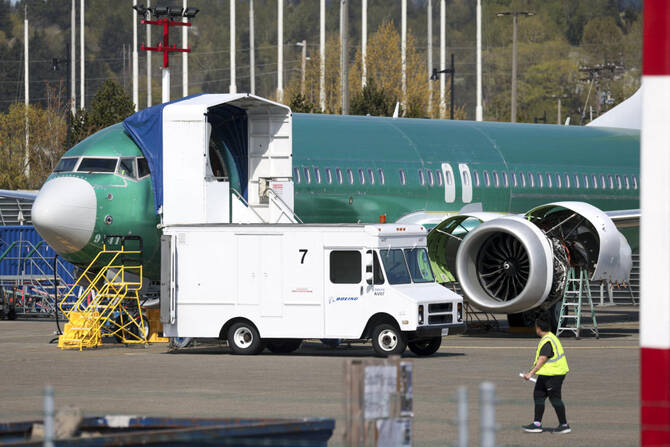
A Boeing 737 aircraft is pictured outside Boeing’s Renton Factory in Renton, Washington on April 15, 2025. (AFP)
Short Url
Updated 29 April 2025
Follow

China blames US tariffs for halting Boeing plane deliveries

  • Beijing spokesperson: The levies had ‘disrupted the international air transport market’
  • Boeing’s CEO confirmed last week that China had stopped accepting new aircraft due to the trade war

BEIJING: China on Tuesday blamed US tariffs for Beijing’s decision to stop accepting new aircraft from aviation giant Boeing, saying the levies had “disrupted the international air transport market.”
“The United States’ wielding of tariffs has severely impacted the stability of the global industrial chain and supply chain,” China’s commerce ministry said in a statement.
“Relevant Chinese airlines and Boeing in the United States have suffered greatly,” a spokesperson said.
New US tariffs have reached 145 percent on many Chinese products, while Beijing has responded with fresh 125 percent duties on imports from the United States.
And Boeing’s CEO confirmed last week that China had stopped accepting new aircraft due to the trade war.
In a televised interview with CNBC, Boeing chief executive Kelly Ortberg said Chinese customers had “stopped taking delivery of aircraft due to the tariff environment,” adding that if the halt continued, the aviation giant would soon market the jets to other carriers.
Boeing had planned to deliver around 50 aircraft to China in 2025, said Ortberg, adding that the company wouldn’t “wait too long” to send the jets to other customers.
US President Donald Trump also criticized Beijing for backing out of the deal, saying Boeing should “default China for not taking the beautifully finished planes.”
Beijing’s commerce ministry on Tuesday hit back, saying “many companies have been unable to carry out normal trade and investment activities” due to Trump’s tariffs.
“China is willing to continue to support the normal business cooperation between the two countries’ enterprises,” its spokesperson said.
Beijing “hopes that the United States can listen to the voices of enterprises and create a stable and predictable environment for their normal trade and investment activities,” they added.


Fourth Palestine Action activist ends hunger strike in UK prison

Protesters take part in a demonstration in support of "Defend Our Juries" and their campaign against the ban on Palestine Action
Updated 24 December 2025
Follow

Fourth Palestine Action activist ends hunger strike in UK prison

  • Amy Gardiner-Gibson began eating again after 49 days of protest
  • Govt rejects claims it ignored prison safety protocols

LONDON: A fourth Palestine Action activist imprisoned in the UK has ended her hunger strike.

Amy Gardiner-Gibson, who also uses the name Amu Gib, began eating again after 49 days of fasting, the campaign group Prisoners for Palestine said.

Qesser Zuhrah, another activist, ended her hunger strike last week after 48 days but said she might resume it next year, Sky News reported.

Four Palestine Action activists have now ended their hunger strikes while in prison, while four others are continuing to fast.

All of them are in prison on remand, awaiting trial for a series of high-profile alleged break-ins and criminal damage.

Palestine Action was proscribed as a terrorist organization and banned earlier this year.

On Tuesday, Swedish climate activist Greta Thunberg was arrested in central London at a rally in support of the hunger strikers.

The protesters are demanding that weapons factories in Britain with ties to Israel be shut down, as well as the removal of Palestine Action’s proscription.

They are also calling for immediate bail to be given to imprisoned pro-Palestine activists and an end to the alleged mistreatment of prisoners in custody.

Seven imprisoned members of Palestine Action have been transferred to hospital over the course of the hunger strike campaign. Doctors have highlighted concerns about the long-term impact of fasting on the activists.

Lawyers representing the group on Monday initiated legal action against the government over its alleged failure to follow prison safety regulations.

The government, however, has rejected this accusation, Sky News reported.

A Ministry of Justice spokesperson said: “Ministers do not intervene in individual cases. Where individuals are on remand, doing so would risk prejudicing ongoing legal proceedings and undermine the independence of the justice system.

“Concerns about welfare and process can be raised through established legal and administrative channels, including prison governors and ultimately the prison and probation ombudsman.

“Healthcare decisions are taken independently by qualified NHS professionals and appropriate care and oversight frameworks remain in place.”

The activists still on hunger strike include Heba Muraisi and Teuta Hoxha. Hoxha has been on remand for 13 months and her family told Sky News they feared she would die in prison.

Another of the activists, Kamran Ahmad, is believed to have been on hunger strike for 45 days and hospitalized three times.

Lewie Chiaramello, who has Type 1 diabetes, is on day 31 of his strike and taking part by fasting every other day.