
JEDDAH: Two elements sit at the heart of Ramadan hospitality in homes across Saudi Arabia: coffee and dates. They have become symbols of hospitality, faith and cultural identity.
“We usually buy large quantities of blond Harari coffee beans, cloves, cardamom and saffron,” Jawahir Al-Juhani, based in Madinah, told Arab News. “We prepare coffee before iftar and again after Taraweeh prayers.
“I like to buy cups that reflect the spirit of Ramadan,” she continued. “I place them on a serving tray next to the traditional golden dallah that keeps the coffee hot. Beside it, I set a covered dish of dates.”

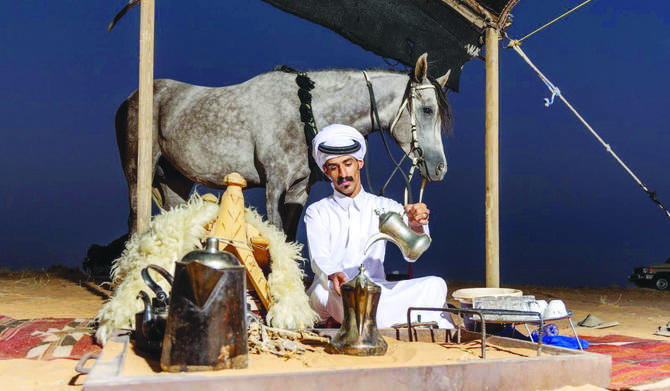
Typically crafted from copper or stainless steel, the dallah for serving Saudi coffee remains a centerpiece of Saudi homes. (SPA)
While Al-Juhani said she prefers seasonal dates throughout the year, during Ramadan she chooses sagai dates and fresh rutab.
The sequence of serving follows a familiar rhythm in many Saudi homes: dates and coffee at sunset, Maghrib prayer, savory dishes, then a second round of coffee after Taraweeh, often accompanied by homemade sweets prepared by family members.
“Prophet Muhammad (peace be upon him) would break his fast with fresh dates, or if they were unavailable, with dried dates,” said Makkah-based Amal Al-Harbi. “This practice continues to shape Ramadan tables today.”
FASTFACT
Hail, Al-Jouf, and Asir regions alone produce over 157,000 tonnes of dates annually from 3.5 million palm trees.
In Qassim, one of the Kingdom’s most prominent date-producing regions, demand begins to climb well before the crescent moon is sighted. Market activity typically accelerates from mid-Sha’ban, peaking during the first 10 days of Ramadan.
Bashar Al-Kuriea, the CEO of Zadna Dates Co., told Arab News that consumption and product diversity increase significantly around that time.

Typically crafted from copper or stainless steel, the dallah for serving Saudi coffee remains a centerpiece of Saudi homes. (SPA)
“Traditions account for nearly 60 percent of purchasing decisions,” he said, noting that preferences vary across regions of the Kingdom. The most sought-after varieties during Ramadan include khalas, sukkari, ajwa, helwa and sufri. Of these, khalas and sukkari consistently make up the largest share of sales.
Al-Kuriea added: “Ajwa dates, in particular, carry religious significance, especially in the holy cities of Makkah and Madinah, and are often favored by pilgrims.”
Seasonality also plays a role. When harvest periods align with Ramadan, demand increases for fresh rutab and other varieties that cannot be stored for extended periods.

Saudi families often purchase large quantities of dates and coffee beans ahead of Ramadan, as the ritual of drinking Saudi coffee is observed twice daily in many households. (AN photo by Huda Bashatah)
Climate differences between winter and summer, as well as regional heritage and family traditions, further influence consumers’ choices. Varieties such as wannaan and halwat Hail are particularly popular in specific areas.
Al-Kuriea said that while traditional varieties dominate the market, new trends are emerging, and Riyadh-based merchant Ahmed Al-Mutairi backed that up, saying: “Premium packaging and stuffed dates are gaining popularity, especially for Ramadan gifts. But khalas and sukkari remain the backbone of the market.”
Despite evolving consumer behavior and expanded distribution channels, the core rituals remain unchanged, with coffee poured from a polished dallah, and dates offered first at sunset.
In Saudi homes, Ramadan hospitality is not simply about food. It is about continuity, faith and preserving a tradition that connects generations.