

Pakistan stocks slide on surging tensions with neighboring India

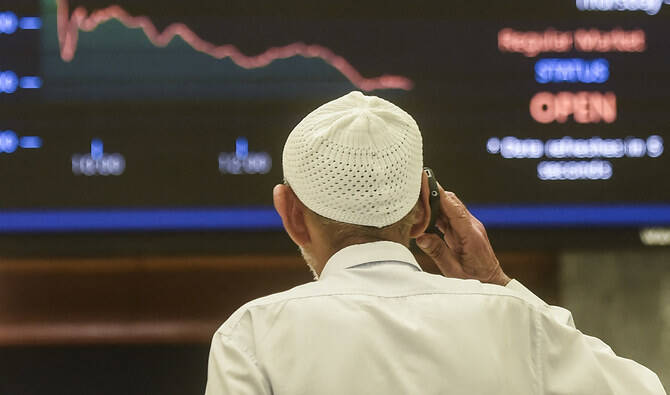
A stockbroker monitors the latest share prices during a trading session at the Pakistan Stock Exchange (PSX) in Karachi on February 24, 2022. (AFP/File)
Short Url
Updated 28 April 2025
Follow

Pakistan stocks slide on surging tensions with neighboring India

  • The stock market shed 1,405.44 points, or 1.22 percent, to close at 115,469.34 points
  • The below-expectation corporate results also disappointed investors, an analyst says

ISLAMABAD: The Pakistan Stock Exchange plunged and lost more than 1,400 points in intraday trading, traders and analysts said on Monday, as rising tensions with India triggered geopolitical jitters and fueled a wave of investor selling at the market.

The benchmark KSE-100 index shed 1,405.44 points, or 1.22 percent, to close at 115,469.34 points after touching an intraday high of 116,658.94 points on Monday, according to stock traders.

The development came amid heightened tensions between Pakistan and India over the killing of 26 tourists in Indian-administered Kashmir on April 22. New Delhi has blamed the attack on Pakistan, Islamabad denies any complicity.

"The prevailing negative sentiment was largely driven by escalating tensions between India and Pakistan, which heightened investor concerns and weighed heavily on overall market confidence," Karachi-based Topline Securities brokerage firm said.

It said companies like SYS, LUCK, MEBL and HBL contributed 489 points to the index, while ENGRO, UBL, MARI, EFERT and PSO shaved off 907 points from the benchmark.

"Despite the risk-averse sentiment, overall participation remained firm with volumes clocking in at 421 million shares and a turnover of Rs26.43 billion," the firm said in its review.

The market saw an overall trade of 533 million shares, valued at Rs33.7 billion.

Below-expectation corporate results also disappointed investors, according to Muhammad Rizwan, a director at Chase Securities.

Companies like Systems Limited (SYS), Lucky Cement Limited (LUCK), Meezan Bank Limited (MEBL) and Habib Bank Limited (HBL) contributed 489 points to the index, while ENGRO, United Bank Limited (UBL), Mari Energies Limited (MARI), Engro Fertilizers (EFERT) and Pakistan State Oil (PSO) shaved off 907 points from the benchmark.

"National Refinery Limited (NRL), Pak Electron Limited (PAEL) and Engro Holding disappointed investors, impacting stocks in a range of 5.4 percent to 9.7 percent," Rizwan said.


Pakistan, global crypto exchange discuss modernizing digital payments, creating job prospects 

Updated 8 sec ago
Follow

Pakistan, global crypto exchange discuss modernizing digital payments, creating job prospects 

  • Pakistani officials, Binance team discuss coordination between Islamabad, local banks and global exchanges
  • Pakistan has attempted to tap into growing crypto market to curb illicit transactions, improve oversight

ISLAMABAD: Pakistan’s finance officials and the team of a global cryptocurrency exchange on Friday held discussions aimed at modernizing the country’s digital payments system and building local talent pipelines to meet rising demand for blockchain and Web3 skills, the finance ministry said.

The development took place during a high-level meeting between Finance Minister Muhammad Aurangzeb, Pakistan Virtual Assets Regulatory Authority (PVARA) Chairman Bilal bin Saqib, domestic bank presidents and a Binance team led by Global CEO Richard Teng. The meeting was held to advance work on Pakistan’s National Digital Asset Framework, a regulatory setup to govern Pakistan’s digital assets.

Pakistan has been moving to regulate its fast-growing crypto and digital assets market by bringing virtual asset service providers (VASPs) under a formal licensing regime. Officials say the push is aimed at curbing illicit transactions, improving oversight, and encouraging innovation in blockchain-based financial services.

“Participants reviewed opportunities to modernize Pakistan’s digital payments landscape, noting that blockchain-based systems could significantly reduce costs from the country’s $38 billion annual remittance flows,” the finance ministry said in a statement. 

“Discussions also emphasized building local talent pipelines to meet rising global demand for blockchain and Web3 skills, creating high-value employment prospects for Pakistani youth.”

Blockchain is a type of digital database that is shared, transparent and tamper-resistant. Instead of being stored on one computer, the data is kept on a distributed network of computers, making it very hard to alter or hack.

Web3 refers to the next generation of the Internet built using blockchain, focusing on giving users more control over their data, identity and digital assets rather than big tech companies controlling it.

Participants of the meeting also discussed sovereign debt tokenization, which is the process of converting a country’s debt such as government bonds, into digital tokens on a blockchain, the ministry said. 

Aurangzeb called for close coordination between the government, domestic banks and global exchanges to modernize Pakistan’s payment landscape.

Participants of the meeting also discussed considering a “time-bound amnesty” to encourage users to move assets onto regulated platforms, stressing the need for stronger verifications and a risk-mitigation system.

Pakistan has attempted in recent months to tap into the country’s growing crypto market, crack down on money laundering and terror financing, and promote responsible innovation — a move analysts say could bring an estimated $25 billion in virtual assets into the tax net.

In September, Islamabad invited international crypto exchanges and other VASPs to apply for licenses to operate in the country, a step aimed at formalizing and regulating its fast-growing digital market.