
TEHRAN: Iran’s interior minister on Monday blamed “negligence” for a massive explosion that killed 65 people at the country’s largest commercial port, with firefighters still battling a blaze at the facility two days later.
The blast occurred on Saturday at the Shahid Rajaee Port in Iran’s south, near the strategic Strait of Hormuz, a waterway through which one-fifth of global oil output passes.
“The death toll has reached 65 in this horrific incident,” Mohammad Ashouri, governor of the southern Hormozgan province where the port is located, told state television, adding that the fire has not been fully extinguished yet.
Officials have said more than 1,000 people were injured. The province’s crisis management director, Mehrdad Hassanzadeh, said most had already been released after treatment.
On Monday, Interior Minister Eskandar Momeni told state TV that “culprits have been identified and summoned,” and that the blast was caused by “shortcomings, including noncompliance with safety precautions and negligence.”
Momeni, who has been in the area since hours after the blast, stated that the “investigation is still underway.”
Iran’s state TV showed images of firefighters still dousing the flames Monday, and said the damage would be assessed after the fire was fully brought under control.
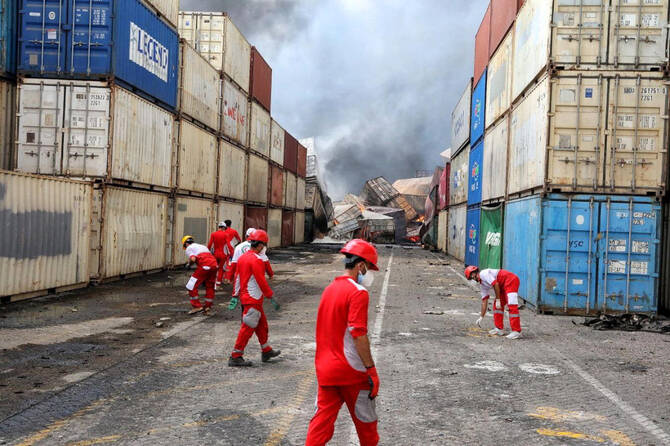
Heavy charcoal-black smoke continued to billow over low flames at part of the site, above which a firefighting helicopter flew, pictures from the Iranian Red Crescent showed.
Iran’s supreme leader Ayatollah Ali Khamenei has ordered a probe into the incident.
It was not immediately clear what caused the explosion but the port’s customs office said it likely resulted from a fire that broke out at the hazardous and chemical materials storage depot.
CCTV images on social media showed it began gradually, with a small fire belching orange-brown smoke among a few containers stacked outside, across from a warehouse.
A small forklift truck drives past the area and men can be seen walking nearby.
About one minute after the small fire and smoke become visible, a fireball erupts as vehicles pass nearby, with men running for their lives.
President Masoud Pezeshkian visited hospitals treating the wounded on Sunday in the nearby city of Bandar Abbas.
Since the explosion, authorities have ordered all schools and offices in the area closed, and have urged residents to avoid going outside “until further notice” and to use protective masks.
The New York Times quoted a person with ties to Iran’s Islamic Revolutionary Guard Corps, speaking on condition of anonymity to discuss security matters, as saying that what exploded was sodium perchlorate — a major ingredient in solid fuel for missiles.
Defense ministry spokesman Reza Talaei-Nik later told state TV that “there has been no imported or exported cargo for military fuel or military use in the area.”
Iran’s ally Russia has dispatched specialists to help battle the blazes.
Authorities have declared Monday a national day of mourning, while three days of mourning began Sunday in Hormozgan province.
The blast occurred as Iranian and US delegations were meeting in Oman for high-level talks on Tehran’s nuclear program.
While Iranian authorities so far appear to be treating the blast as an accident, it also comes against the backdrop of years of shadow war with regional foe Israel.
According to The Washington Post, Israel launched a cyberattack targeting the Shahid Rajaee Port in 2020.