

Alwaleed Philanthropies allocates $15 million for global polio eradication efforts

1 / 2
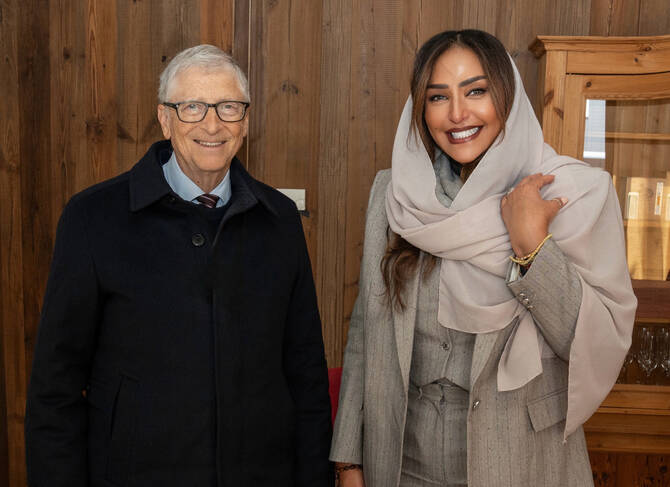
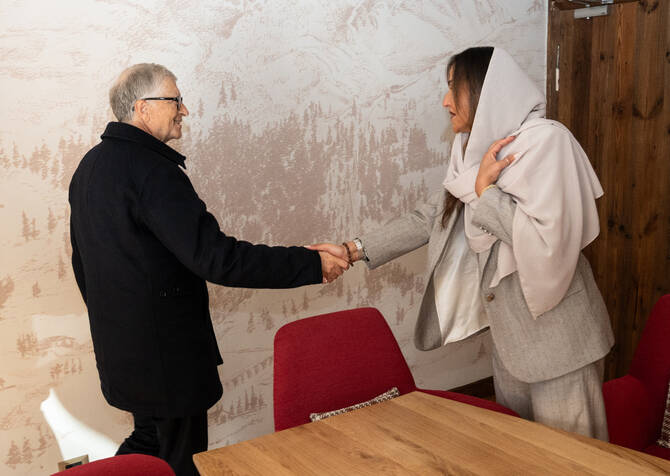
Bill Gates meets with HRH Princess Lamia Bint Majid Al Saud, Secretary General, Alwaleed Philanthropies in Davos, Switzerland to discuss the future of global health. (Supplied)
2 / 2
Bill Gates meets with HRH Princess Lamia Bint Majid Al Saud, Secretary General, Alwaleed Philanthropies in Davos, Switzerland to discuss the future of global health. (Supplied)
Short Url
Updated 22 January 2026
Follow

Alwaleed Philanthropies allocates $15 million for global polio eradication efforts

  • The new contribution will support frontline vaccination campaigns, disease surveillance and rapid outbreak response over three years

DAVOS: Alwaleed Philanthropies, chaired by Prince Alwaleed bin Talal Al-Saud, renewed its commitment to the Global Polio Eradication Initiative on Thursday with a $15 million contribution during the World Economic Forum Annual Meeting 2026 in Davos, Switzerland.

The announcement was made by Princess Lamia Bint Majed Al-Saud, secretary general of Alwaleed Philanthropies, and Bill Gates, chair of the Gates Foundation.

The new contribution will support frontline vaccination campaigns, disease surveillance and rapid outbreak response over three years, helping the program reach children in vulnerable and conflict-ravaged areas through the Gates Philanthropy partners.

The donation comes at a pivotal moment for the global effort to end polio, as the program intensifies operations in the last remaining endemic countries and responds to outbreaks worldwide.

With cases of wild poliovirus now confined to just two countries — Afghanistan and Pakistan — sustained political leadership and financing remain essential to protect hard-won gains and ensure that no child is left behind.

The princess said the contribution “builds on Alwaleed Philanthropies’ long-standing support for global health and its partnership with the Global Polio Eradication Initiative, reinforcing the critical role of philanthropy in addressing some of the world’s most complex public health challenges.”

Gates said that polio eradication “is within sight, but the last mile is the hardest.” He added: “Alwaleed Philanthropies’ latest commitment is exactly the kind of leadership the world needs to build a future where no family has to live in fear of polio paralyzing their child.”

Mike McGovern, chair of the Polio Oversight Board, said sustained support enables organizations to reach children in vulnerable and remote communities and to preserve the progress made over the past four decades.

Launched in 1988, the GPEI, led by national governments and supported by its core partners, has reduced polio cases by more than 99 percent and protected over 20 million people from paralysis.

The World Health Organization and UNICEF play a leading role, working alongside governments and communities to sustain access, build trust and ensure that polio eradication efforts reach the most vulnerable children.


Saudi Arabia to hold Human Capability Initiative conference in Riyadh in May

Updated 12 February 2026
Follow

Saudi Arabia to hold Human Capability Initiative conference in Riyadh in May

  • HCI 2026 set to attract over 15,000 leaders, 250 speakers, including policymakers, industry leaders, experts from various sectors
  • Program to focus on optimizing learning, working environments to maximize human capability in age of AI

LONDON: Saudi Arabia’s Human Capability Development Program has announced the third edition of the Human Capability Initiative conference, featuring the UK as the country of honor.

The HCI will be held under the patronage of Crown Prince Mohammed bin Salman at the King Abdulaziz International Conference Center in Riyadh, from May 3-4.

HCI 2026 is set to attract over 15,000 leaders and feature 250 speakers, including policymakers, industry leaders, and experts from various sectors.

Under the theme “The Human Code,” the program will focus on optimizing learning and working environments to maximize human capability in the age of artificial intelligence.

Yousef bin Abdullah Al-Benyan, Saudi Arabia's minister of education and chairman of the Executive Committee of the HCDP, said the conference would showcase the Kingdom’s commitment to investing in people for sustainable economic growth and to enriching a global dialogue.

He added: “Human potential remains the most critical driver of progress in a rapidly changing global landscape, and investing in humans is the most critical pillar in building a competitive economy and a knowledge-based society.”

Majid Al-Kassabi, the Saudi minister of commerce and chairman of the Economic and Social Committee of the Saudi-British Strategic Partnership Council, welcomed the UK as the conference’s country of honor.

He said: “(This) represents a continuation of the strategic cooperation between (Saudi Arabia and the UK), including the launch of the Skills of the Future initiative at the 2025 HCI conference, focused on advancing economic cooperation, educational exchange, and workforce development.”

The last two HCI conferences attracted over 23,000 participants, featured 550 speakers, and announced 156 partnerships, organizers said.

The HCDP aligns with Saudi Arabia’s Vision 2030, focusing on enhancing citizens’ potential and competitiveness, they added.