SRINAGAR: Anger in Indian-administered Kashmir escalated on Monday over sweeping detentions in the hunt for the gunmen who carried out a deadly attack last week that New Delhi blames on arch-rival Pakistan.
New Delhi has accused Pakistan of supporting “cross-border terrorism” after gunmen killed 26 people on April 22, the worst attack on civilians in contested Muslim-majority Kashmir for a quarter of a century.
Islamabad has denied any role, calling attempts to link Pakistan to the attack “frivolous” and vowing to respond to Indian action.
Relations between the nuclear-armed rivals have plunged to their lowest level in years, sparking worries by analysts of possible military action.
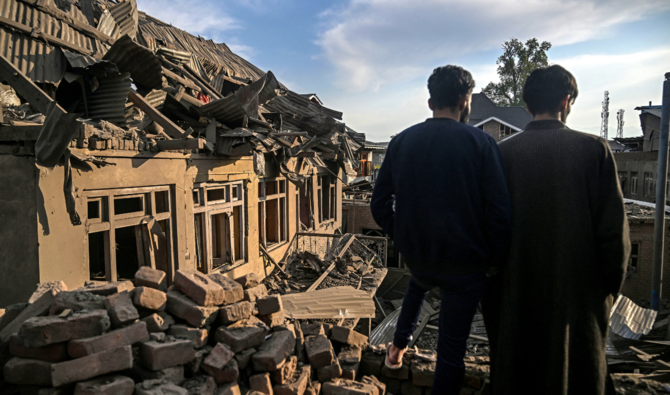
The attack also sparked a huge manhunt for the gunmen in Kashmir, with Indian security forces blowing up nine homes of suspected rebels, as well as detaining nearly 2,000 people for questioning, a senior police official told AFP.
“Punish the guilty, show them no mercy, but don’t let innocent people become collateral damage,” Jammu and Kashmir’s Chief Minister Omar Abdullah said in a statement.
Aga Ruhullah, a federal lawmaker from Kashmir, said: “Kashmir and Kashmiris are being given a collective punishment.”
Security operations in the search for the gunmen come as India and Pakistani forces have exchanged fire across the de facto border in the rugged and remote high-altitude Himalayan outposts.
India’s army said on Monday its troops and Pakistani forces had fired at each other for a fourth night in a row.
There were no reported casualties. Islamabad did not immediately confirm the gunfire from Pakistan.
“During the night of April 27-28... Pakistan Army posts initiated unprovoked small arms fire across the Line of Control,” the Indian army said in a statement, referring to the de facto border in contested Kashmir.
“Indian troops responded swiftly and effectively,” it said.
Muslim-majority Kashmir has been divided between India and Pakistan since their independence from British rule in 1947.
Both claim the territory in full.
Rebels in the Indian-run area have waged an insurgency since 1989, seeking independence or a merger with Pakistan.
Indian police have issued wanted posters for three men — two Pakistanis and an Indian — who they say are members of the Pakistan-based Lashkar-e-Taiba group, a UN-designated terrorist organization.
They have announced a two million rupee ($23,500) bounty for information leading to each man’s arrest.
India is also hunting several of its own citizens in connection to the killings, sweeping up those they suspect may have information on the attackers.
“It’s a revolving door in police stations as part of the ongoing investigation,” said a senior police official who spoke on condition of anonymity because they were not authorized to talk to the media.
“Some have already been let go, and more are being summoned to police stations,” the officer said.
The homes of men suspected of having links to the attackers have also been blown up at night.
Yasmeena, the sister of fugitive accused Ashif Sheikh, said her family was being punished, with their home demolished even though they had not seen her brother for three years.
“If my brother is involved, how is it the family’s sin?” she said.
“This house doesn’t belong to him alone.”
New Delhi has downgraded diplomatic ties since the attack, withdrawn visas for Pakistanis, suspended a water-sharing treaty, and announced the closure of the main land border crossing with Pakistan.
In response, Islamabad ordered the expulsion of Indian diplomats and military advisers, canceled visas for Indian nationals and barred its airspace to Indian airplanes.
India’s Defense Minister Rajnath Singh met with Prime Minister Narendra Modi on Monday after warning last week that those responsible for the attack in Kashmir would see a response “loud and clear.”
The United Nations has urged the arch-rivals to show “maximum restraint” so that issues can be “resolved peacefully through meaningful mutual engagement.”
China, which shares a border with both India and Pakistan, urged both sides on Monday to “exercise restraint, meet each other halfway” and “properly handle relevant differences through dialogue,” foreign ministry spokesman Guo Jiakun said.
Iran has already offered to mediate, and Saudi Arabia has said Riyadh was trying to “prevent an escalation.”


Indian-administered Kashmir crackdown sparks anger as Pakistan tensions escalate
https://arab.news/r8scj
Indian-administered Kashmir crackdown sparks anger as Pakistan tensions escalate

- New Delhi has accused Pakistan of supporting ‘cross-border terrorism’ after gunmen killed 26 people in Kashmir on Apr. 22
- Islamabad has denied any role and called attempts to link Pakistan to the attack ‘frivolous,’ vowing to respond to Indian action

Pakistan to play India in T20 World Cup, government says
- Islamabad announced boycotting the Feb. 15 match in Colombo to protest the ICC’s exclusion of Bangladesh from the T20 World Cup
- Pakistan’s government says the decision to play India is taken to protect ‘spirit of cricket and to support the continuity of global sport’
ISLAMABAD: Pakistan Prime Minister Shehbaz Sharif has cleared the country’s cricket team to play India in the T20 World Cup on Feb. 15, the Pakistani government announced late Monday, ending a week-long standoff.
Islamabad announced boycotting the Feb. 15 match in Colombo to protest the International Cricket Council’s (ICC) exclusion of Bangladesh from the T20 World Cup, following Dhaka’s decision to not play matches in India owing to security fears.
On Sunday, ICC Deputy Chairman Imran Khwaja arrived in Lahore for talks with Pakistan Cricket Board (PCB) officials and Bangladesh Cricket Board (BCB) President Aminul Islam as the sport’s governing body strived to save the high-stakes T20 World Cup encounter.
PCB Chairman Mohsin Naqvi met PM Sharif late Monday and briefed him regarding the outcomes of high-level deliberations held between the PCB, Bangladesh board and ICC representatives, the Pakistani government said on X.
“The Government of Pakistan has reviewed the formal requests extended to the PCB by the Bangladesh Cricket Board, as well as the supporting communications from Sri Lanka, the United Arab Emirates, and other member nations. These correspondences sought Pakistan’s leadership in securing a viable solution to recent challenges,” the Pakistani government said.
“In view of the outcomes achieved in multilateral discussions, as well as the request of friendly countries, the Government of Pakistan hereby directs the Pakistan National Cricket Team to take the field on February 15, 2026, for its scheduled fixture in the ICC Men’s T20 World Cup.”
The BCB earlier thanked the PCB, ICC and all others for their positive roles in trying to “overcome recent challenges,” particularly thanking PCB Chairman Naqvi and Pakistani cricket fans for demonstrating “exemplary sportsmanship and solidarity.”
“We are deeply moved by Pakistan’s efforts to go above and beyond in supporting Bangladesh during this period. Long may our brotherhood flourish,” BCB President Islam said in a statement.
“Following my short visit to Pakistan yesterday and given the forthcoming outcomes of our discussions, I request Pakistan to play the ICC T20 World Cup game on 15 February against India for the benefit of the entire cricket ecosystem.”
The dispute stemmed from the ICC’s decision to replace Bangladesh with Scotland last month after Bangladesh refused to play tournament matches in India. Dhaka’s decision followed the removal of Mustafizur Rahman from the Indian Premier League (IPL). He was bought for $1 million by the IPL’s Kolkata Knight Riders, but on Jan. 3 the Board of Control for Cricket in India (BCCI) ordered Kolkata to release Mustafizur without a public explanation but amid regional tensions.
Pakistani cricket authorities subsequently announced boycotting the match against India at R. Premadasa Stadium in Colombo on Feb. 15. An India-Pakistan fixture is the sport’s most lucrative asset, generating a massive share of global broadcasting and sponsorship revenue.
“This decision [to play India in T20 World Cup] has been taken with the aim of protecting the spirit of cricket, and to support the continuity of this global sport in all participating nations,” the Pakistani government said.
“We remain confident that our team will carry the spirit of sportsmanship and national pride onto the field as they compete for global glory.”


