WASHINGTON: Ahead of his second go-around in the White House, President Donald Trump spoke with certainty about ending Russia’s war in Ukraine in the first 24 hours of his new administration and finding lasting peace from the devastating 18-month conflict in Gaza.
But as the Republican president nears the 100th day of his second term, he’s struggling to make good on two of his biggest foreign policy campaign promises and is not taking well to suggestions that he’s falling short. And after criticizing President Joe Biden during last year’s campaign for preventing Israel from carrying out strikes on Iranian nuclear sites, Trump now finds himself giving diplomacy a chance as he tries to curb Tehran’s rapidly advancing nuclear program.
“The war has been raging for three years. I just got here, and you say, ‘What’s taken so long?’” Trump bristled, when asked about the Ukraine war in a Time magazine interview about his first 100 days. As for the Gaza conflict, he insisted the war “would have never happened. Ever. You then say, ‘What’s taking so long?’“
Measuring a US president by his first 100 days in office is an arbitrary, albeit time-honored, tradition in Washington. And brokering peace deals between intractable warring parties is typically the work of years, not weeks.
But no other president has promised to do as much out of the gate as Trump, who is pursuing a seismic makeover of America’s approach to friends and foes during his second turn in the White House.
Trump has moved at dizzying speed to shift the rules-based world order that has formed the basis for global stability and security in the aftermath of World War II.
All sides have scrambled to acclimate as Trump launched a global tariff war and slashed US foreign aid all while talking up the ideas of taking Greenland from NATO ally Denmark and making Canada the 51st state.
But Trump’s inability to broker deals in Ukraine and Gaza — at least to date — might be the most demonstrable evidence that his effort to quickly shake up US foreign policy through sheer will could have its limits.
And Trump hasn’t obscured his frustration, particularly over the Ukraine war, which he’s long dismissed as a waste of US taxpayer money and of lives lost in the conflict.
The president and his team have gone hot and cold about prospects for peace in Ukraine since Trump’s Oval Office blowup with Ukrainian President Volodymyr Zelensky in February.
In that encounter, both Trump and Vice President JD Vance lectured the Ukrainian leader for being insufficiently grateful for US assistance in the fight to repel Russia’s invading forces before asking him to leave the White House grounds.
Secretary of State Marco Rubio has warned that the White House is ready to walk away if Ukraine and Russia don’t make substantial progress toward a peace deal soon.
And Trump on back-to-back days this past week lambasted Zelensky for “prolonging” the “killing field” and then Russian President Vladimir Putin for complicating negotiations with “very bad timing” in launching brutal strikes that pummeled Kyiv.
But by Friday, Trump was expressing optimism again after his special envoy Steve Witkoff met in Moscow with Putin. Following the talks, Trump declared that the two sides were “very close to a deal.”
Less than 24 hours later, Trump was once again downcast after he met with Zelensky on the sidelines of Pope Francis’s funeral, expressing doubt in a social media post that Putin was serious about forging a deal.
“It makes me think that maybe he doesn’t want to stop the war, he’s just tapping me along,” Trump said of Putin and Russia’s ongoing bombardment of Ukraine.
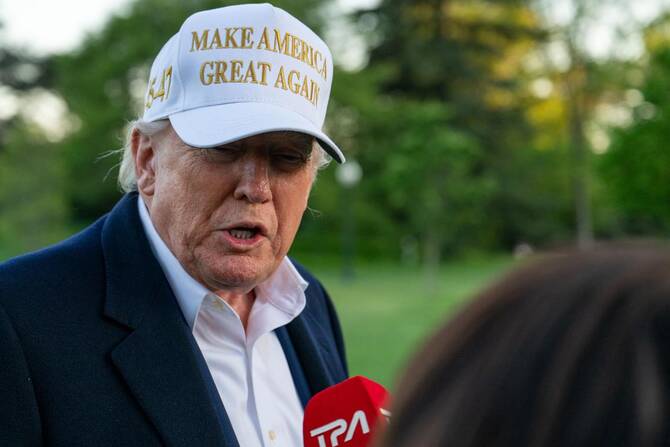
Trump again expressed frustration with Putin in an exchange with reporters on Sunday evening. “I want him to stop shooting, sit down and sign a deal,” Trump said. “We have the confines of a deal, I believe. And I want him to sign it and be done with it.”
White House National Security Council spokesman James Hewitt said Trump remains committed to getting a deal done and is “closer to that objective than at any point during Joe Biden’s presidency.”
“Within 100 days, President Trump has gotten both Ukraine and Russia to the negotiating table with the aim to bring this horrific war to a peaceful resolution,” Hewitt said. “It is no longer a question of if this war will end but when.”
Peace in Gaza remains elusive
Trump started his second term with some momentum on ending the Israel-Hamas war in Gaza.
His envoy Witkoff, a fellow New York real estate maverick turned high-stakes diplomat, teamed up with the outgoing Biden Middle East adviser Brett McGurk to get Israeli and Hamas officials to agree to a temporary ceasefire deal that went into effect one day before Trump’s inauguration.
On the eve of his return to office, Trump took full credit for what he called an “epic” agreement that would lead to a “lasting peace” in the Middle East.
The temporary ceasefire led to the freeing of 33 hostages held in Gaza and the release of roughly 2,000 Palestinian prisoners held by Israel.
But the truce collapsed in March, and fighting resumed, with the two sides unable to come to an agreement for the return of 59 remaining hostages, more that half of whom Israeli officials believe are dead.
Conditions in Gaza remain bleak. Israel has cut off all aid to the territory and its more than 2 million people. Israel has disputed that there is a shortage of aid in Gaza and says it’s entitled to block the assistance because, it claims, Hamas seizes the goods for its own use.
Trump, as he flew to Rome on Friday for the pope’s funeral, told reporters that he’s pressing Israeli Prime Minister Benjamin Netanyahu “very hard” to get food and medicine into Gaza but dismissed questions about how the Israeli leader is responding to his appeal.
“Well, he knows all about it, OK?” Trump told reporters.
Hewitt, the National Security Council spokesman, pushed back on the notion that Trump has fallen short on his effort to find an endgame to the Gaza conflict, setting the blame squarely on Hamas.
“While we continue to work to secure the release of all remaining hostages, Hamas has chosen violence over peace, and President Trump has ensured that Hamas continues to face the gates of hell until it releases the hostages and disarms,” Hewitt said.
Trump’s team says the president has racked up more foreign policy wins than any other US president this early in a term.
The White House counts among its early victories invoking a 1798 wartime law, the Alien Enemies Act, to deport Venezuelan migrants it accuses of being gang members, securing the release of at least 46 Americans detained abroad, and carrying out hundreds of military strikes in Yemen against Houthi militants who have been attacking commercial shipping vessels in the Red Sea.
Trump hopeful for Iran nuclear deal breakthrough
The White House this month also launched direct talks with Iran over its nuclear program, a renewed push to solve another of the most delicate foreign policy issues facing the White House and the Middle East.
Trump says his administration is making progress in its effort to secure a deal with Iran to scupper Tehran’s rapidly advancing nuclear program.
Witkoff flew directly from meeting with Putin in Moscow to Muscat, Oman, to take part in talks on Saturday, the third engagement between US and Iranian officials this month.
The US and other world powers in 2015 reached a long-term, comprehensive nuclear agreement that limited Tehran’s enrichment of uranium in exchange for the lifting of economic sanctions. But Trump unilaterally withdrew the US from the nuclear agreement in 2018, calling it the “worst deal ever.”
Since Trump pulled out of the Obama-era deal, Iran has accelerated its production of near weapons-grade uranium.
The president said on Friday that he’s open to meeting with Iranian Supreme Leader Ali Khamenei or President Masoud Pezeshkian, while also indicating military action — something that US ally Israel has advocated — remains an option.
As Trump increasingly expresses his preference for diplomacy rather than military action, Iran hawks at home are urging him to tread carefully in his hunt for a legacy-defining deal.
“The Iranians would have the talking point that they forced the same person who left the deal many years later, after them resisting maximum pressure, into an equal or worse deal,” said Behnam Ben Taleblu, senior director of the Iran program at the Foundation for Defense of Democracies.
But Trump wants a solution, and fast.
“I think a deal is going to be made there,” Trump said Sunday “That’s going to happen pretty soon.”


![]()

Trump struggles to make good on promises to quickly end Ukraine and Gaza wars
Short Url
https://arab.news/n3w84
Trump struggles to make good on promises to quickly end Ukraine and Gaza wars
- Trump’s inability to broker deals in Ukraine and Gaza to date might be the most demonstrable evidence his effort to more broadly shake up US foreign policy


Latest updates




© 2026 SAUDI RESEARCH & PUBLISHING COMPANY, All Rights Reserved And subject to Terms of Use Agreement.