

Surge in gold prices amid Trump tariff turmoil dulls Pakistani wedding season demand

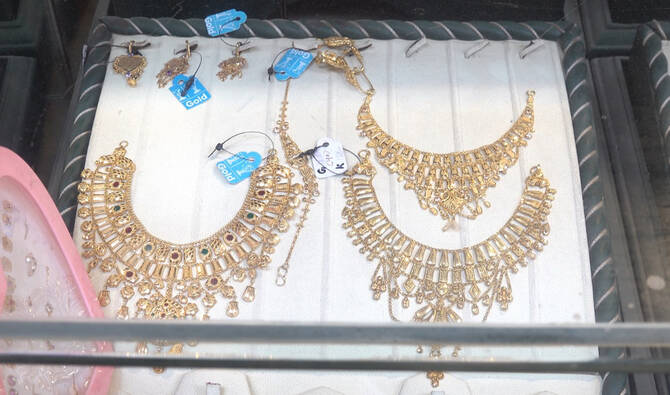
Gold jewelry set on display in a shop in Karachi, Pakistan, on April 26, 2025. (AN Photo)
Short Url
Updated 28 April 2025
Follow

Surge in gold prices amid Trump tariff turmoil dulls Pakistani wedding season demand

  • Price of tola or 12 grams of gold is currently at $1,200, commodity has seen 38 percent rise in prices since beginning of 2025
  • Gold has globally offered investors safe haven from chaos enveloping financial markets since Trump’s tariff announcements

KARACHI: As US President Donald Trump ratcheted up his tariff war on the world, gold kept climbing in lockstep to reach a succession of record highs, including in Pakistan.

In recent weeks, gold has globally offered investors a safe haven from the chaos that has enveloped many financial markets since Trump’s tariff announcements on April 2. But at the same time, it has dampened consumption during the wedding season in Pakistan, as buyers and jewelers feel the brunt of high prices, with one tola, or nearly 12 grams, costing about Rs348,700 ($1,200). The average monthly income in Pakistan, meanwhile, is roughly Rs70,000 ($248).

“We can see that gold is hovering around an all-time high,” Kamal Ahmed, a commodities analyst at AKD Securities, told Arab News, adding that gold prices in Pakistan had surged 38 percent since the beginning of the year.

The increase, he said, was triggered by geopolitical tensions, the Russia-Ukraine war and macroeconomic uncertainty worsened by the latest US trade actions.

“When there is uncertainty in the economy, when there is uncertainty in the geopolitical situation, people like to invest in gold,” Ahmed explained, adding that central banks around the world had also bought “a lot of gold” recently to hedge against a possible tariff-driven recession.

In international markets, gold touched a record $3,500 per ounce, about 28.35 grams, on April 22, pushing local prices in Pakistan to fresh highs. 
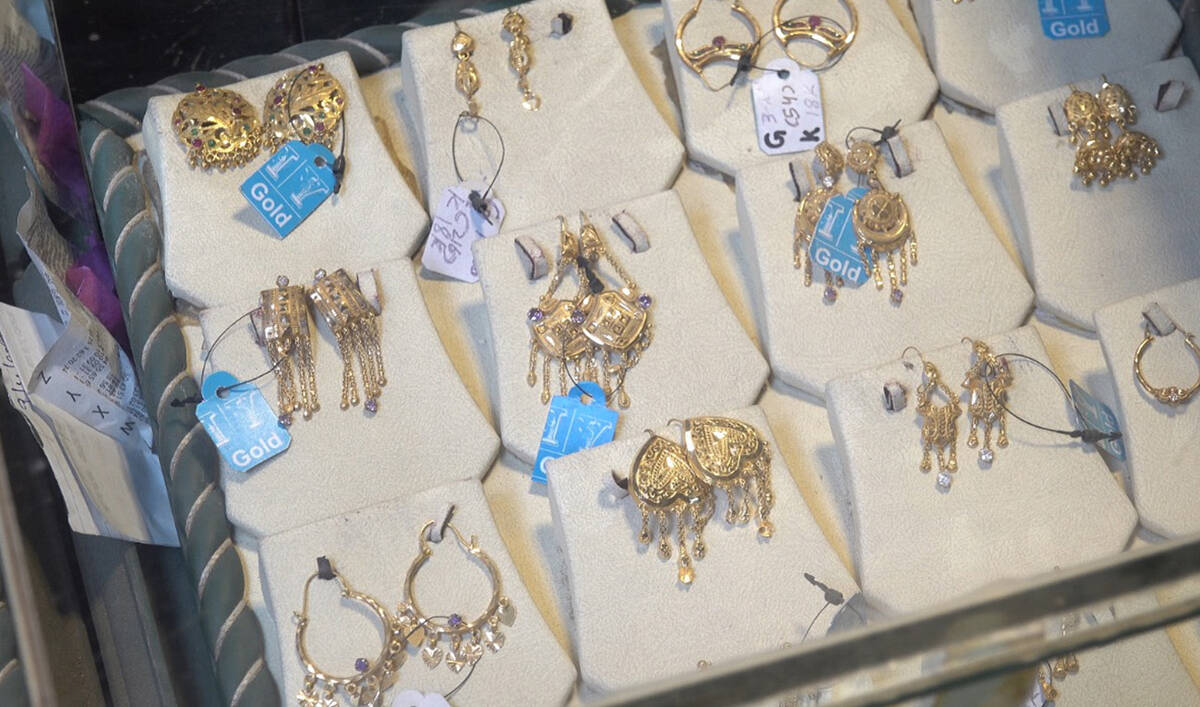


Gold earrings on display in a jewelry shop in karachi, Pakistan on April 26, 2025. (AN Photo) 

Analysts suggest more pain ahead.

“I think gold might test $3,800 per ounce this year, and if it breaches that level, you could see $4,500 per ounce by the end of 2025,” said Ahmed.

Global brokerage firm JP Morgan has also predicted gold could rise beyond $4,000 per ounce next year, warning of growing recession risks tied to inflated US tariffs.

The impact on Pakistan, on a tricky path to economic recovery under a $7 billion IMF bailout program, could be severe.

“Investors would prefer to buy gold than invest in equities because they seek a very safe option,” said Ahmed.

For now, the math is simple: If Trump continues his trade war against China, and increases tariffs from the 10 percent base on other countries after his 90-day pause, then it’s likely that gold will continue to rally. But if a compromise with Beijing is worked out that allows both parties to save face, and other countries reach deals with Trump that largely preserve global trade, then the case for gold looks less secure.

On Monday, gold retreated as easing US-China trade tensions boosted investors’ risk appetite and dented demand for safe-haven assets such as bullion, while a stronger dollar also piled on the pressure.

In the domestic market, the price of 24-karat gold per tola fell by Rs3,300 on Monday, bringing it down to Rs348,700 ($1,200). The price of 10 grams of 24-karat gold also saw a decrease of Rs2,833, settling at Rs298,950 ($1,063).

But prices are still too high for most consumers and are dampening the spring/early summer wedding season in Pakistan, where gold is an intrinsic part of celebrations.

At a jeweler’s shop in Karachi’s oldest Sarafa Bazaar, Fatima, a housewife who only gave her first name, stared last week at rows of glittering gold sets she could no longer afford.

“I was buying gold for my daughter’s wedding that we have delayed for now because the prices of gold are very high,” Fatima said. “You either don’t give gold to your children at all or delay the marriage.” 

She said she hoped prices might ease after Eid Al-Adha in June. 
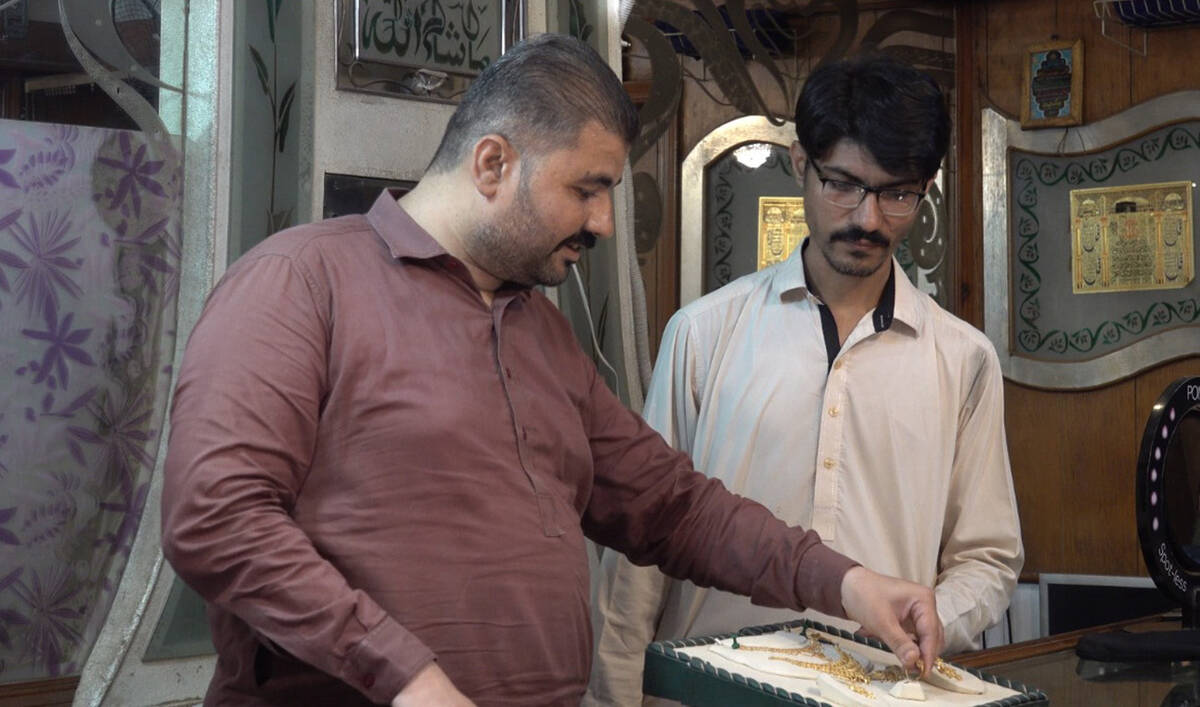


Jeweler, Muhammad Ishaq, observes a gold jewelry set in his shop in Karachi, Pakistan, on April 26, 2025. (AN Photo)

“The prevailing rates have made gold unreachable for the poor,” M. Iqbal, director of the All Pakistan Sarafa Gems & Jewelers Association, said, estimating that about 65 percent of traders in the gold market were actively buying, further driving up demand and prices.

“It’s risen beyond their purchasing power now. Gold has become an investor’s business only.”

He warned that if the tariff war dragged on, gold prices in Pakistan could swell beyond Rs500,000 ($1,780) per tola.

“People are managing their weddings by purchasing lesser quantities of gold,” Iqbal warned. “People who used to buy two or more tolas are now purchasing only half of it, and that too because it’s a tradition.”

Muhammad Yaqoob Ishaq, a jeweler whose family has traded gold for more than a century, said many customers were now opting for artificial jewelry.

“Nowadays artificial jewelry is trending in weddings,” he said. “People have been buying artificial jewelry or using silver ornaments that are gold coated.”


Pakistan government confirms Imran Khan’s brief hospital visit as party renews health concerns

Updated 8 sec ago
Follow

Pakistan government confirms Imran Khan’s brief hospital visit as party renews health concerns

  • Information minister says jailed ex-PM underwent 20-minute eye procedure and returned to prison
  • Khan’s party questions lack of notice to family and seeks independent medical oversight

ISLAMABAD: Pakistan’s government on Thursday confirmed that jailed former prime minister Imran Khan was taken to a public hospital over the weekend for a brief eye procedure, saying his condition was stable and routine, as his opposition party renewed concerns over his health and the lack of information shared with his family and lawyers.

The episode has added to long-running tensions surrounding Khan’s incarceration, which has become a flashpoint in Pakistan’s polarized politics. Khan, who served as prime minister from 2018 to 2022, has been in prison since August 2023 following multiple convictions that he and his Pakistan Tehreek-e-Insaf (PTI) party say are politically motivated, a claim the government denies.

News of Khan’s hospital visit first emerged on Wednesday in Pakistan’s leading English-language daily Dawn, prompting PTI leaders to hold a news conference and question why neither Khan’s family nor his legal team had been informed in advance.

Information Minister Attaullah Tarar confirmed on Thursday that Khan was moved on Jan. 24 from Rawalpindi’s Adiala Jail to the Pakistan Institute of Medical Sciences (PIMS), a major public hospital in Islamabad, on the advice of eye specialists.

“At PIMS, he underwent a further eye examination, and after obtaining his written consent, a 20-minute medical procedure was carried out,” Tarar said while speaking to journalists on camera. 

“He was then returned to Adiala Jail with the necessary instructions ... During the procedure, his vitals and all other parameters were completely stable. He is absolutely healthy.”

Tarar said all prisoners were entitled to medical care under jail rules and that the process followed in Khan’s case complied fully with prison regulations.

“Everything was done completely according to the rules,” he said.

In a statement issued shortly after Tarar’s remarks, PTI cited the minister’s confirmation but said the hospital visit had taken place “without prior notice to his family, legal counsel or political representatives.”

“Authorities have provided no verifiable details regarding Imran Khan’s medical condition, the treatment administered, the specialists involved or the basis for his immediate return to prison,” said Syed Zulfiqar Bukhari, a close aide of Khan and a former federal minister.

“Government claiming that the episode was routine remain unsupported by transparent medical disclosure,” he added.

Bukhari said the party had “credible concerns” that Khan was suffering from a serious medical condition affecting his vision and required independent specialist care.

“Continued denial of access to family members and personal physicians, particularly following hospitalization, raises grave human-rights concerns and appears inconsistent with Pakistan’s obligations under international standards,” he said.

“We, therefore, request close monitoring by foreign missions and urge engagement with Pakistani authorities to ensure transparency, independent medical oversight, and full respect for due process and detainee rights,” Bukhari added.

Concerns over Khan’s health are not new. 

In November last year, his sisters publicly raised alarm over rumors that he had died in custody, claims the government dismissed at the time. Khan’s sisters later met him in December and said he was in good health.

Khan has been held at Adiala Jail since his arrest in August 2023 following a series of convictions, including corruption-related cases, which he and his party deny, saying legal proceedings against him are politically driven. 

Khan, who was ousted from the PM’s office through a parliamentary no-trust vote in April 2022, has since accused Pakistan’s powerful military of colluding with his political rivals to remove him from power and keep him imprisoned. The military denies the allegations and says it does not interfere in politics. 

Khan’s health and access dispute comes against a backdrop of multiple high-profile convictions. 

In December 2025, a special court in Rawalpindi sentenced Khan and his wife Bushra Bibi to 17 years’ imprisonment each in the Toshakhana-2 corruption case, involving alleged fraud over state gifts received from foreign dignitaries, with fines also imposed on both.  

Earlier in January 2025, an accountability court convicted Khan and Bibi in the £190 million Al-Qadir Trust land corruption case, sentencing him to 14 years and her to seven years after finding that the trust was used to acquire land and funds in exchange for alleged favors.  

Khan and his allies deny wrongdoing in all cases, saying they are politically motivated, and legal appeals are ongoing.