NASA plans ISS medical evacuation for Jan. 14

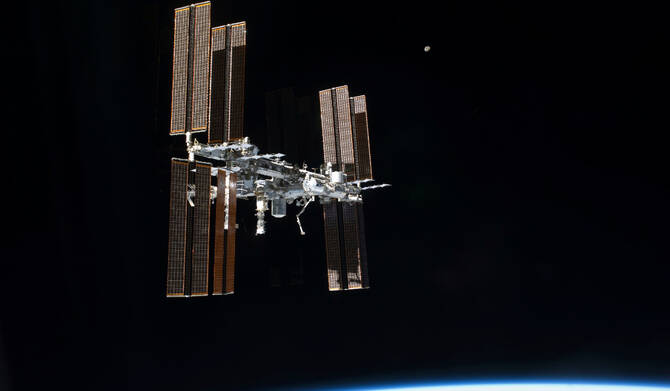
The International Space Station is seen from the space shuttle Atlantis on July 19, 2011, after it left the orbiting complex. (AP)
Short Url
Updated 10 January 2026
Follow

NASA plans ISS medical evacuation for Jan. 14

  • Space station set to be decommissioned after 2030
  • NASA and SpaceX target undocking Crew-11 from the International Space Station no earlier than 5 p.m. ET on Jan. 14, with splashdown off California targeted for early Jan. 15 depending on weather and recovery conditions

WASHINGTON: NASA crew members aboard the International Space Station could return to Earth as soon as Thursday, the US space agency said, after a medical emergency prompted the crew to return from their mission early.

“NASA and SpaceX target undocking Crew-11 from the International Space Station no earlier than 5 p.m. ET on Jan. 14, with splashdown off California targeted for early Jan. 15 depending on weather and recovery conditions,” the agency said in a post on X.

Details of the medical evacuation, the first in ISS history, were not provided by officials, though they said it did not result from any kind of injury onboard and that the unidentified crew member is stable and not in need of an emergency evacuation.

The four astronauts on Nasa-SpaceX Crew 11 have been on their mission since Aug. 1. These expeditions generally last around six months, and the crew was already due to return to Earth in the coming weeks.

American astronauts Mike Fincke and Zena Cardman, as well as Japan’s Kimiya Yui and Russia’s Oleg Platonov, would be returning, while American Chris Williams will stay onboard the international body to maintain a US presence.

Officials indicated it was possible the next US mission could depart to the ISS earlier than scheduled, but did not provide specifics.

Continuously inhabited since 2000, the ISS functions as a testbed for research that supports deeper space exploration — including eventual missions to Mars.

The ISS is set to be decommissioned after 2030, with its orbit gradually lowered until it breaks up in the atmosphere over a remote part of the Pacific Ocean called Point Nemo, a spacecraft graveyard.


Fans bid farewell to Japan’s only pandas

Updated 25 January 2026
Follow

Fans bid farewell to Japan’s only pandas

TOKYO: Panda lovers in Tokyo said goodbye on Sunday to a hugely popular pair of the bears that are set to return to China, leaving Japan without the beloved animals for the first time in half a century.
Loaned out as part of China’s “panda diplomacy” program, the distinctive black-and-white animals have symbolized friendship between Beijing and Tokyo since the normalization of diplomatic ties in 1972.
Some visitors at Ueno Zoological Gardens were left teary-eyed as they watched Japan’s only two pandas Lei Lei and Xiao Xiao munch on bamboo.
The animals are expected to leave for China on Tuesday following a souring of relations between Asia’s two largest economies.
“I feel like seeing pandas can help create a connection with China too, so in that sense I really would like pandas to come back to Japan again,” said Gen Takahashi, 39, a Tokyo resident who visited the zoo with his wife and their two-year-old daughter.
“Kids love pandas as well, so if we could see them with our own eyes in Japan, I’d definitely want to go.”
The pandas’ abrupt return was announced last month after Japan’s conservative premier Sanae Takaichi hinted Tokyo could intervene militarily in the event of any attack on Taiwan.
Her comment provoked the ire of Beijing, which regards the island as its own territory.
The 4,400 lucky winners of an online lottery took turns viewing the four-year-old twins at Ueno zoo while others gathered nearby, many sporting panda-themed shirts, bags and dolls to celebrate the moment.
Mayuko Sumida traveled several hours from the central Aichi region in the hope of seeing them despite not winning the lottery.
“Even though it’s so big, its movements are really funny-sometimes it even acts kind of like a person,” she said, adding that she was “totally hooked.”
“Japan’s going to be left with zero pandas. It feels kind of sad,” she said.
Their departure might not be politically motivated, but if pandas return to Japan in the future it would symbolize warming relations, said Masaki Ienaga, a professor at Tokyo Woman’s Christian University and expert in East Asian international relations.
“In the future...if there are intentions of improving bilateral ties on both sides, it’s possible that (the return of) pandas will be on the table,” he told AFP.