

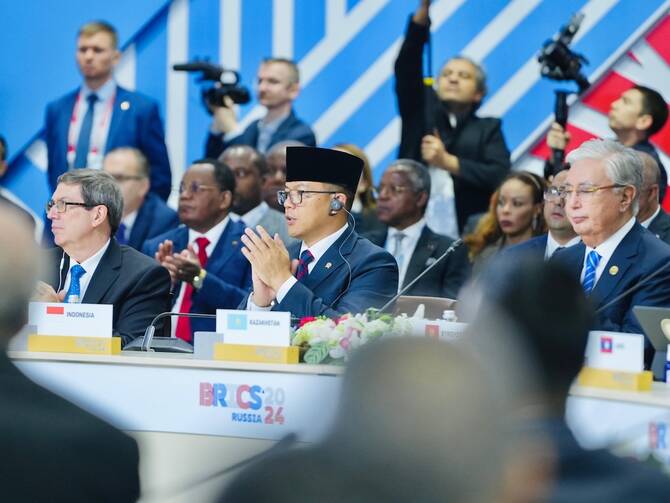
Indonesia joins BRICS foreign ministers meeting as member

Indonesia’s Foreign Minister Sugiono attends the BRICS Summit in Kazan, Russia on Oct. 24, 2024. (Ministry of Foreign Affairs)
Short Url
Updated 27 April 2025
Follow

Indonesia joins BRICS foreign ministers meeting as member

  • BRICS accounts for about 48% of world’s population, over 37% of global economy
  • Ministerial meeting comes amid Trump’s trade tariffs on nearly all goods imported to US

JAKARTA: Indonesia’s Foreign Minister Sugiono will attend a meeting with his counterparts of the BRICS bloc of emerging economies in Rio de Janeiro on Monday, the country’s first ministerial participation since becoming a full member of the geopolitical forum earlier this year.

Initially comprising Brazil, Russia, India, China and South Africa, the group has expanded with the accession of Egypt, Iran, Ethiopia and the UAE last year, and Indonesia in January.

Morphing into the most powerful geopolitical forum outside the Western world, BRICS now accounts for about 48 percent of the world’s population and more than 37 percent of the global economy.

“The Indonesian foreign minister will encourage BRICS to play a more constructive role in maintaining peace and upholding global norms that have been mutually agreed upon,” Indonesia’s Ministry of Foreign Affairs said in a statement.

“(He) will also emphasize the importance of reforming various multilateral institutions to be more inclusive, transparent, and responsive in facing various challenges in the world.” 

Brazil holds the BRICS presidency this year under the theme “Enhancing Global South Cooperation for a More Inclusive and Sustainable Governance.” 

The two-day meeting of the group’s foreign ministers in Rio de Janeiro will also cover preparations for the upcoming annual leaders’ summit, which Brazil will host in July.

The ministerial-level meeting comes amid the US’ 90-day pause on sweeping “reciprocal” tariffs, while it has raised tariffs on Chinese imports to an effective rate of 145 percent. Beijing has responded with retaliatory hikes on US exports.

The Trump administration has imposed a 47 percent tariff on Indonesian imports, raising concerns about its billions of dollars-worth exports to the US.

The intensifying trade war with the US and the impacts of Washington’s tariffs around the world will be high on the agenda of the BRICS meeting, said Dinna Prapto Raharja, founder of Jakarta-based think-tank Synergy Policies.

“It will be a big part of the agenda, how BRICS countries will respond to the US tariffs,” Raharja told Arab News on Sunday. 

Alternative payment methods in international trade and the role of the New Development Bank — a multilateral bank developed by BRICS member nations — are also likely to be discussed. 

She noted that the BRICS meeting is taking place as China urges a unified response in Southeast Asia, following Chinese President Xi Jinping’s tour to the region earlier this month.

“Indonesia must be able to choose and talk about extremely strategic matters in these negotiation processes,” Raharja said. 

Jakarta must decide on which aspects it is willing to work with the US and in which areas it is open to create alternatives with BRICS countries.

She added: “This must be decided, so that in the case of China coming into the forums with offers or even a little push for BRICS member countries to choose a certain path, Indonesia is ready.”


US bombers join Japanese jets in show of force after China–Russia drills

Updated 8 sec ago
Follow

US bombers join Japanese jets in show of force after China–Russia drills

  • Japan says US B-52 bombers flew with Japanese F-35s and F-15s
  • South Korea and Japan have scrambled jets during Chinese and Russian drills

TOKYO: US nuclear-capable bombers flew over the Sea of Japan alongside Japanese fighter jets on Wednesday, Tokyo said, in a show of force following Chinese and Russian drills in the skies and seas around Japan and South Korea.
Japan and the US “reaffirmed their strong resolve to prevent any unilateral attempt to change the status quo by force and confirmed the readiness posture of both the Self-Defense Forces (SDF) and US forces,” Japan’s defense ministry said in a press release on Thursday.
The flight of two US B-52 strategic bombers with three Japanese F-35 stealth fighters and three F-15 air-superiority jets was the first time the US had asserted its military presence since China began military exercises in the region last week.
The display follows a joint flight of Chinese and Russian strategic bombers in the East China Sea and western Pacific on Tuesday and separate Chinese aircraft carrier drills that prompted Japan to scramble jets that Tokyo said were targeted by radar beams.

A Russian Tu-95 nuclear-capable strategic bomber which flew from the Sea of Japan to the East China Sea to rendezvous with two Chinese H-6 bombers before heading into the Western Pacific on December 9, 2025. (Japan Self Defense Forces/Handout via REUTERS)

The encounter drew criticism from Washington, which said the incident was “not conducive to regional peace and stability” and reaffirmed that its alliance with Japan was “unwavering.”
Both Japan and South Korea host US forces, with Japan home to the biggest concentration of American military power overseas, including an aircraft carrier strike group and a US Marine expeditionary force.
China denied Tokyo’s accusation, saying Japanese jets flying near the carrier had endangered its air operations south of Japan.

South Korea’s military said it also scrambled fighter jets when the Chinese and Russian aircraft entered its air defense identification zone on Tuesday, an area that extends beyond its airspace and is used for early warning.
 

Chinese H6 nuclear-capable strategic bomber flies from the East China Sea over the Miyako Strait into the Western Pacific on December 9, 2025. (Japan Self Defense Forces/Handout via REUTERS)

Regional tensions have risen since Japanese Prime Minister Sanae Takaichi triggered a dispute with Beijing last month with her remarks on how Tokyo might react to a hypothetical Chinese attack on Taiwan.
China claims democratically governed Taiwan and has not ruled out using force to take control of the island, which sits just over 100 km (62 miles) from Japanese territory and is surrounded by sea lanes on which Tokyo relies.