

Pakistan says tensions with India escalating into nuclear conflict a ‘far-fetched analysis’

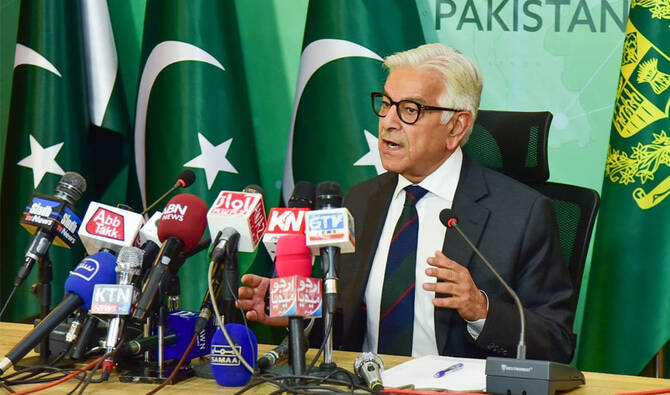
Pakistan’s Defense Minister Khawaja Asif speaks during a press conference in Islamabad on May 11, 2023. (PID/File)
Short Url
Updated 27 April 2025
Follow

Pakistan says tensions with India escalating into nuclear conflict a ‘far-fetched analysis’

  • Defense Minister Khawaja Asif says presence of nuclear weapons guarantees India won’t commit any “irresponsible” adventure
  • Tensions between India and Pakistan have spiked after Apr. 22 attack in Indian-administered Kashmir that killed 26 tourists

ISLAMABAD: Defense Minister Khawaja Asif said this week that the possibility of Pakistan’s tensions with India escalating into a nuclear conflict is a “far-fetched analysis,” saying that both countries are aware of the consequences of such a scenario.

Tensions between the nuclear-armed neighbors spiked this week after gunmen killed 26 tourists in Indian-administered Kashmir on Apr. 22. New Delhi blamed Islamabad for being involved in the attack and downgraded ties with Pakistan. Islamabad denies New Delhi’s allegations.

Troops from both sides have traded fire along the disputed Kashmir territory for three nights in a row, raising fears of an all-out war breaking out between the two nations who both possess nuclear weapons. 

When asked about the possibility of a “nuclear standoff” between the two countries, Asif told Russia Today channel on Saturday:

“I don’t think so, that’s a very far-fetched analysis that this will ultimately result in a nuclear conflict. I don’t think so, the countries know the consequences of a nuclear conflict.”

The minister said that the presence of nuclear weapons guarantees Pakistan that India will not escalate military tensions. 

“Knowing that we are nuclear powers gives us some sort of security against an irresponsible adventure by India,” he said, describing it as the “only hostile country around us.”

Asif said Pakistan’s Prime Minister Shehbaz Sharif has offered cooperation to India in holding an international inquiry with the support of several countries into the attack that triggered tensions between the two countries. 

“We are ready to welcome any commission or committee formed to investigate this incident,” the minister said. 

Asif condemned India’s move to release additional flow of water into Pakistan on Saturday, which prompted the government in Pakistan-administered Kashmir to warn residents about potential flooding in its river Jhelum.

The Jhelum river flows from Indian-administered Kashmir into Azad Kashmir and then Pakistan’s Punjab province. India had announced this week it was suspending the decades-old Indus Waters Treaty, which regulates the flow of the six rivers of the Indus Basin between the two nations. 
Suspension of the treaty means India can stop sharing crucial information and data on the release of water from barrages/dams or on flooding.
“I would call it water terrorism,” he said. “Without any warning. So low-lying areas in Pakistan would be flooded, there will be destruction of crops, there will be destruction of populated areas,” he added.

As per the Indus Waters Treaty, Pakistan has rights to the western rivers— Indus, Jhelum, and Chenab— for irrigation, drinking, and non-consumptive uses like hydropower. India controls the eastern rivers— Ravi, Beas, and Sutlej— for unrestricted use but must not significantly alter their flow.

India can use the western rivers for limited purposes such as power generation and irrigation, without storing or diverting large volumes. Experts, like Hassaan F. Khan from Tufts University, argue that India lacks the infrastructure to divert large amounts of Indus waters.

Prime Minister Shehbaz Sharif on Saturday warned attempts to reduce or divert the flow of water belonging to Pakistan under the Indus Waters Treaty would be “responded to with full force.”


Pakistan to open today televised bidding for privatization of loss-making flag carrier PIA

Updated 10 sec ago
Follow

Pakistan to open today televised bidding for privatization of loss-making flag carrier PIA

  • Pakistan plans to privatize 75 percent of the carrier, while retaining its name and branding
  • Three contenders remain in race to buy the airline after Fauji Fertilizer Company’s withdrawal

ISLAMABAD: Pakistan is set to hold a live broadcast bidding process today, Tuesday, for the privatization of the Pakistan International Airlines (PIA), officials said, with three consortiums contending to buy the loss-making national flag carrier.

The government prequalified four investor groups in July, but Fauji Fertilizer Company, part of a military-backed conglomerate, withdrew from the process recently.

The remaining contenders include two consortiums led by Lucky Cement and Arif Habib Corporation, and a private airline Airblue.

Pakistan aims to privatize 75 percent of the carrier, while retaining its name and branding, according to PM Shehbaz Sharif’s office. The decision marks Islamabad’s most aggressive push in decades to reform the debt-ridden airline, which has accumulated more than $2.8 billion in losses.

Speaking to Arab News, Muhammad Ali, adviser to the prime minister on privatization, said the exit of Fauji Fertilizer Company from the bidding process does not preclude future collaboration.

“We don’t know if Fauji [Fertilizer Company] will partner or not with the winning bidder. However, they have withdrawn from the race,” he said.

The sealed bids will be submitted by the bidders at 10:30am on Tuesday.

“Reference price for PIACL’s (Pakistan International Airlines Corporation Limited) bidding will only be approved by the Privatization Commission Board and the Cabinet Committee on Privatization after bids have been received,” the government said in a statement on Monday.

“The bids will be opened in a ceremony starting at 3:30pm [on Tuesday] in the presence of the bidders. The bids and the reference prices will be announced and the bidding will be concluded as per agreed terms.”

PIA’s sale is a central to Islamabad’s economic reform agenda under a $7 billion bailout agreed last year with the International Monetary Fund (IMF). Officials say the airline’s privatization is essential to halt recurring losses, revive international routes and ease pressure on the budget.

This is Pakistan’s third attempt at PIA privatization, following a failed 2024 auction that received only one bid of $35 million that was far below the government’s nearly $300 million asking price, according to Privatization Commission records. Islamabad is targeting $302 million in privatization proceeds this year.

“Privatization of PIA will avoid burden on exchequer, expand airline’s fleet, improve service quality, create employment opportunities, and help Pakistan’s aviation, tourism and GDP (gross domestic product) to grow,” Ali said.

Once considered among Asia’s leading airlines, PIA has accumulated more than $2.8 billion in losses. The airline has struggled with chronic mismanagement, political interference, overstaffing, mounting debt and operational issues that led to a 2020 ban on flights to the European Union, United Kingdom and the United States (US) after a pilot licensing scandal, further shrinking PIA revenues.

Pakistan’s Finance Adviser Khurram Schehzad said PIA used to be the region’s “best airline” in the 70s and 80s, adding that Pakistani diaspora in various countries wants their own airline to flourish again.

“Airlines help turnaround the economy, promote growth, investment and economic activity through multiple ways,” he said, noting, “We are a country of 250 million people, with a huge diaspora.”

Former finance minister Miftah Ismail believed the airline’s privatization would benefit consumers and taxpayers even if it did not materially move the macroeconomic needle.

“PIA’s privatization will have a positive impact on the aviation industry,” he told Arab News. “There will be greater competition and hopefully better service for consumers. It will also save the money people of Pakistan have to pay every year for PIA to keep going.”

Ismail noted the government had already transferred around Rs800 billion ($2.85 billion) of PIA’s liabilities onto the public balance sheet ahead of the sale.

“So, PIA has lost 800 billion rupees of people’s money. That money is gone forever and the consumers will have to pay, but at least further losses will be cut,” he said.

To a question, he said the process of privatization was “transparent” this time around but cautioned that broader privatization momentum remains limited only to state assets like power companies, oil exploration groups and gas distribution companies.

Islamabad has launched a five-year privatization plan covering 24 state entities between 2024 and 2029, including the Roosevelt Hotel in New York, three banks, power distribution companies, and the Postal Life Insurance Company, according to the Privatization Commission.

Aviation industry veterans say structural constraints under state ownership doomed repeated turnaround plans for PIA.

Speaking to Arab News, former PIA chief executive officer Musharraf Rasool Cyan pointed to “pervasive interference” and “rigid” public-sector rules for the failure of PIA.

“Due to interference by institutions like the judiciary and even parliament, the management cannot take market-aligned decisions,” he said, citing non-performance-based contracts, slow procurement rules, union pressures and corruption.

Cyan said PIA failed to adapt as competition intensified from the 1990s, lagged in network optimization and technology, and suffered from weak accountability.

“The work culture became more political than professional,” he said, adding the airline now needs equity injections and a fleet renewal.