ISLAMABAD: Prime Minister Shehbaz Sharif on Saturday said Pakistan’s armed forces were fully prepared to defend the country’s sovereignty and called for a “neutral” investigation into a militant attack in Indian-administered Kashmir that has brought Pakistan and India close to the brink of another conflict.
Sharif’s remarks came as Indian and Pakistani troops exchanged gunfire for a second straight day on Saturday as ties plummeted between the two nuclear-armed neighbors over the attack in Pahalgam that killed 26 tourists on Tuesday.
Indian police have identified three suspects, including two Pakistani nationals, who carried out the April 22 attack. Pakistan has denied any involvement. Since the attack, both nations have unleashed a raft of measures against each other, with Pakistan closing its airspace to Indian airlines and India suspending the 1960 Indus Waters Treaty that regulates water-sharing from the Indus River and its tributaries.
Sharif said the tragic incident in Pahalgam was yet another example of New Delhi’s “perpetual blame game” that must come to a halt, adding that Islamabad was “open to participate in any neutral, transparent and credible investigation.”
“Water is a vital national interest of Pakistan... any attempt to stop, reduce or divert the flow of water belonging to Pakistan under the Indus Water Treaty would be responded to with full force and might and nobody should remain under any kind of false impression and confusion,” Sharif said during a passing-out parade at the Pakistan Military Academy in Abbottabad.
“Our valiant armed forces remain fully capable and prepared to defend the country’s sovereignty and its territorial integrity against any misadventure as clearly demonstrated by its measured yet resolute response to India’s reckless incursion in February 2019.”
Sharif’s comment was a reference to the downing of an Indian fighter jet in 2019 in response to Indian airstrikes in Pakistan, following a militant attack in Pulwama in Indian-administered Kashmir in which at least 40 Indian paramilitary police were killed. India had also blamed the Pulwama attack on Pakistan, Islamabad had denied any complicity.
Kashmir has been divided between India and Pakistan since their independence in 1947, with both claiming the territory in full but governing separate portions of it.
Rebel groups have waged an insurgency in Indian-controlled Kashmir since 1989, demanding independence or a merger with Pakistan.
Tuesday’s assault happened as tourists enjoyed tranquil mountain views at the popular site at Pahalgam, when gunmen burst out of forests and raked crowds with automatic weapons. Survivors told Indian media the gunmen targeted men and spared those who could give the Islamic declaration of faith.
Modi on Thursday said his country would “track and punish every terrorist and their backer,” vowing to “pursue them to the ends of the Earth.” There has been growing concern since Tuesday’s attack that India could conduct a military strike in Pakistani territory as it did in 2019.
The United Nations has urged the nuclear-armed neighbors to show “maximum restraint,” while US President Donald Trump has downplayed the tensions, saying that the dispute will get “figured out, one way or another.”
Rapidly deteriorating relations between India and Pakistan over the deadly shooting in Indian-administered Kashmir are starting to have small but prickly economic consequences for both nations.
While India unveiled a series of mostly symbolic diplomatic measures against Pakistan, Islamabad responded on Thursday with similar tit-for-tat measures but upped the ante by halting trade with New Delhi and closing its airspace to Indian airlines.
Experts say that while the retaliatory moves will not have an immediate or far-reaching impact, it will likely result in longer and more expensive flights for Indians, while forcing Pakistan to increase pharmaceutical imports from other countries.


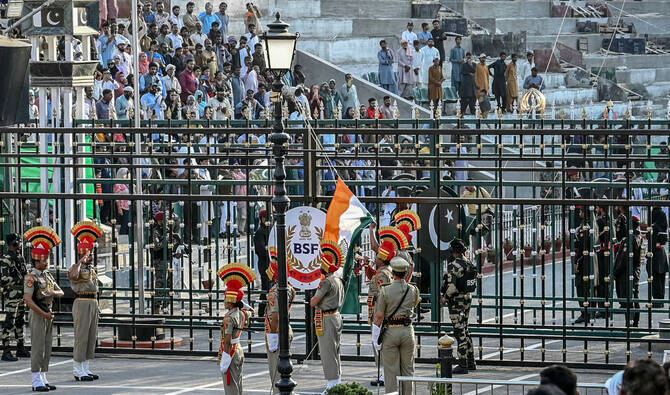
PM Sharif says prepared to defend sovereignty, calls for ‘neutral’ probe into Kashmir attack

https://arab.news/94xt4
PM Sharif says prepared to defend sovereignty, calls for ‘neutral’ probe into Kashmir attack

- Shehbaz Sharif’s remarks came as Indian, Pakistani troops exchanged gunfire for a second straight day on Saturday
- Ties have plummeted between the nuclear-armed neighbors over this week’s attack in Pahalgam that killed 26 tourists


Pakistan says it struck TTP, Daesh militant camps near Afghan border, Kabul alleges civilian deaths
- Islamabad says it targeted seven militant hideouts in “retributive response” to attacks
- Afghan Taliban accuse Pakistan of bombing civilians in Nangarhar and Paktika provinces
ISLAMABAD: Pakistan said on Saturday it carried out “intelligence-based selective targeting” against militant camps near the Afghan border after a series of attacks inside the country, while the Afghan Taliban accused Pakistani forces of killing civilians in the assault.
Pakistan has faced a renewed surge in militant violence in recent months, particularly in its northwestern Khyber Pakhtunkhwa province and two major attacks in the capital, Islamabad. Authorities say many of the attacks have been carried out by the Tehreek-e-Taliban Pakistan (TTP) and allied groups that Islamabad alleges are operating from sanctuaries in Afghanistan. Kabul denies this.
According to Pakistan’s information ministry, recent incidents included a suicide bombing at a Shiite mosque in Islamabad, separate attacks in Bajaur and Bannu, and another recent incident in Bannu during the holy month of
Ramadan, which started earlier this week. The government said it had “conclusive evidence” linking the attacks to militants directed by leadership based in Afghanistan.
“Pakistan in a retributive response, has carried out intelligence based selective targeting of seven terrorist camps and hideouts belonging to Pakistani Taliban ... and its affiliates and ISKP [Daesh] at the border region of Pakistan
Afghan border with precision and accuracy,” the Pakistani information ministry said in a statement on Feb. 21.
The statement, which did not specify the exact nature of the attacks, said it had hit camps of the “Fitna al Khwarij (FAK),” a term Pakistani authorities use for the TTP, as well as the Islamic State Khorasan Province (ISKP), the regional affiliate of the Daesh group.
Islamabad has repeatedly urged Afghanistan’s Taliban authorities to take action against militants it says are using Afghan territory to plan and launch attacks inside Pakistan. The latest statement said Kabul had “failed to undertake any substantive action” despite prior requests.
In an X post, Kabul government spokesperson Zabihullah Mujahid said Pakistani forces had violated Afghan territory.
“Pakistani special military circles have once again trespassed into Afghan territory,” Mujahid said. “Last night, they bombed our civilian compatriots in Nangarhar and Paktika provinces, martyring and wounding dozens of people, including women and children.”
The Afghan Taliban’s claims of civilian casualties could not be independently verified. Pakistan did not immediately comment on the allegation that civilians had been killed in the strikes.
Tensions between Islamabad and Kabul have escalated since the Afghan Taliban returned to power in 2021. Pakistan says cross-border militant attacks have increased since then and has accused the Taliban of failing to honor commitments under the 2020 Doha Agreement to prevent Afghan soil from being used for attacks against other countries. The Taliban deny allowing such activity and have previously rejected similar accusations.
Saturday’s exchange of accusations marks one of the most direct confrontations between the two neighbors in recent months and risks further straining already fragile ties along the volatile border.