Ukraine accuses Hungary, Slovakia of ‘blackmail’ over threats to cut electricity

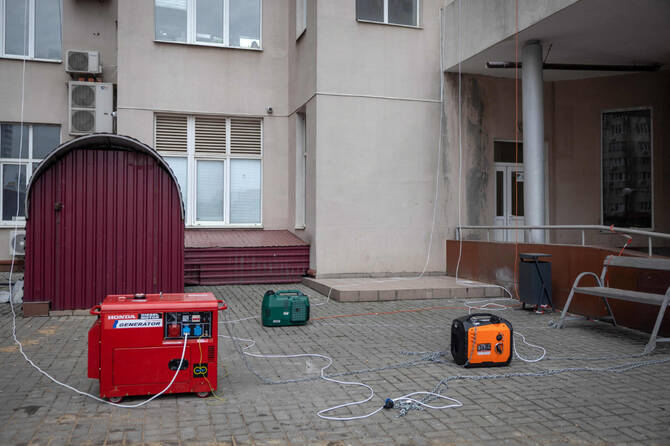
Power generators supply apartments of the Chudo-Gorod residential complex with electricity in Odesa on February 17, 2026, amid the Russian invasion of Ukraine. In the ‘Wonderful City’ residential district of Ukraine’s Odesa, life has been anything but for the hundreds of residents suffering some of the worst Russian bombardments of the entire four-year war. (AFP)
Short Url
Updated 22 February 2026
Follow

Ukraine accuses Hungary, Slovakia of ‘blackmail’ over threats to cut electricity

  • Slovakia’ has threatened to cut off emergency electricity supplies to Ukraine unless Kyiv resumes Russian oil transit to Slovakia over Ukraine’s ‌territory

KYIV: Ukraine’s Foreign Ministry condemned what it described as “ultimatums and blackmail” by the governments of Hungary and Slovakia on Saturday, after they threatened to stop electricity supplies to ​Ukraine unless Kyiv restarts flows of Russian oil.
Shipments of Russian oil to Hungary and Slovakia have been cut off since January 27, when Kyiv says a Russian drone strike hit pipeline equipment in Western Ukraine. Slovakia and Hungary say Ukraine is to blame for the prolonged outage.
Slovakia’s Prime Minister Robert Fico said on Saturday that he would cut off emergency electricity supplies to Ukraine within two days unless Kyiv resumes Russian oil transit to Slovakia over Ukraine’s ‌territory. Hungary’s Viktor ‌Orban made a similar threat days earlier.
The issue ​has ‌become ⁠one of ​the ⁠angriest disputes yet between Ukraine and two neighbors that are members of the EU and NATO but whose leaders have bucked the largely pro-Ukrainian consensus in Europe to cultivate warm ties with Moscow.
Slovakia and Hungary are the only two EU countries that still rely on significant amounts of Russian oil shipped via the Soviet-era Druzhba pipeline over Ukraine.
“Ukraine rejects and condemns the ultimatums and blackmail by the ⁠governments of Hungary and the Slovak Republic regarding energy supplies ‌between our countries,” the Ukrainian Foreign Ministry said ‌in a statement. “Ultimatums should be sent to the Kremlin, ​and certainly not to Kyiv.”

Hungary, ‌Slovakia are key for Ukraine’s electricity imports
Between them, Hungary and Slovakia ‌have been providing around half of European emergency electricity exports to Ukraine, which Kyiv increasingly relies on as Russian attacks have damaged its grid.
“If oil supplies to Slovakia are not resumed on Monday, I will ask SEPS, the state-owned joint-stock company, to stop emergency electricity ‌supplies to Ukraine,” Fico said in a post on X.
Kyiv said that such actions were “provocative, irresponsible, and threaten the energy ⁠security of ⁠the entire region.”
Throughout the war that began with the full-scale Russian invasion whose fourth anniversary falls on Tuesday, Ukraine has allowed its territory to be used for Russian energy exports to Europe, which have been sharply curtailed but not halted.
Ukraine has proposed alternative transit routes to ship oil to Europe while emergency pipeline repair works are under way.
In a letter seen by Reuters, the Ukrainian mission to the EU proposed shipments through Ukraine’s oil transportation system or a maritime route, potentially including the Odesa-Brody pipeline linking Ukraine’s main Black Sea port to the EU.
Since October last year, Russia has intensified its drone and ​missile attacks on the Ukrainian ​energy system, knocking out electricity and heat and plunging millions of Ukrainians into long blackouts during bitterly cold winter temperatures.


Saudi ambassador becomes first foreign envoy to meet Bangladesh’s new PM

Updated 4 sec ago
Follow

Saudi ambassador becomes first foreign envoy to meet Bangladesh’s new PM

  • Tarique Rahman took oath as PM last week after landslide election win
  • Ambassador Abdullah bin Abiyah also meets Bangladesh’s new FM

Dhaka: Saudi Arabia’s ambassador to Dhaka became on Sunday the first foreign envoy to meet Bangladesh’s new Prime Minister Tarique Rahman since he assumed the country’s top office.

Rahman’s Bangladesh Nationalist Party made a landslide win in the Feb. 12 election, securing an absolute majority with 209 seats in the 300-seat parliament.

The son of former Prime Minister Khaleda Zia and former President and BNP founder Ziaur Rahman, he was sworn in as the prime minister last week.

The Saudi government congratulated Rahman on the day he took the oath of office, and the Kingdom’s Ambassador Abdullah bin Abiyah was received by the premier in the Bangladesh Secretariat, where he also met Bangladesh’s new foreign minister.

“Among the ambassadors stationed in Dhaka, this is the first ambassadorial visit with Prime Minister Tarique Rahman since he assumed office,” Saleh Shibli, the prime minister’s press secretary, told Arab News.

“The ambassador conveyed greetings and best wishes to Bangladesh’s prime minister from the king and crown prince of Saudi Arabia … They discussed bilateral matters and ways to strengthen the ties among Muslim countries.”

Rahman’s administration succeeded an interim government that oversaw preparations for the next election following the 2024 student-led uprising, which toppled former leader Sheikh Hasina and ended her Awami League party’s 15-year rule.

New Cabinet members were sworn in during the same ceremony as the prime minister last week.

Foreign Minister Khalilur Rahman is a former UN official who served as Bangladesh’s national security adviser during the interim government’s term.

He received Saudi Arabia’s ambassador after the envoy’s meeting with the prime minister.

“The foreign minister expressed appreciation for the Saudi leadership’s role in promoting peace and stability in the Middle East and across the Muslim Ummah. He also conveyed gratitude for hosting a large number of Bangladeshi workers in the Kingdom and underscored the significant potential for expanding cooperation across trade, investment, energy, and other priority sectors, leveraging the geostrategic positions of both countries,” the ministry said in a statement.

“The Saudi ambassador expressed his support to the present government and his intention to work with the government to enhance the current bilateral relationship to a comprehensive relationship.”

Around 3.5 million Bangladeshis live and work in Saudi Arabia. They have been joining the Saudi labor market since 1976, when work migration to the Kingdom was established during the rule of the new prime minister’s father.

Bangladeshis are the largest expat group in the Kingdom and the largest Bangladeshi community outside Bangladesh and send home more than $5 billion in remittances every year.