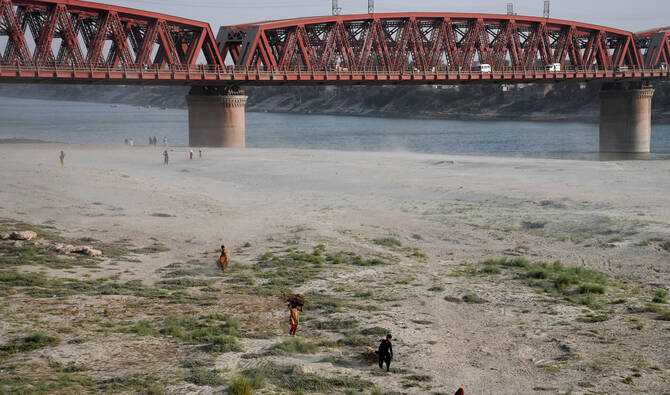
ISLAMABAD: India’s suspension of the Indus Waters Treaty (IWT) could set a precedent for China to block the Brahmaputra River, a senior aide to Prime Minister Shehbaz Sharif warned on Friday, potentially putting New Delhi in a difficult position.
India relies on rivers that originate in China, particularly from the Tibetan Plateau, where major waterways like the Brahmaputra and Sutlej rivers begin.
China’s dam-building activities and lack of a formal water-sharing agreement have raised concerns in India about future water security during floods or droughts. The absence of binding treaties leaves India vulnerable to upstream decisions made by Beijing.
In 2016, China blocked the flow of the Xiabuqu River, which feeds the Brahmaputra, as part of a hydropower project in Tibet after a militant attack in Indian-administered Kashmir.
“If India does something like this that they stop the flow [of rivers] to Pakistan, then China can also do the same thing,” Rana Ihsaan Afzal said while speaking to Geo News. “But if things like this happen then the entire world will be in a war.”
The IWT is a landmark water-sharing agreement signed in 1960 between India and Pakistan, brokered by the World Bank, to manage the use of rivers flowing through both countries from the Himalayas. Under the treaty, India was granted control over the three eastern rivers — Ravi, Beas and Sutlej — while Pakistan received rights over the three western rivers — Indus, Jhelum and Chenab.
Despite multiple wars and ongoing tensions, the treaty has largely held as a rare example of sustained cooperation.
However, India on Wednesday suspended the six-decade-old river-sharing treaty with Pakistan as part of a series of measures following a deadly militant attack in Indian-administered Kashmir, for which it holds Islamabad responsible.
Pakistan has denied any involvement in the attack, in which gunmen killed 26 people at a tourist site in Pahalgam, a scenic town in Anantnag district, marking the deadliest assault on civilians in the country in nearly two decades.
Highlighting that India’s actions threatened the food security of 250 million people, Afzal said under international water laws, upper riparian countries cannot “stop” water but may only “regulate” it.
He added that upper and lower riparian countries coexist peacefully across the world and warned that India’s threat could undermine the entire system of peaceful water-sharing mechanisms, potentially escalating tensions toward conflict.
“This will not be easy at all,” he said. “The United Nations and lower riparian countries throughout the world will raise their voice against it.”
Afzal confirmed that Pakistan was engaging friendly countries through diplomatic channels and was also in contact with the UN.


![]()

Islamabad warns Indian suspension of Indus Waters Treaty could set precedent for China
Short Url
https://arab.news/r6yb8
Islamabad warns Indian suspension of Indus Waters Treaty could set precedent for China
- New Delhi suspended the river-sharing agreement after a militant attack in Indian-administered Kashmir
- PM Sharif’s aide says Pakistan is discussing the situation with friendly countries and the United Nations
Latest updates





Recommended


© 2026 SAUDI RESEARCH & PUBLISHING COMPANY, All Rights Reserved And subject to Terms of Use Agreement.