Pakistan’s deputy PM briefs Saudi FM on response to India’s actions after Kashmir attack

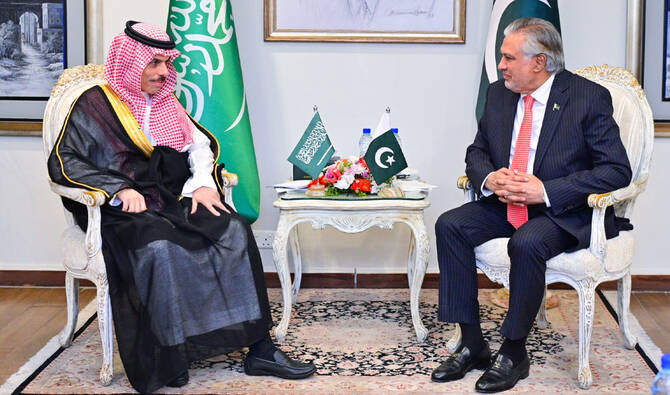
Pakistan’s Deputy Prime Minister and Foreign Minister, Ishaq Dar, meets Saudi Foreign Minister, Prince Faisal bin Farhan (left), in Islamabad on April 16, 2025. (MOFA/File)
Short Url
Updated 29 April 2025
Follow

Pakistan’s deputy PM briefs Saudi FM on response to India’s actions after Kashmir attack

  • Ishaq Dar criticizes India’s ‘baseless’ accusations against Pakistan, cautions against escalatory moves
  • Pakistan denies involvement in a militant attack in Indian-administered Kashmir in which 26 were killed

ISLAMABAD: Pakistan’s Deputy Prime Minister Ishaq Dar, who also serves as foreign minister, briefed his Saudi counterpart, Prince Faisal bin Farhan, on Islamabad’s response to India’s retaliatory moves after a militant attack in Indian-administered Kashmir, saying his country would respond firmly to any external aggression.
The two leaders spoke over the phone amid heightened tensions between the nuclear-armed neighbors after gunmen killed 26 civilians in the tourist town of Pahalgam earlier this week.
India accused Pakistan of involvement in the attack — a charge Islamabad denied — before announcing a series of retaliatory steps, including suspending the Indus Waters Treaty, expelling Pakistani diplomats and shutting down the Attari-Wagah border crossing.
Pakistan held a high-level national security meeting in response, criticizing Indian actions and promising a forceful response if New Delhi diverted river waters or resorted to any military action.
“DPM/FM [Dar] briefed Prince Faisal on decisions taken by Pakistan’s National Security Committee in the wake of unilateral measures announced by India,” the foreign office of Pakistan said in a statement after the phone call. “He rejected India’s baseless allegations and cautioned against further escalatory moves.”
“DPM/FM reaffirmed Pakistan’s resolve to respond firmly to any aggression,” the statement added.
Both ministers also expressed satisfaction with the state of bilateral relations and agreed to maintain consultations on evolving regional dynamics.
Pakistan and Saudi Arabia have long-standing ties, particularly in defense and diplomacy, and often coordinate positions at multilateral forums.
As part of its wider diplomatic outreach, Pakistan’s Foreign Secretary Amna Baloch briefed ambassadors and senior diplomats in Islamabad earlier this week, highlighting the National Security Committee’s stance and reiterating Pakistan’s rejection of militancy in all its forms.
Pakistan also hosted the Organization of Islamic Cooperation’s Special Envoy for Jammu and Kashmir, Yousef Al Dobeay, from April 19 to 22.
Officials briefed him on the situation in the disputed region of Kashmir while maintaining that the people of Kashmir looked to the Muslim world and the OIC for support in their struggle for self-determination.


Pakistan says ensuring interfaith harmony key priority as nation marks Christmas

Updated 7 sec ago
Follow

Pakistan says ensuring interfaith harmony key priority as nation marks Christmas

  • Pakistan is home to over 3 million Christians, making it the third-largest religion in the country
  • PM Sharif economic well-being, equal opportunities for all in message to nation on Christmas

ISLAMABAD: Prime Minister Shehbaz Sharif on Thursday identified ensuring interfaith harmony and freedom of rights for all citizens, especially minorities, as his government’s key priorities as the nation marks Christmas today. 

Millions of Christians worldwide celebrate Dec. 25 as the birth of Jesus Christ, marking the day with religious and cultural festivities. The Christian community in Pakistan marks the religious festival every year by distributing gifts, decorating Christmas trees, singing carols and inviting each other to lavish feasts. 

Christianity is the third-largest religion in Pakistan, with results from the 2023 census recording over three million Christians, or 1.3 percent of the total population in the country. 

However, Christians have faced institutionalized discrimination in Pakistan, including being targeted for blasphemy accusations, suffering abductions and forced conversions to Islam. Christians have also complained frequently of being reserved for jobs considered by the masses of low status, such as sewage workers or brick kiln workers. 

“It remains a key priority of the Government of Pakistan to ensure interfaith harmony, protection of rights and freedoms, economic well-being, and equal opportunities for professional growth for all citizens without discrimination of religion, race, or ethnicity,” Sharif said in a statement issued by the Prime Minister’s Office (PMO). 

The Pakistani premier said Christmas was not only a religious festival but also a “universal message of love, peace, tolerance, and goodwill” for all humanity. 

Sharif noted the Christian community’s contributions to Pakistan’s socio-economic development were immense.

“Their significant services in the fields of education, health care, and other walks of life have greatly contributed to the promotion of social harmony,” the Pakistani prime minister said. 

Despite the government’s assurances of protection to minorities, the Christian community has endured episodes of violence over the past couple of years. 

In May 2024, at least 10 members of a minority Christian community were rescued by police after a Muslim crowd attacked their settlement over a blasphemy accusation in eastern Pakistan.

In August 2023, an enraged mob attacked the Christian community in the eastern city of Jaranwala after accusing two Christian residents of desecrating the Qur’an, setting Churches and homes of Christians on fire. 

In 2017, two suicide bombers stormed a packed church in southwestern Pakistan just days before Christmas, killing at least nine people and wounding up to 56. 

An Easter Day attack in a public park in 2016 killed more than 70 people in the eastern city of Lahore. In 2015, suicide attacks on two churches in Lahore killed at least 16 people, while a pair of suicide bombers blew themselves up outside a 130-year-old Anglican church in the northwestern city of Peshawar after Sunday Mass in 2013. 

The Peshawar blast killed at least 78 people in the deadliest attack on Christians in the predominantly Muslim country.