

How Pope Francis touched a migrant’s heart, saying ‘we’re all the same people’

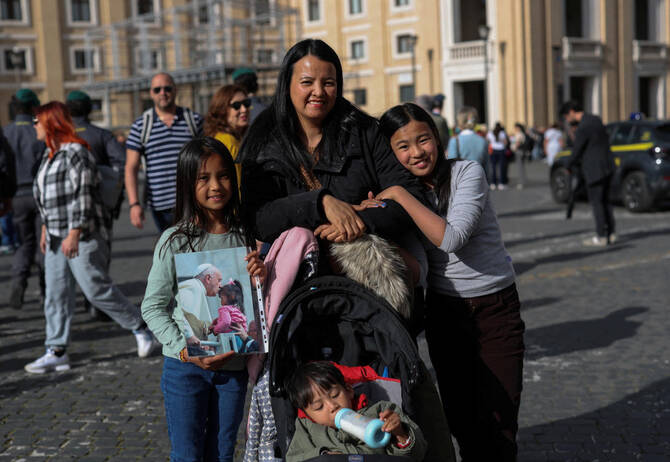
Francezka Abano, 9, holds a picture of her and Pope Francis from 2018, as she poses for a picture with her mother Diane Karla Abano, her sister Sophia, 9, and her brother John Florence, 2, in Rome, Apr. 24, 2025. (Reuters)
Short Url
Updated 25 April 2025
Follow

How Pope Francis touched a migrant’s heart, saying ‘we’re all the same people’

  • “In the eyes of Pope Francis, we are not migrants, we’re all the same people,” not Filipino or Indian or Asian, said Abano
  • Francis, himself the son of Italian immigrants in Argentina, placed the plight of migrants and refugees at the heart of his moral agenda

VATICAN CITY: Diane Karla Abano, a Filipino migrant living in Rome, has vivid memories of the day that Pope Francis touched her heart and made her feel at home, kissing her two young daughters during an audience in St. Peter’s Square in May, 2018.
“The moment that I reached out to the pope and saw his smile, I don’t know, all the hurt, all the pain that I felt, it changed into happiness and hope,” Abano said, her voice breaking and tears welling in her eyes as she showed photos of the event.
“In the eyes of Pope Francis, we are not migrants, we’re all the same people,” not Filipino or Indian or Asian, said Abano.
She was back in St. Peter’s Square this week, queuing up with tens of thousands of other mourners to pay her last respects to a man whose brief blessing proved transformative.
Francis, himself the son of Italian immigrants in Argentina, placed the plight of migrants and refugees at the heart of his moral agenda during his 12-year papacy, personally intervening to assist asylum seekers and pushing governments to do much more to help.
He repeatedly spoke out for the poor and marginalized, and criticized countries that shunned migrants.
His first trip outside Rome after he was elected pope in 2013 was to the tiny Italian island of Lampedusa to pay tribute to the thousands of people who had drowned in the Mediterranean while trying to reach Europe and a better life.
In 2016 he visited the Greek island of Lesbos and brought a dozen Syrian refugees back to Italy with him on his plane. In 2021, he flew to Cyprus and again ensured safe passage for a group of 50 asylum seekers.
Among them was Grace Enjei, who had escaped fighting in her native Cameroon in 2020 and had ended up stranded in the so-called “buffer zone” that divides the island as she sought to reach territory that falls within the European Union.
Just before the trip, Vatican officials told her that the pope had learnt of the plight of those caught in a legal limbo, and had arranged for them to be relocated to Italy.
“We were so happy, like, we were singing the whole night, we were dancing, we were celebrating actually. Something so, so, so good, like it was real good, we were so happy,” said Enjei.
Days after she arrived in Italy, Enjei was unexpectedly invited to celebrate Pope Francis’ birthday.
“He was like ‘these are the people from the buffer zone?’ and we were like, ‘Yes, yes, yes’. He said, ‘Oh, you guys are welcome, I heard about your story, and I was so touched, so I needed to do something’,” Enjei said.

BRIDGES NOT WALLS
The late pope repeatedly urged political leaders to defend migrants, saying their safety should take precedence over national security concerns.
In 2015 he became the first pope to address the US Congress, where he recalled his own migrant background and said it was natural for people to cross borders in search of better opportunities for them and their families.
“Is this not what we want for our own children?” he said. “I say this to you as the son of immigrants, knowing that so many of you are also descended from immigrants.”
In 2016 he publicly clashed with Donald Trump — who was then campaigning for his first term in the White House — over his plans to build a wall between the United States and Mexico to keep out migrants.
“A person who thinks only about building walls, wherever they may be, and not building bridges, is not Christian,” Francis told reporters. Trump, who will attend the pope’s funeral on Saturday, said at the time that it was “disgraceful” for a religious leader to question a person’s faith.
Francis was critical again as the US president began his second term, telling American bishops in a letter in February that he disagreed with migrant deportations.
The pope faced resistance not just from politicians, but also sometimes from within his own Church with a number of parishes, especially in Eastern Europe, unhappy over his call for religious communities to take in refugees.
But speaking from her new home in Rome, Enjei stressed the positive impact that Francis had on so many people, not just herself.
“It’s not only about me. He has helped so many people, and we thank him for the fight he’s fighting for the migrants. We really appreciate and thank him so much,” she said.



Bangladesh mourns Khaleda Zia, its first woman prime minister

Updated 30 December 2025
Follow

Bangladesh mourns Khaleda Zia, its first woman prime minister

  • Ousted ex-premier Sheikh Hasina, who imprisoned Zia in 2018, offers condolences on her death
  • Zia’s rivalry with Hasina, both multiple-term PMs, shaped Bangladeshi politics for a generation

DHAKA: Bangladesh declared three days of state mourning on Tuesday for Khaleda Zia, its first female prime minister and one of the key figures on the county’s political scene over the past four decades.

Zia entered public life as Bangladesh’s first lady when her husband, Ziaur Rahman, a 1971 Liberation War hero, became president in 1977.

Four years later, when her husband was assassinated, she took over the helm of his Bangladesh Nationalist Party and, following the 1982 military coup led by Hussain Muhammad Ershad, was at the forefront of the pro-democracy movement.

Arrested several times during protests against Ershad’s rule, she first rose to power following the victory of the BNP in the 1991 general election, becoming the second woman prime minister of a predominantly Muslim nation, after Pakistan’s Benazir Bhutto.

Zia also served as a prime minister of a short-lived government of 1996 and came to power again for a full five-year term in 2001.

She passed away at the age of 80 on Tuesday morning at a hospital in Dhaka after a long illness.

She was a “symbol of the democratic movement” and with her death “the nation has lost a great guardian,” Bangladesh’s interim leader Muhammad Yunus said in a condolence statement, as the government announced the mourning period.

“Khaleda Zia was the three-time prime minister of Bangladesh and the country’s first female prime minister. ... Her role against President Ershad, an army chief who assumed the presidency through a coup, also made her a significant figure in the country’s politics,” Prof. Amena Mohsin, a political scientist, told Arab News.

“She was a housewife when she came into politics. At that time, she just lost her husband, but it’s not that she began politics under the shadow of her husband, president Ziaur Rahman. She outgrew her husband and built her own position.”

For a generation, Bangladeshi politics was shaped by Zia’s rivalry with Sheikh Hasina, who has served as prime minister for four terms.

Both carried the legacy of the Liberation War — Zia through her husband, and Hasina through her father, Sheikh Mujibur Rahman, widely known as the “Father of the Nation,” who served as the country’s first president until his assassination in 1975.

During Hasina’s rule, Zia was convicted in corruption cases and imprisoned in 2018. From 2020, she was placed under house arrest and freed only last year, after a mass student-led uprising, known as the July Revolution, ousted Hasina, who fled to India.

In November, Hasina was sentenced to death in absentia for her deadly crackdown on student protesters and remains in self-exile.

Unlike Hasina, Zia never left Bangladesh.

“She never left the country and countrymen, and she said that Bangladesh was her only address. Ultimately, it proved true,” Mohsin said.

“Many people admire Khaleda Zia for her uncompromising stance in politics. It’s true that she was uncompromising.”

On the social media of Hasina’s Awami League party, the ousted leader also offered condolences to Zia’s family, saying that her death has caused an “irreparable loss to the current politics of Bangladesh” and the BNP leadership.

The party’s chairmanship was assumed by Zia’s eldest son, Tarique Rahman, who returned to Dhaka just last week after more than 17 years in exile.

He had been living in London since 2008, when he faced multiple convictions, including an alleged plot to assassinate Hasina. Bangladeshi courts acquitted him only recently, following Hasina’s removal from office, making his return legally possible.

He is currently a leading contender for prime minister in February’s general elections.

“We knew it for many years that Tarique Rahman would assume his current position at some point,” Mohsin said.

“He should uphold the spirit of the July Revolution of 2024, including the right to freedom of expression, a free and fair environment for democratic practices, and more.”