ISLAMABAD: Pakistan and Afghanistan have agreed to enhance trade and connectivity during a visit to Kabul by top officials from Islamabad, the foreign office said on Friday, amid a push by the two neighbors to reset soured relations.
Pakistan-Afghanistan relations have been strained by a spike in militancy in Pakistan’s western regions that border Afghanistan, following the Taliban’s takeover of Kabul in 2021. Islamabad says anti-Pakistan militants carry out cross-border attacks using safe havens in Afghanistan, a charge Kabul denies.
Another source of tension has been Pakistan’s decision to expel undocumented Afghans and those who had temporary permission to stay, saying it can no longer cope. Since November 2023 when Islamabad first launched the deportation drive against illegal foreigners, over 900,000 Afghans have left the country. The Afghan government has condemned the “unilateral measures” to forcibly deport tens of thousands of Afghans. Afghans have also reported weeks of arbitrary arrests, extortion and harassment by authorities as Islamabad has accelerated the deportation drive since April, a charge officials deny.
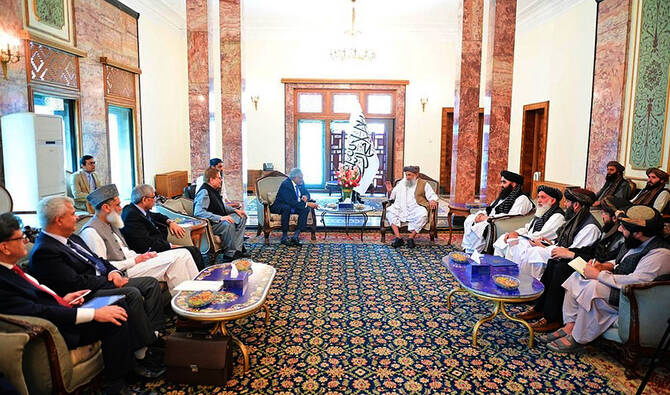
Amid these tensions, Pakistani Deputy Prime Minister Ishaq Dar and special envoy to Kabul, Ambassador Mohammad Sadiq, went to Afghanistan on a one-day visit last week widely seen as an attempt to resolve outstanding issues of contention.
“During the visit, the deputy prime minister [and] foreign minister held meetings with the acting Afghan prime minister, acting Afghan deputy prime minister and acting Afghan foreign minister,” Shafqat Ali Khan, a Pakistani foreign office spokesperson, told reporters at a weekly news briefing in Islamabad.
“Both sides held extensive discussions on a range of issues including peace and security, people-to-people contacts and agreed to enhance bilateral trade and economic cooperation to the mutual benefit of people of both countries.”
Pakistan remains at loggerheads with two of its main neighbors, India and Afghanistan, while Islamabad’s relations with Iran have also seen friction in recent weeks over the killing of eight Pakistani laborers in Iran’s Sistan-Baluchestan province. Both Pakistan and Iran last year exchanged strikes against what they called militant hideouts, but quickly moved to de-escalate tensions.
This week, an attack on tourists in India’s Himalayan territory of Kashmir has sparked a new crisis between nuclear armed neighbors India and Pakistan, with New Delhi blaming militants with “cross-border linkages” for the killings, which Islamabad denies. Both nations have announced tit-for-tat measures to downgrade ties in the aftermath of the violence.
The tensions have come as Pakistan navigates a tricky path to economic recovery, seeking to boost trade by enhancing connectivity with regional countries and attract foreign investment from allies in the region and beyond.
In this regard, Dar on Thursday held a telephonic conversation with Uzbekistan Foreign Minister Seyedov Bakhtiar Odilovic and apprised him of his discussions with Afghan officials about a tri-nation railway line project involving Uzbekistan, Pakistan and Afghanistan.
“The deputy prime minister shared his discussions in Kabul regarding Uzbekistan-Afghanistan-Pakistan railway line project and hoped that the three countries would soon sign the framework agreement for this important regional connectivity project,” the foreign office spokesman said at the briefing.
The project is part of Pakistan’s efforts to position itself as a key trade and transit hub, connecting the landlocked Central Asian states to the global market.


![]()

Pakistan, Afghanistan agree to enhance trade and connectivity in push to reset ties
Short Url
https://arab.news/c744f
Pakistan, Afghanistan agree to enhance trade and connectivity in push to reset ties
- Ties with Kabul have been strained over a spike in militancy and a deportation drive against Afghan nations
- Pakistani deputy PM and special envoy to Kabul visited Islamabad last week in an attempt to resolve issues
Latest updates








© 2026 SAUDI RESEARCH & PUBLISHING COMPANY, All Rights Reserved And subject to Terms of Use Agreement.