
LONDON: Syria’s foreign minister, Asaad Al-Shaibani, helped raise his nation’s new flag at the UN headquarters in New York on Friday, before pleading with the international community to remove the punishing sanctions imposed on his country.
Al-Shaibani’s trip to the US is his first official visit since opposition forces seized control of Damascus from President Bashar Assad in December after nearly 14 years of civil war.
Addressing a meeting of the UN Security Council, he said the sanctions, imposed by the US and EU, among others, were introduced to target the Assad regime but could now derail Syria’s political transition.
“The burden of sanctions continues to threaten our stability,” Al-Shaibani said. “The lifting of sanctions could be a crucial step in transforming Syria from a country known for its dark past to an active and powerful partner in peace, prosperity and the international economy.”
Many of the international sanctions were imposed in response to the Assad regime’s brutal crackdown on protesters in 2011 that sparked the war.

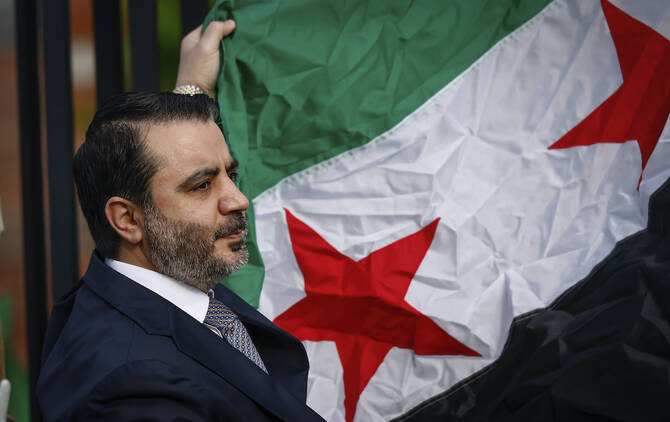
Syria's Foreign Minister Asaad Al-Shibani holds the Syrian flag during a ceremony adding it to the 100 flags flying in line at the UN headquarters in New York on Friday. (AP)
The UK on Thursday said it had withdrawn asset freezes on a number of Syrian government organizations, including the defense and interior ministries. The EU and US have also removed some sanctions but many remain in place, imposing severe restrictions on Syria’s crippled economy.
Al-Shaibani said these restrictions prevent international organizations from investing in Syria, and capital and expertise from entering the country.
Syria’s interim president, Ahmad Al-Sharaa, who led the opposition Islamist militant group Hayat Tahrir Al-Sham that swept Assad from power, has made similar repeated calls for sanctions to be lifted.
Al-Shaibani’s visit to the US is part of a push to gain support from the Trump administration, and to lobby for the removal of the restrictions. US authorities have been cautious so far, opting to wait and see the direction in which Syria’s new rulers will lead the country.
During Friday’s Security Council meeting, the US ambassador to the UN, Dorothy Shea, said Washington would “continue to observe the actions of the interim authorities and will determine our actions based on a pattern of behavior.”

Syrian Foreign Minister Asaad Al-Shaibani speaks during a UN Security Council meeting on the Middle East at the UN headquarters in New York on Friday. (AFP)
She said the Syrian government would be held accountable in a number of areas, including the actions it takes to combat terrorism, its record of nonaggression against neighboring states, and efforts to ensure the security and freedoms of all Syrians.
The UN’s special envoy for Syria, Geir Pedersen, called for the easing of sanctions on Syria “at a larger scale and quicker pace.”
He continued: “This is essential to reactivate Syria’s economy, to realize concrete support from the region, and to enable many to actively participate in a national effort to rebuild their country.”
Pedersen warned that while a lot had been achieved since Assad’s downfall, the challenges facing the country’s “extremely fragile” political transition were huge but the government could be successful if there was greater inclusion within the political process, and much-needed economic stability.
“With a sea change on both these elements, the political transition in Syria can succeed,” he added. “Without both, it likely will not and the consequences would be grave.”

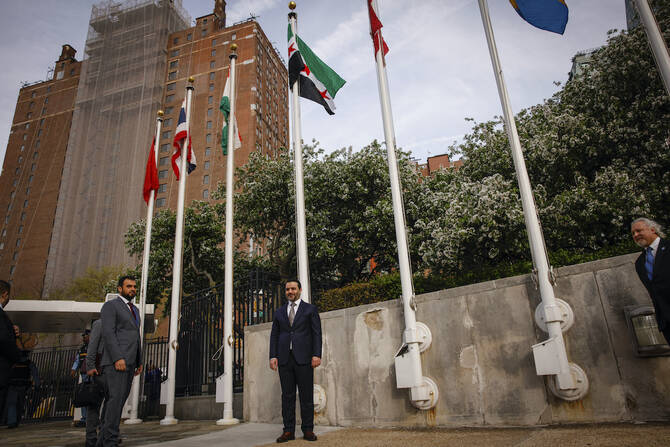
Syria's Foreign Minister Asaad Al-Shibani stands next to the Syrian flag during a ceremony outside the UN headquarters on Friday. (AP)
Al-Sharaa last month formed a new Cabinet to replace the caretaker government installed after his forces captured Damascus. However, he faces international pressure to ensure the political process includes greater representation across Syria’s wide array of ethnic and religious groups.
The fragile nature of Syria’s political transition was illustrated last month when violence erupted in its coastal region. Pro-Assad groups attacked government security forces there, sparking revenge killings against the Alawite community in which hundreds of civilians were killed.
The new Syrian government has also been undermined by Israeli attacks on the country, including clashes in Deraa and airstrikes on Damascus, Hama and Homs. In addition, Israeli troops remain stationed inside Syrian territory after seizing positions there in December.
“The ongoing aggression undermines our reconstruction efforts and undermines the peace and security we seek,” Al-Shaibani said.
“We have repeatedly stated our commitment that Syria will not pose a threat to any country in the region or the world, including Israel.”
Pedersen described Israel’s approach to Syria as “highly confrontational” and “unwarranted,” given that there is clearly scope for diplomacy.
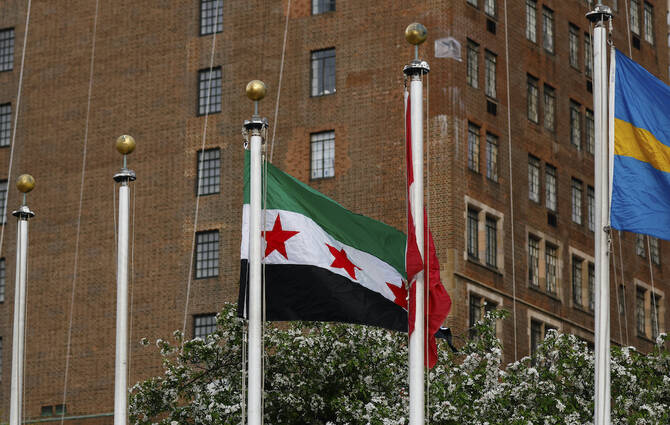
In a symbolic break from the Assad regime, Syria’s new rulers have replaced the nation’s previous flag, which featured two stars, with a three-star flag used by opposition forces during the conflict.
Al-Shaibani held the new flag as it began to rise into the New York sky, alongside the flags of dozens of other countries, during a ceremony at the UN building on Friday morning.
“This flag is not just a symbol, it is a declaration of a new existence born of suffering, embodying a future born of steadfastness and a promise of change after years of pain,” he said.