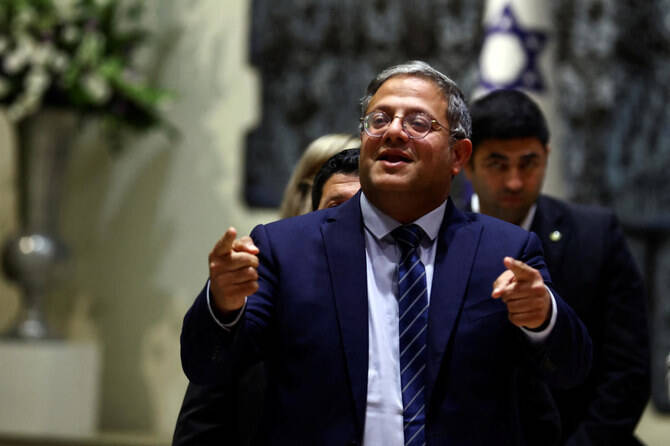

LONDON: Itamar Ben-Gvir, Israel’s far-right national security minister, made an appearance at Yale University on Wednesday just a day after attending a fundraiser at Donald Trump’s Mar-a-Lago resort in Florida.
Ben-Gvir, who has past convictions for racist incitement and supporting a terrorist group, was previously considered persona non grata by the Joe Biden administration.
At Tuesday’s event in Palm Beach, he addressed a room of Republican figures and business leaders, where he outlined harsh new measures against Palestinian prisoners, according to a report in The Guardian.
“I love the American people very much,” Ben-Gvir told attendees through a translator. “We have a joint war against the jihad.”
While the Israeli minister did not meet Trump, who was not in attendance at the event, he did hold talks with “dozens of senior businessmen from Miami” and Republican House Majority Whip Tom Emmer, according to The Times of Israel.
Ben-Gvir later posted on X that he “had the honor and privilege” of meeting senior Republican officials at Mar-a-Lago, though he did not name them, and in the post he further claimed they endorsed his call to bomb Gaza’s food and aid depots to ramp up pressure for the release of Israeli hostages.
The minister has repeatedly sparked controversy both within Israel and abroad. Since entering Prime Minister Benjamin Netanyahu’s coalition government in 2022, he has threatened to quit if the Gaza war ends and has advocated for the mass deportation of Arab citizens.
His US visit has prompted condemnation from Jewish organizations and human rights groups alike.
At Yale, protests were held ahead of his scheduled appearance at a meeting hosted by Shabtai, a Jewish society at the university. Demonstrators from Yale’s Students for Justice in Palestine led campus opposition.
Yale did not respond to a request for comment.
Khaled Elgindy, a visiting scholar at Georgetown University’s Center for Contemporary Arab Studies, said Ben-Gvir’s warm reception in the US was “deeply disturbing.”
He added: “That the GOP is aligned with the most fanatical elements in Israeli politics, while perhaps not surprising, is extremely alarming and does not bode well for the stability of the region.”
Ben-Gvir’s history has long drawn scrutiny.
In 2007, he was convicted of inciting racism and supporting a terrorist organization. He once displayed in his home a photo of Baruch Goldstein, who killed 29 Muslim worshipers in the 1994 Hebron massacre. In 2022, the US State Department condemned his visit to the memorial of extremist rabbi Meir Kahane, whose violent ideology Ben-Gvir has expressed admiration for in the past.
“Celebrating the legacy of a terrorist organization is abhorrent. There is no other word for it,” US State Department spokesperson Ned Price said at the time.
“We urge all parties to maintain calm, exercise restraint and to refrain from actions that only serve to exacerbate tensions, and that includes in Jerusalem,” he added.
Despite international rebukes, Ben-Gvir has continued to court controversy. His provocative visits to Jerusalem’s Al-Aqsa mosque compound, most recently earlier this month, have drawn fierce criticism across the region, including a rare public reprimand from Netanyahu last year.
The White House did not comment on Ben-Gvir’s US visit.
Following his Yale appearance, the minister was scheduled to speak at another event in New York City, billed as a discussion on “securing Israel post-Oct. 7.”