Hard-line Israeli minister Ben-Gvir threatens to quit over Gaza deal

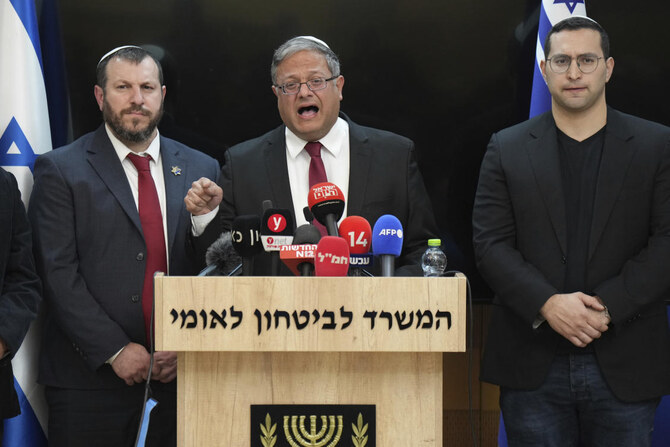
Israel’s National Security Minister Itamar Ben-Gvir, center, said that he will quit if Israel approves a ceasefire in Gaza, Jerusalem, Thursday, Jan. 16, 2025. (AP Photo)
Short Url
Updated 16 January 2025
Follow

Hard-line Israeli minister Ben-Gvir threatens to quit over Gaza deal

  • Itamar Ben-Gvir: ‘The deal that is taking shape is a reckless deal’
  • Ben-Gvir urged Bezalel Smotrich to join him in a last-ditch attempt to prevent a ceasefire deal

JERUSALEM: Israel’s hard-line National Security Minister Itamar Ben-Gvir said on Thursday he would resign from Prime Minister Benjamin Netanyahu’s government if it ratifies the ceasefire deal in Gaza, which he has strongly opposed.
Israeli media outlets reported earlier that the cabinet was expected to vote to ratify the agreement on Friday, but there has been no confirmation from the prime minister’s office.
“The deal that is taking shape is a reckless deal,” Ben-Gvir said in a televised statement, saying it would “erase the achievements of the war” by releasing hundreds of Palestinian militants and withdrawing from strategic areas in Gaza, leaving Hamas undeafeated.
“If this irresponsible deal is approved and implemented, we the members of Jewish Power will submit letters of resignation to the prime minister,” he said.
Ben-Gvir, whose departure would not bring down Netanyahu’s government, this week urged Finance Minister Bezalel Smotrich to join him in a last-ditch attempt to prevent a ceasefire deal, which he described as a dangerous capitulation to Hamas.
Smotrich has described the deal to halt the fighting in Gaza and exchange Israeli hostages for Palestinian prisoners as a catastrophe for Israel but has not threatened the quit the government.
Earlier on Thursday, Smotrich’s Religious Zionism party repeated its opposition, threatening to quit the government if it did not go back to war to defeat Hamas after the first six-week phase of the ceasefire was completed.


US officials say Gaza stabilization force will not fight Hamas

Updated 8 sec ago
Follow

US officials say Gaza stabilization force will not fight Hamas

  • An American two-star general is under consideration to lead the ISF, but no decision has been made, officials said

NEW YORK: International troops could be deployed in the Gaza Strip as early as next month to form a UN-authorized stabilization force, two US officials said, but it remains unclear how Hamas will be disarmed.
Officials said the International Stabilization Force, or ISF, would not fight Hamas. 
They said many countries have expressed interest in contributing, and US officials are currently working out the size of the ISF, its composition, housing, training, and rules of engagement.

There is a lot of quiet planning that’s going on behind the scenes right now for phase two of the peace deal.

Karoline Leavitt, White House spokesperson

An American two-star general is under consideration to lead the ISF, but no decision has been made, officials said.
Deployment of the force is a key part of the next phase of US President Donald Trump’s Gaza peace plan. 
Under the first phase, a fragile ceasefire in the two-year war began on Oct.10, and Hamas released hostages, and Israel freed detained Palestinians.
“There is a lot of quiet planning that’s going on behind the scenes right now for phase two of the peace deal,” White House spokesperson Karoline Leavitt said. 
“We want to ensure an enduring and lasting peace.”
Indonesia has said it is prepared to deploy up to 20,000 troops to take on health and construction-related tasks in Gaza.
“It is still in the planning and preparation stages,” said Rico Sirait, spokesperson of the Indonesian Defense Ministry. 
“We are now preparing the organizational structure of the forces to be deployed.”

Israel still controls 53 percent of Gaza, while nearly all the 2 million people in the enclave live in the remaining Hamas-held area. The plan — which needs to be finalized by the so-called Board of Peace — is for the ISF to deploy in the area held by Israel, the US officials said.
Then, according to the Trump peace plan, as the ISF establishes control and stability, Israeli troops will gradually withdraw “based on standards, milestones, and timeframes linked to demilitarization.”
A UN Security Council resolution adopted on Nov. 17 authorized a Board of Peace and countries working with it to establish the ISF. 
Trump said on Wednesday that an announcement on which world leaders will serve on the Board of Peace will be made early next year.
The Security Council authorized the ISF to work alongside newly trained and vetted Palestinian police to stabilize security “by ensuring the process of demilitarizing the Gaza Strip, including the destruction and prevention of rebuilding of the military, terror, and offensive infrastructure, as well as the permanent decommissioning of weapons from non-state armed groups.”
However, it remains unclear exactly how that would work.
US Ambassador to the UN Mike Waltz noted on Thursday that the Security Council authorized the ISF to demilitarize Gaza by all means necessary, which means the use of force. 
“Obviously, that’ll be a conversation with each country,” he told Israel’s Channel 12, adding that discussions on rules of engagement were underway.
Hamas has said the issue of disarmament has not been discussed with them formally by the mediators — the US, Egypt, and Qatar — and the group’s stance remains that it will not disarm until a Palestinian state is established.
Israel’s Prime Minister Benjamin Netanyahu said in a speech on Sunday that the second phase would move toward demilitarization and disarmament.
“Now that raises a question: Our friends in America want to try and establish a multinational task force to do the job,” he said. “I told them I welcome it. Are volunteers here? Be my guest,” Netanyahu said.
“We know there are certain tasks that this force can perform ... but some things are beyond their abilities, and perhaps the main thing is beyond their abilities, but we will see about that,” he said.