Pakistan’s stocks, dollar bonds plunge amid investor concerns over surging tensions with India

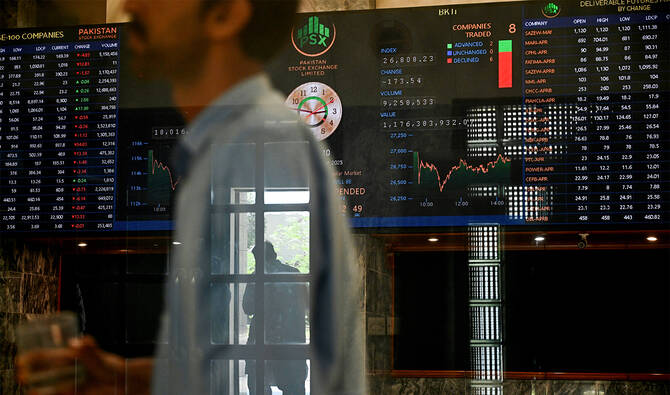
A stockbroker walks past share prices on a financial market board during a trading session at the Pakistan Stock Exchange (PSX) in Karachi on April 9, 2025. (REUTERS/File)
Short Url
Updated 24 April 2025
Follow

Pakistan’s stocks, dollar bonds plunge amid investor concerns over surging tensions with India

  • Pakistani stocks lose two percent of their index value at close of market, dollar bonds decline by more than four cents
  • Tensions between India and Pakistan surged this week after Delhi blamed Islamabad for an attack in Jammu and Kashmir

KARACHI: Pakistan’s stocks and dollar-denominated bonds plunged in value on Thursday, which financial experts attributed to investor concerns over surging tensions between Islamabad and New Delhi. 

Pakistan’s stocks shed two percent of their index value when the market closed on Thursday, as per data from the Pakistan Stock Exchange (PSX). The benchmark KSE-100 Index plummeted to 114,661 points but managed to recover some ground before closing at 115,019.81 points. 

Pakistan’s dollar-denominated bonds maturing in 2036 also declined by more than four cents to 74 cents, international news agency Reuters reported, citing data from Tradeweb. Pakistani financial experts attributed the plunges to increasing investor concerns after renewed tensions between Islamabad and New Delhi. 

New Delhi on Wednesday blamed Pakistan for being involved in an attack this week in Indian-administered Kashmir. Gunmen killed 26 men at a tourist site in the Anantnag district in Indian-administered Kashmir, following which India announced it was suspending its decades-old water-sharing treaty with Pakistan, among a raft of measures that included downgrading ties with Islamabad on Wednesday. Pakistan denied involvement in the attack and reciprocated with similar measures on Thursday. 

“Both the KSE-100 and Nifty-50 are in the red today due to pressure from rising Pakistan-India tensions following the Pahalgam incident,” Najeeb Ahmed Khan Warsi, head of online trading at brokerage firm Foundation Securities Ltd., told Arab News.

The Nifty-50 is India’s National Stock Exchange index, representing the float-weighted average of the country’s 50 largest listed companies.

Warsi said investor sentiment remained “cautious” despite corporate earnings largely aligning with market expectations, noting that trading at Asian markets had also subdued with global recovery losing momentum amid uncertainty over the US–China tariff policy.

“Geopolitical and global economic concerns continue to overshadow market fundamentals,” he said. 

Kamal Ahmed, an analyst at AKD Securities Ltd., said whenever border tensions arise, stock markets in both countries experience uncertainty. This prompts investors to take safer positions that impacts the market negatively. 

“The market sentiment going forward will depend on how long this standoff lasts,” Ahmed explained. “Investors will remain cautious and the market could decline further if the situation escalates.”

Top brokerage firm Topline Securities said the plunge reflected “heightened investor caution.”

“Despite the risk-averse sentiment, overall participation remained firm with volumes clocking in at 505 million shares and a turnover of Rs24.44 billion ($87.94 million), underscoring continued investor engagement amid macro and geopolitical overhangs,” Topline Securities said in a statement. 

Despite being supported by strong earnings, Pakistan’s stock index has lost 2.9 percent since Tuesday, when the attack took place. Pakistan’s stock market has been performing impressively, gaining more than 80 percent last year in both dollar and rupee terms. This surge was primarily driven by investor optimism surrounding a positive review by the International Monetary Fund, whose executive board is expected to approve a $1 billion tranche for Pakistan next month.

Further positive developments, such as global ratings agency Fitch recently upgrading Pakistan’s credit rating, are expected to support the growth of the country’s equities. 


Pakistan offers Kyrgyzstan Arabian Sea access as two states sign 15 cooperation accords

Updated 5 sec ago
Follow

Pakistan offers Kyrgyzstan Arabian Sea access as two states sign 15 cooperation accords

  • Pakistan and Kyrgyzstan sign MOUs spanning trade, energy, agriculture, ports, education, security cooperation
  • Kyrgyz president is on first visit to Pakistan in 20 years as both sides push connectivity and CASA-1000 power links

ISLAMABAD: Pakistan on Thursday offered Kyrgyzstan the shortest and most economical route to the Arabian Sea as the two countries signed 15 agreements and memoranda of understanding aimed at boosting cooperation across trade, energy, agriculture, education, customs data-sharing and port logistics.

The accords were signed during a visit to Islamabad by President Sadyr Zhaparov, the first by a Kyrgyz head of state to Pakistan in two decades, and part of Islamabad’s renewed push to link South Asia with landlocked Central Asian economies through ports, power corridors and transport routes.

For Pakistan, Kyrgyzstan offers access to hydropower through CASA-1000, a $1.2 billion regional electricity transmission project designed to carry surplus summer electricity from Kyrgyzstan and Tajikistan through Afghanistan into Pakistan. For Bishkek, Pakistan provides overland access to warm-water ports on the Arabian Sea, creating a shorter commercial route to global markets.

“President Asif Ali Zardari has reiterated Pakistan’s readiness to offer Kyrgyzstan the shortest and most economical route to the Arabian Sea,” Radio Pakistan reported after Zhaparov met the Pakistani president. 

The two leaders also discussed expanding direct flights to deepen business, tourism and people-to-people ties.

Zardari welcomed Kyrgyzstan’s completion of its segment of the CASA-1000 project and “reaffirmed Pakistan’s commitment to completing its part of the project, which is now at an advanced stage,” the state broadcaster said. 

Zhaparov thanked Islamabad for supporting Bishkek’s candidacy for a non-permanent UN Security Council seat and invited Zardari to visit Kyrgyzstan at a time of his convenience. Both sides expressed satisfaction with progress under the Quadrilateral Traffic in Transit Agreement, designed to facilitate road movement between Pakistan, Kyrgyzstan, Kazakhstan and China.

Earlier, both governments exchanged 15 sectoral cooperation documents covering commerce, mining, geosciences, power, agriculture, youth programs, the exchange of convicted persons, customs electronic data systems and a sister-city linkage between Islamabad and Bishkek.

According to APP, the MOUs were signed by ministers representing foreign affairs, commerce, economy, energy, power, railways, interior, culture, health and tourism. Agreements also covered cooperation between Pakistan’s Foreign Service Academy and the Diplomatic Academy of Kyrgyzstan, as well as collaboration between universities, youth ministries and cultural institutions.

“Our present mutual trade, comprising of about $15–16 million will be enhanced to $200 million in the next two years,” Prime Minister Shehbaz Sharif said after the agreements were signed, calling them “a framework for structured, result-oriented engagement and closer institutional linkages.”

Sharif said Pakistan was ready to serve as a maritime outlet for the landlocked Central Asian republic, offering access to Karachi, Port Qasim and Gwadar to help Kyrgyz goods reach regional and global markets.