ISLAMABAD: Pakistan denounced India’s suspension of the Indus Waters Treaty as an act of “water warfare” ahead of the National Security Committee (NSC) meeting today, Thursday, to finalize the country’s response to New Delhi’s escalatory actions following a deadly attack in Indian-administered Kashmir.
The diplomatic flare-up erupted after 26 people were killed and 17 others injured on Tuesday when gunmen opened fire on tourists in Pahalgam, a scenic town in the Anantnag district. A little-known group, “Kashmir Resistance,” claimed responsibility for the assault, though Indian security agencies said it was a proxy for Pakistan-based outfits like Lashkar-e-Taiba and Hizbul Mujahideen. Pakistan denies any involvement in the attack.
In the wake of a security cabinet meeting chaired by Prime Minister Narendra Modi, India announced sweeping retaliatory measures, including the suspension of the 1960 Indus Waters Treaty, expelling defense staff from the Pakistani high commission, cutting its own diplomatic presence in Islamabad, and canceling all travel exemptions for Pakistani nationals under special visas. A main border crossing between the two countries was also shut down.
“India’s reckless suspension of the Indus Waters Treaty is an act of water warfare; a cowardly, illegal move,” Minister for Power Awais Leghari said. “Every drop is ours by right, and we will defend it with full force — legally, politically and globally.”
The Indus Waters Treaty, brokered by the World Bank, is considered one of the most enduring agreements between the two neighbors, allocating the eastern rivers (Ravi, Beas, Sutlej) to India and the western rivers (Indus, Jhelum, Chenab) to Pakistan.
The treaty is critical for Pakistan, a lower-riparian state whose food security and agricultural productivity depend on consistent access to these waters, especially as the country faces worsening climate vulnerability and erratic monsoon cycles.
Defense Minister Khawaja Asif said India was attempting to exploit a tragic incident to undermine a binding international commitment.
Posting an image of the treaty’s provisions on X, he wrote: “These provisions need no interpretation. They clearly state what India can and cannot do. India has long tried to wriggle out of this agreement under various pretexts and is now using this tragic act of terrorism to fulfill an old objective.”
Pakistan’s Deputy Prime Minister Ishaq Dar announced on social media Wednesday night the NSC would meet today to formulate a unified stance.
“India has a habit of shifting the blame for its own failures onto Pakistan,” he said in an interview with Geo News. “If India has evidence, it should present it. Mere accusations are not enough. Pakistan will give a fitting response.”
Indian officials said the decision to act was made after its security cabinet reviewed evidence of what it called cross-border linkages.
Modi, who cut short a state visit to Saudi Arabia after the attack, called the incident a “heinous act” and pledged justice.
This is not the first time India and Pakistan have teetered on the edge after an attack in Kashmir. In 2019, the Pulwama bombing that killed 40 Indian paramilitary personnel triggered retaliatory air strikes and a near-war scenario. However, the Indus Waters Treaty held firm. Its unilateral suspension a day earlier marks a significant escalation.
Kashmir has been the core dispute between India and Pakistan since 1947, with both nations controlling parts of the territory but claiming it in full. Armed rebellion erupted in the Indian-administered region in 1989, and although major violence has abated in recent years, targeted attacks on civilians and troops continue to roil the area.
India blames Pakistan for fomenting unrest, an allegation Islamabad denies, saying it offers only moral and diplomatic support to Kashmiris seeking self-determination.
In 2019, India revoked the region’s semi-autonomous status under Article 370, further souring relations. Pakistan downgraded diplomatic ties and suspended trade in response.
Last year, the region held its first local elections since the change, a move hailed by New Delhi as a return to normalcy but dismissed by key Kashmiri parties as cosmetic.
The NSC huddle in Islamabad is expected to weigh both diplomatic and legal avenues in response to India’s moves, including outreach to the World Bank and other treaty stakeholders.


![]()

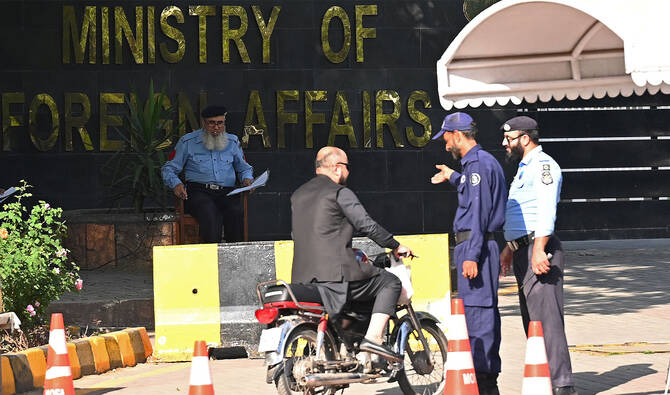
Pakistan slams India’s Indus treaty suspension ahead of National Security Committee huddle today
Short Url
https://arab.news/crwek
Pakistan slams India’s Indus treaty suspension ahead of National Security Committee huddle today
- India announced the move a day after 26 tourists were killed in a deadly attack in Kashmir this week
- Pakistan calls it ‘an act of water warfare’ and plans a formal response through a top security huddle
Latest updates





Recommended


© 2026 SAUDI RESEARCH & PUBLISHING COMPANY, All Rights Reserved And subject to Terms of Use Agreement.