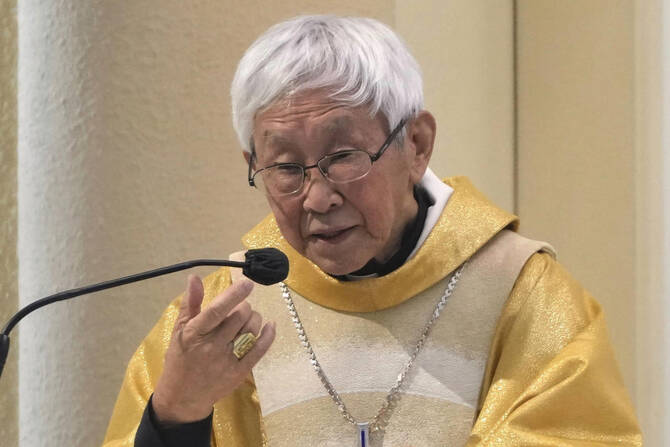
HONG KONG: Hong Kong’s outspoken Roman Catholic Cardinal Joseph Zen was allowed to leave the southern Chinese city to attend Pope Francis’ funeral in Vatican City.
Zen, a 93-year-old retired bishop, left Hong Kong on Wednesday night after applying at a court to get back his passport, his secretary said in a text message on Thursday. Authorities confiscated his passport after his controversial arrest under a Beijing-imposed national security law in 2022.
Zen is among the critics in recent years who have said the Vatican’s agreement with Chinese authorities on the appointment of bishops betrays pro-Vatican Chinese Catholics. He has also criticized Secretary of State Pietro Parolin, the official charged with negotiations with Beijing, as a “man of little faith.”
Parolin is considered one of the main contenders to be the next pope, given his prominence in the Catholic hierarchy.
On Tuesday, media reports said Zen had issued a critique of the Vatican, questioning why pre-conclave meetings started as early as Tuesday. The AP could not independently verify the reports, but Zen reposted the reporters’ posts about his statement on his X account.
His secretary said Zen would return to Hong Kong after the late pope’s funeral, which is scheduled for Saturday. But she was unsure about his exact return date.
It was not the first time Zen had to go through the city’s court to leave Hong Kong. In 2023, he went through similar procedures to pay his respects to the late Pope Emeritus Benedict XVI. He met Pope Francis in a private audience during that trip.
Zen was first arrested in 2022 on suspicion of colluding with foreign forces under the security law. His arrest sent shockwaves through the Catholic community at that time.
While Zen has not yet faced national security-related charges, he and five others were fined in 2022 after being found guilty of failing to register a now-defunct fund that aimed to help people arrested in widespread 2019 pro-democracy protests in Hong Kong. A hearing on his appeal against the conviction is scheduled for December.
Separately, Hong Kong cardinal Stephen Chow will travel to the Vatican for the conclave, the city’s Catholic Social Communications Office said Thursday.
In 2023, a Beijing bishop who was installed by China’s state-controlled Catholic church as an archbishop visited Hong Kong at the invitation of Chow. It was the first-ever official visit by a Beijing bishop to the city. Experts at that time said Chow’s invitation was a symbolic gesture that could strengthen the fragile ties between China and the Vatican.
Beijing and the Vatican severed diplomatic ties following the Chinese Communist Party’s rise to power and the expulsion of foreign priests. Since the break in ties, Catholics in China have been divided between those who belong to an official, state-sanctioned church and those in an underground church loyal to the pope. The Vatican recognizes members of both as Catholics but claims the exclusive right to choose bishops.

Hong Kong allows outspoken Cardinal Joseph Zen to attend Pope Francis’ funeral
https://arab.news/bbuu5
Hong Kong allows outspoken Cardinal Joseph Zen to attend Pope Francis’ funeral
- Zen have said the Vatican’s agreement with Chinese authorities on the appointment of bishops betrays pro-Vatican Chinese Catholics
- He has also criticized Secretary of State Pietro Parolin, the official charged with negotiations with Beijing, as a ‘man of little faith’
Rohingya refugees hope new leaders can pave a path home
- Some 1.7 million Rohingya Muslims displaced in Myanmar's military crackdown live in squalid camps in Cox’s Bazar, Bangladesh
COX’S BAZAR, Bangladesh: Rohingya refugees living in squalid camps in Bangladesh have elected a leadership council, hoping it can improve conditions and revive efforts to secure their return home to Myanmar.
Spread over 8,000 acres in Cox’s Bazar in Bangladesh, the camps are home to 1.7 million members of the stateless group, many of whom fled a 2017 military crackdown that is now subject to a genocide probe at the UN court.
In July, the refugees held their first elections since their influx began eight years ago, resulting in the formation of the United Council of Rohang (UCR).
“They are working to take us home,” said Khairul Islam, 37, who back home had a thriving timber business.
The new council has brought him a glimmer of hope amid an uncertain future.
“We can hardly breathe in these cramped camp rooms... all our family members live in a single room,” he said.
“It’s unbearably hot inside. Back in Myanmar, we didn’t even need a ceiling fan. In summer, we used to sit under tall trees,” Islam said, his eyes welling up.
More than 3,000 voters from across 33 refugee camps cast their ballots to elect an executive committee and five rotating presidents to focus on human rights, education and health.
Addressing a gathering at one of the camps, UCR president Mohammad Sayed Ullah urged refugees not to forget the violence that forced the mostly Muslim group to flee Myanmar’s Rakhine state.
“Never forget that we left our parents’ graves behind. Our women died on the way here. They were tortured and killed... and some drowned at sea,” said Sayed Ullah, dressed in a white full-sleeved shirt and lungi.
“We must prepare ourselves to return home,” he said, prompting members of the audience to nod in agreement.
A seat at the table
“UCR wants to emerge as the voice of the Rohingyas on the negotiation table,” Sayed Ullah later told AFP.
“It’s about us, yet we were nowhere as stakeholders.”
The council is not the first attempt to organize Rohingya refugees.
Several groups emerged after 2017, including the Arakan Rohingya Society for Peace and Human Rights, once led by prominent activist Mohib Ullah.
But he was murdered in 2021.
And even before that, many organizations were shut down after a major 2019 rally, when the Rohingya said they would go home only with full rights and safety guarantees.
“Some newspapers misrepresented us, claiming we wanted to stay permanently in Bangladesh,” Sayed Ullah said.
“Many organizers were detained. The hardest blow was the assassination of Mohib Ullah.”
But trust is slowly building up again among the Rohingya crammed in the camps in Cox’s Bazar.
“Of course we will return home,” said 18-year-old Mosharraf, who fled the town of Buthidaung with his family.
“UCR will negotiate for better education. If we are better educated, we can build global consensus for our return,” he told AFP.
Security threats
Many refugees have started approaching the body with complaints against local Rohingya leaders, reflecting a slow but noticeable shift in attitudes.
On a recent sunny morning, an AFP reporter saw more than a dozen Rohingya waiting outside the UCR office with complaints.
Some said they were tortured while others reported losing small amounts of gold they had carried while fleeing their homes.
Analysts say it remains unclear whether the new council can genuinely represent the Rohingya or if it ultimately serves the interests of Bangladeshi authorities.
“The UCR ‘elections’ appear to have been closely controlled by the authorities,” said Thomas Kean, senior consultant at the International Crisis Group.
Security threats also loom large, undermining efforts to forge political dialogue.
Armed groups like the Arakan Rohingya Salvation Army and Rohingya Solidarity Organization continue to operate in the camps.
A report by campaign group Fortify Rights said at least 65 Rohingyas were killed in 2024.
“Violence and killings in the Rohingya camps need to stop, and those responsible must be held to account,” the report quoted activist John Quinley as saying.


