

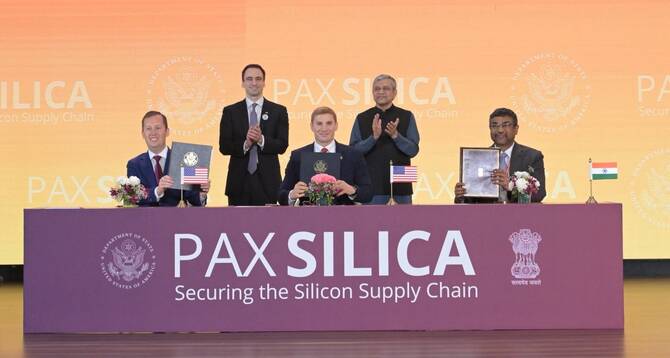

NEW DELHI: India joined a US-led initiative on Friday which will strengthen technology and supply chain cooperation and further boost the development of artificial intelligence infrastructure, making New Delhi the latest member alongside countries including Japan, South Korea, Qatar and the UAE.
The US Department of State launched the Pax Silica Declaration in December, with the aim of securing the global supply chain for silicon-based technologies that are crucial for AI infrastructure and deepen partnerships on artificial intelligence.
India, represented by S. Krishnan, secretary at the Ministry of Electronics and Information, signed the declaration on the sidelines of the AI Impact Summit in New Delhi.
“The signing at the India AI Impact Summit underscored a clear message: The future of artificial intelligence and advanced technologies will not be left to chance. It will be built deliberately, by nations committed to freedom, partnership, and long-term resilience,” the ministry said in a statement.
India’s entry into Pax Silica was both “strategic and essential,” said US Ambassador to India Sergio Gor.
“Pax Silica is the coalition that will define the 21st century economic and technological order,” he said during the signing ceremony.
“It is designed to secure the entire silicon stack, from the mines where we extract critical minerals, to the fabs where we manufacture chips, to the data centers where we deploy frontier AI.”
In 2024, the Indian government launched the IndiaAI Mission, an initiative worth in excess of $1 billion to develop the AI ecosystem in the country.
This week saw it host the five-day India AI Impact Summit 2026, which saw participation from more than 60 countries and the attendance of 20 heads of state, including French President Emmanuel Macron, Finnish Prime Minister Petteri Orpo, and Sheikh Khaled bin Mohamed bin Zayed Al-Nahyan, Abu Dhabi’s crown prince.
Joining Pax Silica gives India a “seat at the table in shaping the global AI order, better access to semiconductors and critical minerals it currently lacks, legitimacy as a trusted technology partner, and deeper economic-security cooperation with the US,” Subimal Bhattacharjee, a policy advisor in cyber security and high-end technology, told Arab News.
The writer of “The Digital Decades,” a book chronicling India’s digital transformation since the early 1990s, said that the South Asian nation brings several assets to the alliance, including a massive pool of AI and software talent, a large domestic data market and a growing manufacturing capacity.
As such, by hosting the first global AI summit in the Global South this week, Delhi is underlining “its ambition to be not just a consumer but a rule setter” for AI governance, he added.
With Pax Silica aiming to become “a technology alliance for the AI age” that encompasses critical minerals and energy to chips, compute, AI infrastructure and digital networks, it serves as a potential platform to establish “coordinated action among trusted partners,” said Pranay Kotasthane, deputy director at the Takshashila Institution.
Indians already make up around 20 percent of the world’s chip design talent, with around 30,000 engineers designing about 3,000 chips annually, he added.
“Indian firms are positioned to be the global deployment engine for enterprise AI,” Kotasthane told Arab News.
“Pax Silica membership could help them get preferential access to the trusted ecosystem of compute, models and markets. India was always going to capture value from this stack. Membership ensures it also captures influence.”


