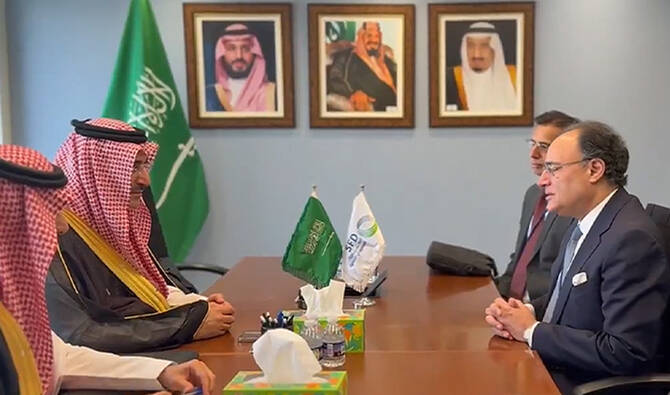
KARACHI: Pakistan’s Finance Minister Muhammad Aurangzeb on Tuesday requested expedited disbursements under the Saudi Oil Facility in a meeting with Sultan bin Abdulrahman Al-Murshid, the top official at the Saudi Fund for Development (SFD), on the sidelines of the IMF-World Bank Spring Meetings in Washington.
The facility, agreed earlier this year, enables Pakistan to defer up to $1.2 billion in oil import payments, offering critical support to its foreign reserves amid a fragile economic recovery.
The SFD, a state-owned Saudi institution, provides concessional loans and grants to developing countries and has been a long-time financier of infrastructure and energy projects in Pakistan.
“The Minister requested expedited disbursements under the Saudi Oil Facility and assured the provision of evidence of oil shipments,” the finance ministry said in a statement issued Wednesday.
Aurangzeb noted that Pakistan’s macroeconomic outlook had improved, pointing to Moody’s recent upgrade of the country’s credit rating to B- with a stable outlook.
Pakistan and Saudi Arabia signed 27 memorandums of understanding (MoUs) worth $2.2 billion in early October 2024 during the Saudi investment minister’s visit to Islamabad.
The number and value of these deals increased later that month during Prime Minister Shehbaz Sharif’s visit to Riyadh, reaching 34 MoUs with a total projected investment of $2.8 billion.
By December, seven of these had been converted into agreements valued at $560 million, with several already under implementation at both the government-to-government (G2G) and business-to-business (B2B) levels.
During his meeting with the top SFD official, the Pakistani finance chief recalled his participation in the Al-Ula Conference on Emerging Markets held in Saudi Arabia in February, where he met with senior Saudi officials, including the kingdom’s finance minister, to expand economic cooperation.
During their conversation, Aurangzeb reviewed the SFD’s ongoing development portfolio in Pakistan and expressed satisfaction with the pace of implementation.
He also sought the SFD’s financial support for the National Highway N-25 infrastructure project.


![]()

Pakistan’s finance minister seeks faster disbursements under Saudi oil facility in talks with SFD chief
Short Url
https://arab.news/rjef7
Pakistan’s finance minister seeks faster disbursements under Saudi oil facility in talks with SFD chief
- Muhammad Aurangzeb calls for SFD’s support for the National Highway infrastructure project
- He says Pakistan’s macroeconomic outlook has improved, with its credit rating hitting B-minus


Latest updates






© 2026 SAUDI RESEARCH & PUBLISHING COMPANY, All Rights Reserved And subject to Terms of Use Agreement.