



ISLAMABAD: Finance Minister Muhammad Aurangzeb has reassured the International Monetary Fund (IMF) that his country would stay the reform course under its $7 billion bailout program, the Pakistani finance ministry said on Tuesday, on the opening day of the IMF-World Bank spring meetings.
Aurangzeb is currently on a visit to Washington, United States to attend the 2025 spring meetings of the IMF and the World Bank Group, where he has held a series of high-level engagements on the sidelines.
In his meeting with IMF Managing Director Kristalina Georgieva, Aurangzeb thanked the IMF team for a staff-level agreement on the first review of Pakistan’s $7 billion program and a new arrangement under the Resilience and Sustainability Facility (RSF).
Pakistan secured the $7 billion program in Sept. last year as it moved to consolidate its economy since averting a default in 2023. Islamabad has since undertaken several reforms to reduce public debt, maintain low inflation, improve energy sector viability, and to accelerate growth.
“He reiterated the Government of Pakistan’s commitment to maintaining the reform momentum and extended an invitation from the Prime Minister of Pakistan for Ms. Georgieva to visit the country,” the Pakistani finance ministry said.
Georgieva said Pakistan had made “great progress” in restoring macroeconomic stability despite global challenges.
“We continue to work with the authorities on their reform agenda for the benefit of Pakistan’s people,” she said on X, following her meeting with the Pakistani finance minister and central bank governor.

IMF Managing Director Kristalina Georgieva (left) Governor of the State Bank of Pakistan, Jameel Ahmad, during the 2025 Spring Meetings of the World Bank Group and the International Monetary Fund in Washington DC, US, on April 21, 2025. (@KGeorgieva/X)
The finance minister held a meeting with World Bank Group President Ajay Banga and commended its leadership in developing a transformative Country Partnership Framework (CPF) — a decade-long strategic roadmap centered around measurable impacts and outcomes.
“He appreciated the World Bank’s ongoing assistance in crafting a comprehensive implementation strategy and action plan to operationalize the CPF while simultaneously enhancing overall efficiency,” Aurangzeb’s ministry said.
“The Minister also provided a detailed overview of Pakistan’s macroeconomic turnaround and reaffirmed the government’s unwavering commitment to ensuring sustainable economic stability.”
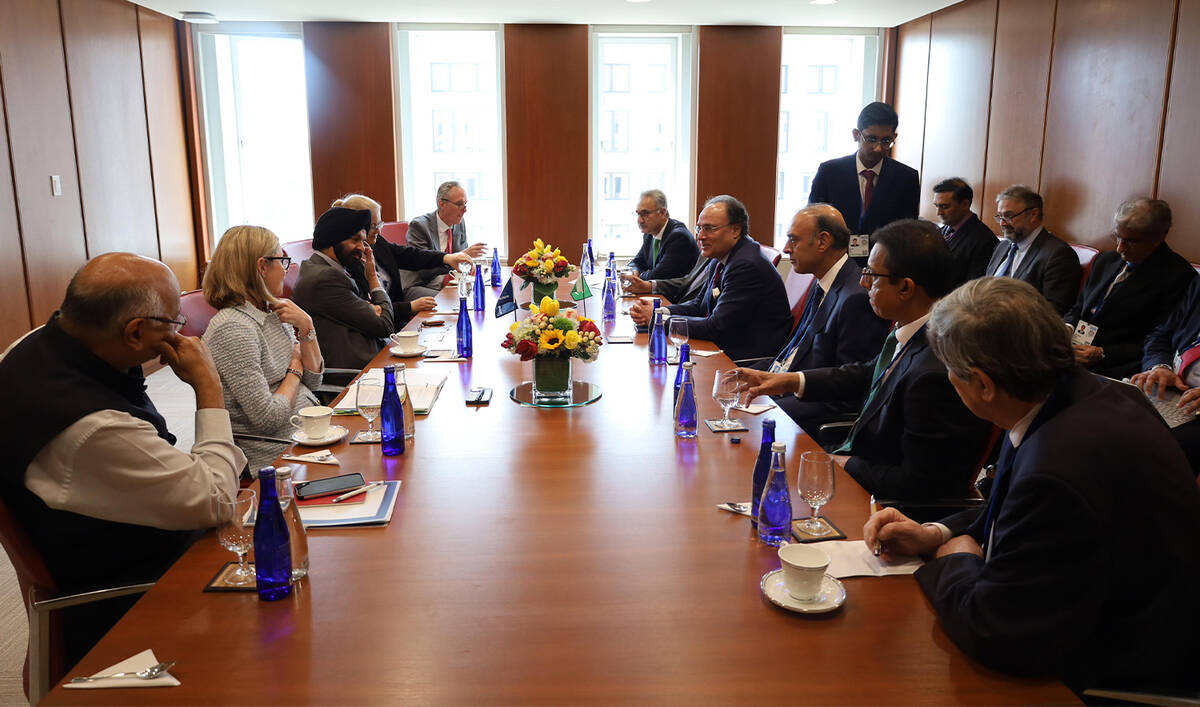
Pakistan's Finance Minister Muhammad Aurangzeb (fourth right) holds meeting with officials of The World Bank Group in Washington DC, US, on April 21, 2025. (Finance Ministry)
In his meetings with Deloitte and the International Finance Corporation (IFC) officials, Aurangzeb discussed cooperation in multiple areas like energy and private sector reforms and critical minerals.
“The Finance Minister met with the Deloitte delegation and apprised them of Pakistan’s macroeconomic outlook, the government’s sectoral development agenda, and its export-led growth priorities. Both sides explored potential collaboration in energy sector reforms, critical minerals extraction and marketing, privatization, technology, crypto policy, and the operationalization of the Country Partnership Framework (CPF),” the Pakistani finance ministry said.
“He reviewed progress on Diversified Payment Rights (DPR) and commended the IFC’s pivotal role in securing USD 2.5 billion in debt financing for the Reko Diq Copper and Gold Mine Project in Balochistan. The Minister emphasized the importance of ensuring that local communities benefit from the project’s economic gains.”
Earlier in the day, the finance minister attended a luncheon hosted by the US-Pakistan Business Council at the US Chamber of Commerce, where he engaged with corporate leaders and detailed Pakistan’s economic progress and reform measures in taxation, energy, and privatization. He emphasized the importance of regional trade, market diversification, and sectoral expansion, and expressed Pakistan’s commitment to continued collaboration in the mining and minerals sector.
During his visit to Washington, Aurangzeb would also meet with finance ministers and counterpart leaders of China, the United States, United Kingdom, Saudi Arabia and Turkiye and officials of global credit rating agencies, commercial and investment banks.


