

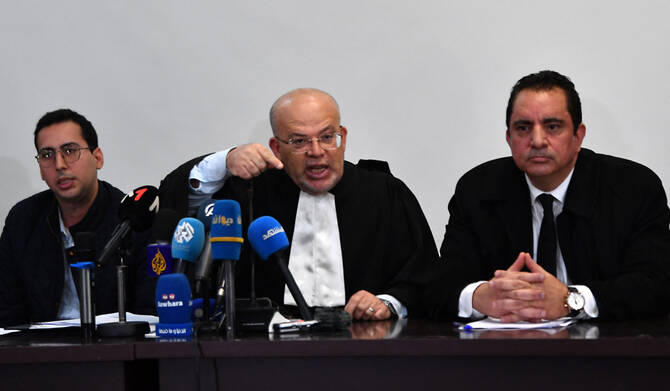

TUNIS: Lawyers and relatives on Monday denounced the hefty sentences handed down to Tunisian opposition figures in last week’s mass trial as “fabricated” and “unfounded,” and said they will appeal.
A court in Tunis in the early hours of Saturday handed down jail terms of up to 66 years to around 40 defendants, including vocal critics of President Kais Saied.
They were accused of “conspiracy against state security” and “belonging to a terrorist group” among other charges, according to their lawyers.
Defense lawyer Samir Dilou said on Monday the trial was “unprecedented in Tunisia” as “it handed the defendants a total of 892 years in prison.”
He said key evidence in the case was still missing, as lawyers had complained that they did not have full access to the case file.
“They still haven’t told us how the defendants conspired against the state,” Dilou told journalists.
He said an appeal could be filed as early as Tuesday.
Among those sentenced were well-known opposition figures, lawyers and business people. Some have already been in prison for two years while others are in exile or still free.
Several were arrested in February 2023, after which Saied labelled them “terrorists.”
Abdennasser Mehri, another defense lawyer, called the trial a “blatant violation of the law.”
“It’s a fabricated, unfounded case with a plan set in advance,” he said. “The scales of justice are broken.”
Dilou said Ahmed Souab, also a defense lawyer, was arrested early Monday after police raided his home.
Local media said he was accused of “threatening to commit terrorist crimes” in a statement made on Saturday after the trial, criticizing political pressure judges were allegedly under.
Online videos showed Souab saying that “knives are not on the necks of detainees, but on the neck of the judge issuing the ruling.”
Souab, a former judge, is expected to remain in detention “for five days and he won’t be allowed to communicate with his lawyers for 48 hours,” Dilou told AFP.
Human Rights Watch said on Saturday the court “did not give even a semblance of a fair trial” to the defendants.
Defense lawyer Dalila Msaddek said the trial was used “to lump together everyone they wanted to get rid of.”
Politicians Issam Chebbi and Jawhar Ben Mbarek of the opposition National Salvation Front coalition, as well as lawyer Ridha BelHajj and activist Chaima Issa, were sentenced to 18 years behind bars.
Activist Khayam Turki was handed a 48-year term and businessman Kamel Eltaief received the harshest penalty — 66 years in prison, according to lawyers.
Some defendants are abroad and were tried in absentia, like French intellectual Bernard Henri-Levy who received a 33-year jail term, lawyers said.
Since Saied launched a power grab in the summer of 2021 and assumed total control, rights advocates and opposition figures have decried a rollback of freedoms in the North African country where the 2011 Arab Spring began.


