

Over 151,000 Pakistani workers went to Gulf countries in first three months of 2025

1 / 3
A worker loads goods onto a dhow along the creek in old Dubai, United Arab Emirates, on November 5, 2018. (REUTERS/File)
2 / 3
3 / 3
Short Url
Updated 23 April 2025
Follow

Over 151,000 Pakistani workers went to Gulf countries in first three months of 2025

  • Ministry of overseas Pakistanis and human resources sent around 172,144 workers abroad in first three months of 2025
  • Saudi Arabia, UAE and other Gulf countries have always remained key destinations for Pakistan’s skilled, unskilled workers

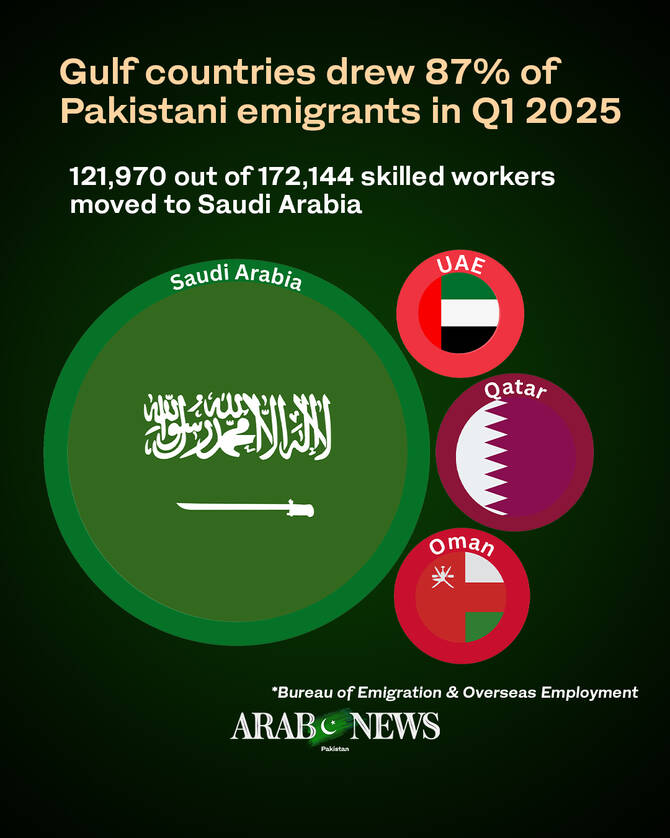
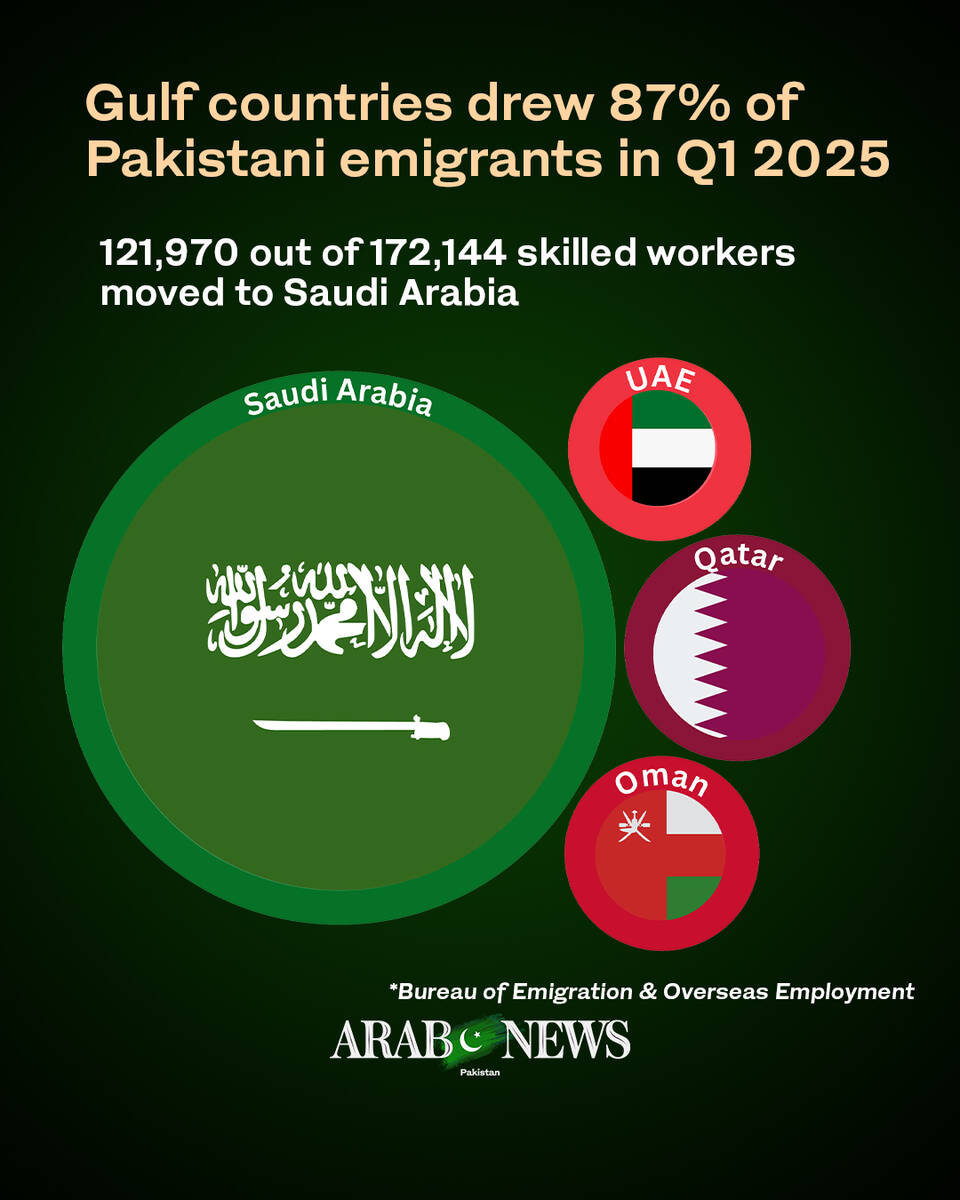
ISLAMABAD: Pakistan sent 151,120 skilled laborers to Gulf countries in the first three months of 2025, state-run media reported on Monday, with Saudi Arabia topping the list of countries where the most number of Pakistani workers went. 

A significant number of Pakistanis seek employment opportunities abroad for a better standard of living as the country grapples with macroeconomic challenges. Saudi Arabia, the United Arab Emirates (UAE) and other Gulf countries are key destinations for Pakistan’s skilled and unskilled workers, whose remittances are vital for the cash-strapped country. 

“The report stated that the highest number of 121,970 Pakistanis went to Saudi Arabia, while 6,891 people went to the UAE, 8,331 to Oman, 12,989 to Qatar and 939 to Bahrain,” the Associated Press of Pakistan (APP) said.

“Bureau of Emigration and Overseas Employment, an attached department of the Ministry of Overseas Pakistanis and Human Resource Development had sent around 172,144 Pakistani workers abroad to different countries in the first three months of this year.”

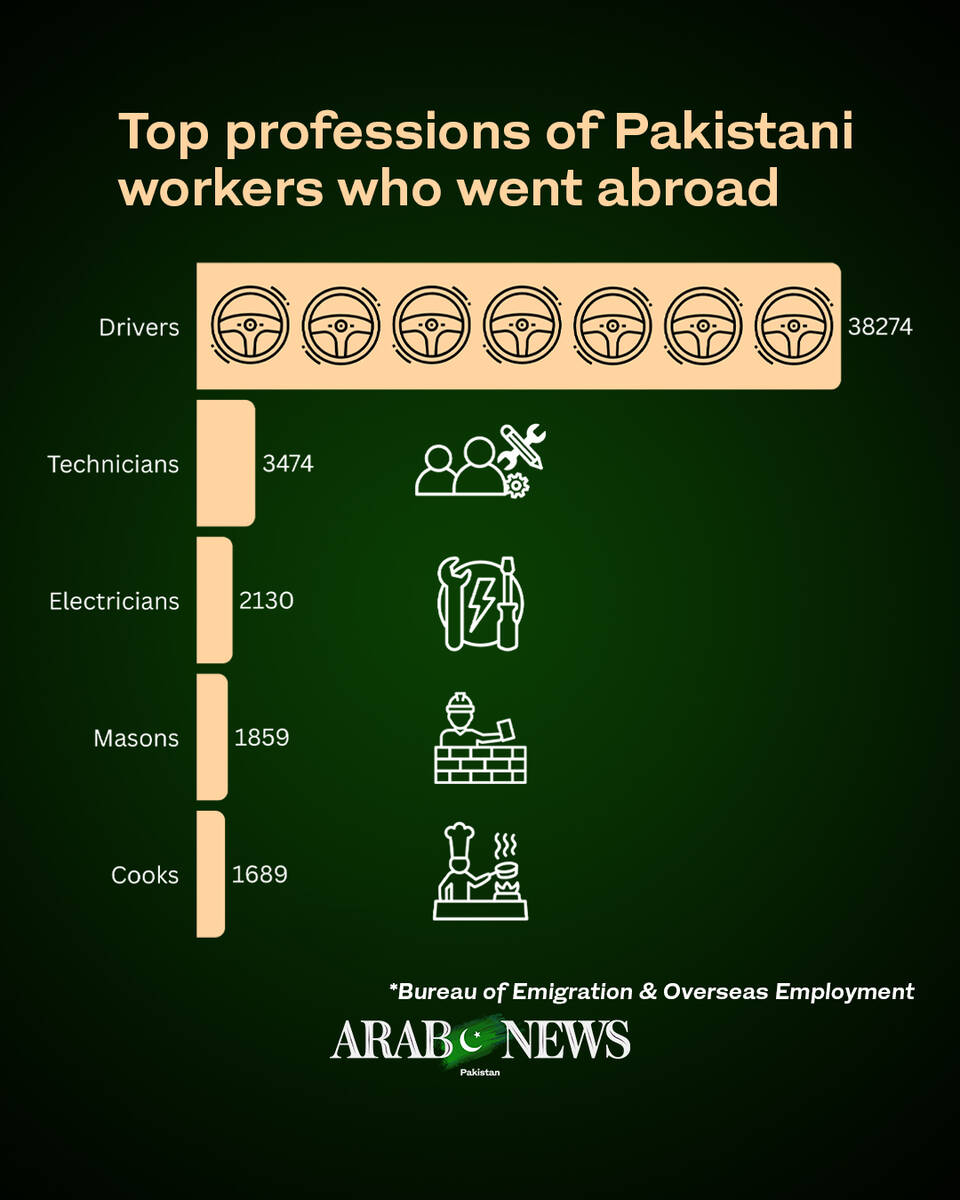
The report said of the Pakistani workers that went abroad, 38,274 were drivers, 3,474 technicians, 2,130 electricians, 1,859 masons, 1,689 cooks, 1,479 engineers, 1,058 welders, 849 doctors, 436 teachers and 390 were nurses.

The report highlighted that 1,454 workers also went to the United Kingdom, 870 to Turkiye, 815 to Greece, 775 to Malaysia, 592 to China, 350 to Azerbaijan, 264 to Germany, 257 to the United States, 109 to Italy and 108 to Japan in the same time period.
In 2024, the Overseas Pakistanis Ministry reported that 727,381 skilled laborers were sent to work in Middle Eastern and European countries. A senior Pakistani official said in February that the government was working to bridge the skills gap and enhance the global competitiveness of Pakistani workers, particularly in the Middle Eastern job market.

In January, Minister for Overseas Pakistanis and Human Resource Development Chaudhry Salik Hussain said Islamabad was focused on increasing the number of skilled workers heading to Saudi Arabia, highlighting the importance of an innovative project management and a well-trained labor force.

Pakistan sends approximately one million skilled workers abroad each year to help reduce unemployment and boost foreign exchange reserves through remittances.

Pakistan also received a record-high $4.1 billion in remittances in March 2025, a positive sign for the government’s efforts to revive an economy it expects to grow by three percent this year, with Saudi Arabia once again leading as the top contributor.


Pakistan issues over $7 billion sukuk in 2025, nears 20 percent Shariah-compliant debt target

Updated 29 December 2025
Follow

Pakistan issues over $7 billion sukuk in 2025, nears 20 percent Shariah-compliant debt target

  • Finance Adviser Khurram Schehzad says this was the highest-ever Sukuk issuance in a single calendar year since 2008
  • Pakistan’s Federal Shariat Court ordered in 2022 the entire banking system to transition to Islamic principles by 2027

ISLAMABAD: Pakistan’s Finance Adviser Khurram Schehzad on Monday said the country achieved a landmark breakthrough in Islamic finance by issuing over Rs2 trillion ($7 billion) sukuk this year, bringing it closer to its 20 percent Shariah-compliant debt target by Fiscal Year 2027-28.

A sukuk is an Islamic financial certificate, similar to a bond, but it complies with Shariah law, which forbids interest. Pakistan’s Federal Shariat Court (FSC) had directed the government in April 2022 to eliminate interest and align the country’s entire banking system with Islamic principles by 2027.

Following the ruling, the government and the State Bank of Pakistan (SBP) have undertaken a series of measures, including legal reforms and the issuance of sukuk to replace interest-based treasury bills and investment bonds.

“In 2025, the Ministry of Finance (MoF) through its Debt Management Office, together with its Joint Financial Advisers (JFAs), successfully issued over PKR 2 trillion in Sukuk,” Schehzad said on X, describing it as “the highest-ever Sukuk issuance in a single calendar year since 2008 by Pakistan.”

Pakistan made a total of 61 issuances across one-, three-, five- and 10-year tenors, according to the finance adviser. The country also successfully launched its first Green Sukuk, a Shariah-compliant bond designed to fund environment-friendly projects.

He said the Green Sukuk was 5.4 times oversubscribed, indicating investor demand was more than five times higher than the amount the government planned to raise, which showed strong market confidence.

“The rising share of Islamic instruments in the government’s domestic securities portfolio (domestic debt) underscores strong momentum, growing from 12.6 percent in June 2025 to around 14.5 percent by December 2025, clearly positioning the MoF to achieve its 20 percent Shariah-compliant debt target by FY28,” Schehzad said.

“This milestone also reflects the structural deepening of Pakistan’s Islamic capital market, sustained investor confidence, and the strengthening of sovereign debt management.”

He said Pakistan was strengthening its government securities market by making it more resilient, diversified, and future-ready, supported by a stabilizing macroeconomic environment, a disciplined debt strategy, and a clear roadmap for Islamic finance.