

Saudi Arabia top contributor as Pakistan worker remittances grow 47.6 percent year-on-year

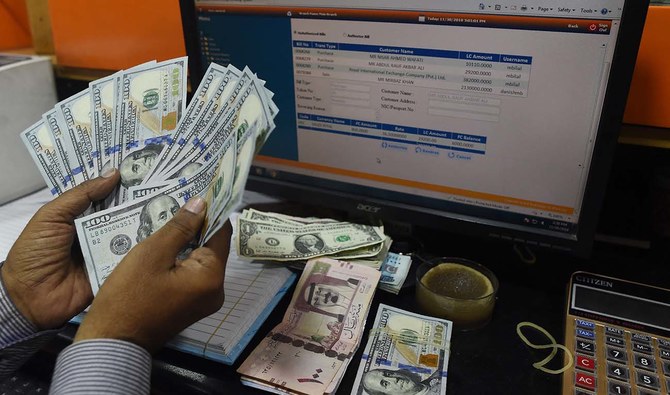
A Pakistani dealer counts US dollars at a currency exchange shop in Karachi on November 30, 2018. (AFP/File)
Short Url
Updated 11 August 2024
Follow

Saudi Arabia top contributor as Pakistan worker remittances grow 47.6 percent year-on-year

  • Remittances from Saudi Arabia and United Arab Emirates were clocked in at $761.1 million and $611.1 million, respectively 
  • Remittances bolster Pakistan’s foreign exchange reserves, stabilize balance of payments and support national currency

ISLAMABAD: Overseas workers’ remittances to Pakistan increased by 47.6 percent on a year-on-year basis in July 2024, the State Bank of Pakistan reported this week, with Saudi Arabia remaining the top contributor for the South Asian country. 

Remittances bring billions of dollars annually from overseas Pakistanis and are vital to Pakistan’s economy. These inflows bolster foreign exchange reserves, stabilize the balance of payments, and support the Pakistani currency. 

“In terms of growth, during July 2024, remittances increased by 47.6 percent on y/y basis,” the SBP said in a press release on Saturday. 

The central bank disclosed that Saudi Arabia remained the top contributor with $761.1 million in remittances during July 2024, followed by the United Arab Emirates (UAE) from where remittances amounting to $611.1 million were received. 

Workers’ remittances amounting to $443.5 million from the UK were received while from the United States, Pakistan received workers’ remittances of $300.1 million. 

Pakistan and Saudi Arabia have deep cultural, defense and economic ties. The kingdom is home to over two million Pakistanis and for years has remained the largest contributor to remittance inflows.

Remittances play a major role in supporting Pakistan’s external account, especially at a time when the country is recording small gains after a prolonged economic crisis that diminished its foreign exchange reserves and weakened its national currency. 


Pakistan increases Reko Diq investment to $244 million as Barrick reviews project

Updated 19 February 2026
Follow

Pakistan increases Reko Diq investment to $244 million as Barrick reviews project

  • State-owned PPL injects $50.2 million more in special purpose vehicle formed to manage Islamabad’s 25 percent stake in copper-gold mine
  • Canadian operator Barrick Mining Corporation this month ordered project’s review following deadly separatist attacks in Balochistan province

KARACHI: The state-run Pakistan Petroleum Limited (PPL) has invested an additional Rs14 billion ($50.2 million) equity in the multi-billion-dollar Reko Diq copper-gold mine, the company said in its latest financial report on Thursday, as the project’s Canadian operator reviews the project following recently deadly attacks. 

Canada’s Barrick Mining Corporation owns a 50 percent share in Reko Diq in the southwestern Balochistan province, along with three Pakistani federal state-owned enterprises including PPL that own 25 percent, while the Balochistan government has the remaining 25 percent share in the project.

The Canadian company announced earlier this month it planned to “immediately” begin a comprehensive review of all aspects of the Reko Diq project following coordinated attacks in Balochistan on Jan. 30-31 that killed 36 civilians and 22 security forces personnel. 

“With respect to the Reko Diq project, the company has made further equity investment in Pakistan Minerals Private Limited (PMPL) during the period amounting to Rs14,025 million ($50.2m),” PPL told its shareholders in its financial statement for the half year ending at Dec. 31.

The additional equity has increased PPL’s total cost of investment in the PMPL to Rs68.1 billion ($243.6 million), it added. 

The PMPL is a special purpose vehicle formed to manage the federal government’s 25 percent stake in the Reko Diq project. It is a consortium of three state-owned enterprises (SOEs) namely the PPL, the Oil & Gas Development Company Limited (OGDCL) and Government Holdings (Private) Limited (GHPL) which is responsible for handling financing, equity contributions and strategic, legal or technical dealings with partners like Barrick.

“The project continued to advance site works during the period (July-December FY26),” the PPL said. “The operator (Barrick) is undertaking a review of all aspects of the project, including with respect to the project’s security arrangements, development timetable and capital budget.” 

This week, Balochistan Chief Minister Sarfraz Bugti assured investors that Pakistan has the “capacity and capability” to secure the Reko Diq project amid surging militancy. 

The PPL explores, drills, and produces oil and natural gas. Its current portfolio, together with its subsidiaries and associates, consists of 47 exploratory blocks that include one offshore Block-5 in Abu Dhabi and one onshore block in Yemen.

In December, PPL signed a strategic Deed of Assignment under which it assigned 25 percent of its participating interest (PI) and operatorship of Eastern Offshore Indus C block to Turkish Petroleum Overseas Company, a unit of state-owned Türkiye Petrolleri Anonim Ortaklığı.

Assigning 20 percent PI each to OGDCL and Mari Energies Limited, the company has retained the remaining 35 percent PI to play a key role in the block’s development.