

Pakistan says 979,486 Afghan nationals deported since 2023 as expulsion drive continues

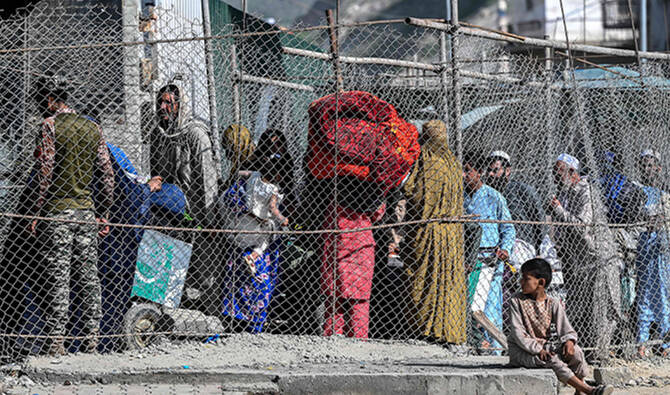
Afghans walk through a fenced corridor after arriving from Pakistan near the zero point at the Torkham International Border Crossing between Afghanistan and Pakistan, in Nangarhar province, Afghanistan, on April 20, 2025. (AFP)
Short Url
Updated 21 April 2025
Follow

Pakistan says 979,486 Afghan nationals deported since 2023 as expulsion drive continues

  • State media says 3,387 “illegal Afghan nationals” were sent back to their homeland from Pakistan on Sunday
  • Pakistan has established a 24/7 control room to assist Afghan nationals, address harassment complaints

ISLAMABAD: Pakistan has deported 979,486 Afghan nationals since the government launched an expulsion drive against illegal foreigners in 2023, state-run media reported on Monday, reiterating that authorities are ensuring their return takes place in a “dignified” manner. 

Islamabad launched the deportation campaign in November 2023, asking all foreigners without legal documentation to leave the country. Earlier this year, it launched the second phase of deportations, setting a deadline of Mar. 31 for people with Afghan Citizen Cards (ACCs) — which since 2017 have granted temporary legal status to Afghans — to leave the country or face being deported.

According to United Nations data, Pakistan has hosted more than 2.8 million Afghan nationals who crossed the border in a desperate attempt to escape decades of war and instability in their home country. Around 1.3 million are formally registered as refugees and hold Proof of Registration (PoR) cards, which grant them legal protection. Another 800,000 Afghans possess ACCs, a separate identity document issued by the Pakistani government that recognizes them as Afghan nationals without conferring refugee status.

“The total number of illegal Afghan nationals leaving Pakistan has reached 979,486,” Radio Pakistan said in a report. “Three thousand, three hundred and eighty-seven illegal Afghan nationals were sent back to their homeland yesterday [Sunday].”

Pakistan established a 24/7 federal control room on Sunday to assist Afghan nationals and respond to harassment complaints during their repatriation. The decision came a day after Deputy Prime Minister and Foreign Minister Ishaq Dar visited Kabul to discuss with the Afghan Taliban the issues linked to the mass return of Afghan nationals. 

Last week during his visit to Pakistan, Afghan refugees minister proposed the formation of a high-level committee comprising officials from Pakistan, Afghanistan and relevant international organizations to address “refugee-related issues in a coordinated manner.”

Afghanistan has called for the peaceful and coordinated repatriation of its citizens amid reports of arrests and harassment during Pakistan’s mass expulsion drive. Islamabad denies the accusations and has urged Kabul to facilitate the reintegration of its citizens.

Pakistan’s deportation policy in 2023 followed a rise in militant attacks, particularly in the northwestern Khyber Pakhtunkhwa province that borders Afghanistan. Islamabad has in the past blamed militant attacks and other crimes on Afghan citizens, who form the largest portion of migrants in the country.

The government says militants, especially from the Pakistani Taliban also known as the Tehreek-e-Taliban Pakistan (TTP), are using safe havens in Afghanistan and links with Afghans residing in Pakistan to launch cross-border attacks. The ruling administration in Kabul has rejected the accusations.


Pakistan alleges India behind Balochistan attacks that killed 18 civilians, 15 troops

Updated 6 sec ago
Follow

Pakistan alleges India behind Balochistan attacks that killed 18 civilians, 15 troops

  • Interior Minister Mohsin Naqvi accuses India of planning coordinated attacks across Balochistan this week 
  • Military says it killed 133 militants on Friday and Saturday in separate operations across various areas in Balochistan

ISLAMABAD: Pakistan’s Interior Minister Mohsin Naqvi this week alleged that India was behind the recent coordinated attacks in the southwestern Balochistan province that the military says killed 18 civilians and 15 troops, vowing to go after those responsible for the violence. 

Pakistan’s military said on Saturday that it had killed 133 militants in the past two days in separate operations in Balochistan. The Inter-Services Public Relations (ISPR) said 41 militants were killed in operations in Panjgur and Harnai areas on Friday while 92 militants, including three suicide bombers, were killed on Saturday as security forces repelled coordinated attacks on civilians and law enforcement personnel in Quetta, Gwadar, Mastung, Nushki, Dalbandin, Kharan, Panjgur, Tump and Pasni areas. 

It added that 18 civilians, including women, children, elderly people and laborers, were killed in the attacks in Gwadar and Kharan, while 15 security personnel were also killed during clearance operations and armed standoffs.

“India is behind these attacks,” Naqvi said during a joint press conference in Quetta late Saturday night with Balochistan Chief Minister Sarfraz Bugti. “I can tell you for sure that India planned these attacks along with these terrorists.”

He vowed that Islamabad would go after the militants who carried out these attacks and their “masters.”

“At this time it is very necessary that the world knows that the main country that is behind terrorism is India, who not only financially supports terrorists but also supports them in their planning and strategy as well,” the minister said. 

In its statement on Saturday, the ISPR said the attacks were launched by “Indian sponsored Fitna al Hindustan,” a reference the military frequently uses for the separatist Balochistan Liberation Army (BLA) militant group. 

The BLA also issued a statement on Saturday, saying it had launched what it called “Operation Herof 2.0,” claiming responsibility for attacks in multiple locations across Balochistan. 

The military had said intelligence reports have confirmed the attacks were orchestrated and directed by militant leaders operating from outside Pakistan who were in direct communication with attackers during the assaults.

Pakistan has frequently blamed India for supporting militant attacks in Balochistan and its northwestern Khyber Pakhtunkhwa (KP) provinces, charges that New Delhi has vehemently denied. 

Balochistan, which borders Iran and Afghanistan, has faced a decades-long insurgency by separatist militant groups, with Pakistani authorities frequently accusing foreign actors of backing the violence. India has repeatedly denied such allegations.