

Unusual ecosystem found deep below Red Sea coral reef

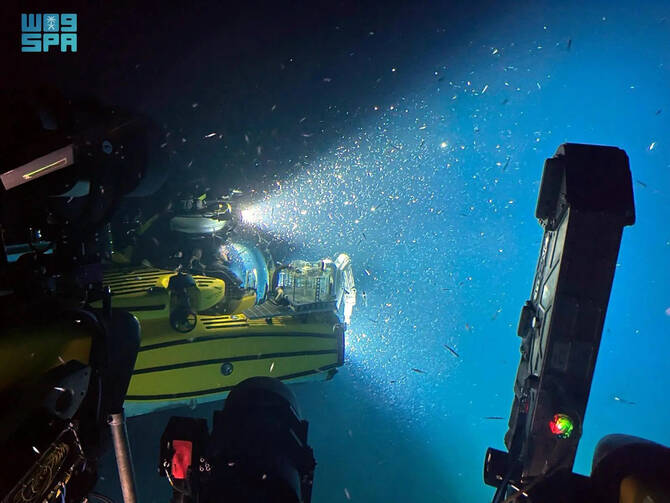
Despite the low oxygen and high acidity of the deep waters of Difat Farasan, corals, fish and other animals were found of be thriving. (KAUST photo)
Short Url
Updated 21 April 2025
Follow

Unusual ecosystem found deep below Red Sea coral reef

  • Study by KAUST and National Center for Wildlife
  • Marine animals thriving in low oxygen, high acidity

RIYADH: Marine scientists have found creatures thriving in deep waters of the Red Sea under seemingly unfavorable conditions of low oxygen levels and high acidity.

The unusual ecosystem was found in Difat Farasan near the border between Saudi Arabia and Yemen.

It was reported in the science journal PNAS Nexus by a team of scientists from the King Abdullah University of Science and Technology and the National Center for Wildlife, KAUST said in a press statement posted on its website.

Also known as the Farasan Bank, Difat Farasan is located below the third-largest coral reef system in the world and biggest in the Red Sea.

Despite the low oxygen and high acidity, corals, fish and other animals were found to be thriving.

“Several of the creatures showed unexpected coping strategies to the extreme environment. Fish swam slower, and corals were healthy in conditions that normally prevent the calcification of their skeletons,” said the statement.

The study explained that calcification was “necessary for coral growth and survival.”

KAUST research scientist Dr. Shannon Klein, who led the study, said: “The ability for these animals to live in warm, oxygen-depleted zones suggests they have an unusual ability to reduce how much oxygen they use to sustain life.

“This discovery highlights the need for greater marine exploration of deeper layers (of) tropical coastal areas, as they may hold unexpected ecosystems.”

The study also noted that while coral reefs usually exist in shallow waters, depressions of more than 200 meters deep were found throughout the Farasan Bank coral reef system. 

“Considering that oxygen depletion in the sea is one consequence of rising temperatures, greater study of how these creatures exist there may help us understand how marine life can withstand the challenges of climate change,” the study stated.

Dr. Mohammad Qurban, CEO of the National Center for Wildlife, said: “This research highlights the significance of the Red Sea as a natural laboratory for studying marine resilience.

“Discovering ecosystems that thrive in extreme conditions expands our understanding of how marine life adapts and reinforces the need for continued exploration and conservation of these unique habitats.”

KAUST Assistant Prof. Froukje van der Zwan, Associate Prof. Francesca Benzoni and KAUST Ibn Sina Distinguished Prof. Carlos Duarte also contributed to the study.


Young photographer highlights Qatif’s natural springs

Updated 8 sec ago
Follow

Young photographer highlights Qatif’s natural springs

RIYADH: Young photographer Redha Al-Hammad is documenting the fading natural springs of Qatif, a landscape shaped by water for thousands of years, before their stories disappear.

His new project, “O Breaker of the Louz,” captures the cultural memory surrounding the springs that once sustained one of the oldest settlements in the Arabian Peninsula.

Alhammad, a 20-year-old visual artist from Qatif and student at the American University of Sharjah, developed the project to preserve his hometown’s identity and share its untold narratives.

Qatif’s springs once fueled its agricultural prosperity, nourished date-palm droves, supported early communities, and served as fathering spaces for trade, social life and storytelling. Today, only one spring — Ayn Al-Labbani — still flows.

With limited written research available, Al-Hammad relied on oral histories from relatives and community elders.

“The good thing about being from a small city is that everyone knows everyone,” he told Arab News. “The stories that we hear … that our parents and our older family members tell us … a lot of the time they can kind of … get drowned out.”

One of his key sources was Abdulrasul Al-Gheryafi, an English teacher and local historian who grew up swimming in the springs and has long studied their disappearance. His firsthand accounts shaped the project and provided the folktale that inspired its title.

Al-Hammad began photographing at Ayn Al-Labbani, where locals still gather. He initially “had no idea” what the work would become until Al-Gheryafi shared the tale of a knight who encountered a mysterious voice while at a spring. The project became centered on the idea that springs are more than water sources; they are magical spaces embedded with communal memory and identity.

Al-Hammad wrote a poem based on the story to accompany the images and express what photography alone could not.

What started out as field notes for his research naturally formed as poetic lines, which luckily earned the seal of approval from poet, friend and collaborator Dalia Mustafa.

“Seeing her develop as a writer as well, that helped me come to terms with what poetry could be within the context of photographic work,” he said.

The project blends documentary photography with lyrical elements, a technique Al-Hammad first explored in “Mahanet” (“Did you not yearn for me?”), created with Mustafa during the Jameel Arts Centre Youth Assembly.

Told through low-contrast, dreamlike images, “Mahanet” maps memories, grief and changing landscapes in Qatif.

“I kind of recreated this experience that I had with my dad whenever I would go back home and he would drive me around,” Al-Hammad said, recounting how his father would explain how a sea once existed where there is now a residential area, or which streets were once fields of palm trees.

His second project, “L3eeb” (“Player”), developed under the Kingdom Photography Award, examines the role of football in transforming overlooked spaces into communal “third spaces” for Saudi youth.

Al-Hammad was mentored by photographer, visual artist and photo book publisher Roi Saade, whose guidance he describes as invaluable: “It fit perfectly, the pairing, because he works in kind of the same realm of narrative-based work. And he was with me every step of the way.

“The Kingdom Photography Award program is very important for people like me who are at the early stages of their artistic journey and have something to say, would definitely benefit from having a platform and … the kind of guidance and mentorship that the professionals around me provided.”

All Al-Hammad’s work centers on his hometown, Qatif. Initially, his photography was personal, helping him reconnect with home after years abroad. Over time, he expanded his focus to share Qatif’s culture and heritage with wider audiences, emphasizing the region has as rich and vibrant a voice as other parts of the Kingdom. 

Al-Hammad and Mustafa plan to turn “Mahanet” into a book next year, continuing their collaboration. 

Citing Saudi Arabia’s rich cultural diversity, Al-Hammad hopes similar opportunities expand to other artistic mediums. Through his work, he seeks to inspire others to document their communities, preserve local heritage and contribute to a broader understanding of the Kingdom’s identity.