

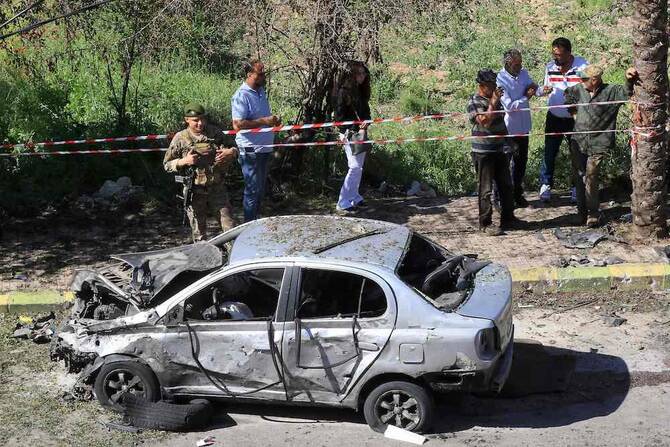

BEIRUT: Five people were killed on the Qsaybeh–Braikeh highway in southern Lebanon on Sunday following an explosion involving ammunition being transported in a military vehicle.
An officer and two soldiers were among those killed in the explosion of the army vehicle loaded with ammunition left over from the recent war in southern Lebanon.
The blast also killed a mother and her child in a nearby car and left several others injured.
The Army Command said it was conducting investigations to determine the circumstances of the incident.
Civil Defense confirmed that five people were killed.
The explosion coincided with Israeli airstrikes targeting the Jal Shihab area, which is situated between the towns of Arnoun, Kfar Tibnit, and Yahmar Al-Shaqif.
These operations were conducted under the pretext of targeting “Hezbollah’s infrastructure and missile launchers.”
The strikes also affected Jabal Al-Rafi’ and the Mleeta hills in the Iqlim Al-Tuffah heights, as well as the Basaliya area on the outskirts of Jbaa.
Additional targets included the areas of Sajd, Al-Luwayzeh, and Jabal Safi in Jabal Al-Rihan in the Jezzine region.
The Israeli army launched a two-missile strike on a prefabricated room in Houla, killing one person.
Another Israeli drone targeted a car with a guided missile in Kawthariyeh Al-Siyad Al-Sharqiya, in the Sidon district, killing Hussein Ali Nasr and wounding two others.
Israeli army spokesman Avichay Adraee claimed that the military eliminated Nasr, who served as “deputy commander of Hezbollah’s Unit 4400 and smuggled weapons and funds into Lebanon to rebuild Hezbollah’s military capabilities.”
Adraee claimed that Nasr had “connections with airport workers who secretly worked for Hezbollah and assisted in smuggling operations.”
He also dealt with arms smugglers on the Syrian-Lebanese border, the army alleged.
Adraee said that the Israeli army targeted “the activities of Unit 4400 and the axes used to transfer combat equipment to Hezbollah, which included targeting and eliminating the unit’s commander, Muhammad Jaafar Qasir, and his deputy, Ali Hassan Gharib.”
Army commander Gen. Rodolphe Heikal briefed President Joseph Aoun and Prime Minister Nawaf Salam on developments in the south and the shelling of targeted villages.
President Aoun, after a private meeting with Maronite Patriarch Bechara Boutros Al-Rai on Easter, affirmed that the Lebanese “do not want war and do not want to hear about it.”
He asserted that the Lebanese Armed Forces “are solely responsible for Lebanon’s sovereignty and independence.”
Aoun’s comments came in response to a question regarding Hezbollah’s recent refusal to disarm.
“We should address this issue calmly and responsibly, as it is vital for maintaining civil peace,” stated the president.
“I will take on this responsibility together with the government,” he added.
“We will implement a state monopoly on bearing arms, but we have to wait for the right circumstances,” he said, adding that “no one is pressuring me regarding timing.”
He emphasized that any controversial domestic issue in Lebanon must be approached through conciliatory, non-confrontational dialogue and communication. “Otherwise, we will drive Lebanon to ruin,” he said.
Also on Sunday, the Lebanese Army Command announced that the Intelligence Directorate had received information about preparations for a new operation to launch missiles toward Israel.
A patrol from the directorate, supported by an army unit, conducted a raid on an apartment in the Sidon-Zahrani area, where they seized several missiles along with the designated launchers. They arrested several people who were involved in the operation, the army said.
Prime Minister Salam praised the “professional work being carried out by the Lebanese army in the south, particularly the Intelligence Directorate.”
The army conducted a preemptive operation that thwarted preparations for a rocket launch from that region and arrested several individuals involved in the operation.
Salam emphasized that “the actions of all security agencies confirm that the government is committed to fulfilling its ministerial statement regarding the extension of its full sovereignty over its territory.”
He said the government alone “is responsible for making decisions about war and peace and is the only entity authorized to possess weapons.”


