

Lebanese leaders criticize Hezbollah’s refusal to disarm

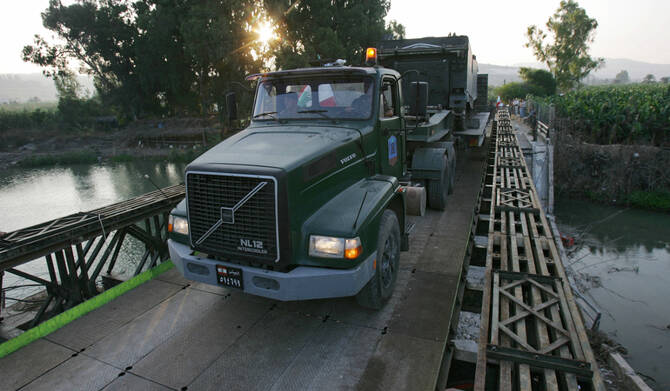
Lebanese Army trailers carrying armored vehicles cross a newly-erected bridge in Qasimiya at the Litani river, about 30 kms north of border with Israel, as Lebanese troops began to move south to take control of the Hezbollah stronghold, 17 August 2006. (AFP file photo)
Short Url
Updated 19 April 2025
Follow

Lebanese leaders criticize Hezbollah’s refusal to disarm

  • ‘Those who use threats must first stop the tragedies,’ says Lebanese Forces leader

BEIRUT: The Lebanese army on Saturday continued to detonate munitions left over from the Israeli war in southern Lebanon, as well as confiscating ordnance in the area south of the Litani River.

Explosions were heard across southern Lebanon, accompanied by reconnaissance flights from Lebanese army Cessna aircraft south of the Litani River.

During the most recent cabinet session, Army Commander Gen. Rudolph Haykal confirmed that it was no longer possible to cross the Litani River from north to south without passing through Lebanese Army checkpoints. The commander also reviewed the seizure and confiscation of equipment, weapons, and ammunition, presenting statistics from more than 5,000 missions.

In a statement earlier this week, President Joseph Aoun announced that weapons would be brought under state control this year. However, campaigns by Hezbollah officials threaten to disrupt the path outlined by President Aoun and Prime Minister Nawaf Salam to achieve this end. On Saturday, several Lebanese politicians came out against Hezbollah’s attempt to retain its weapons.

The Hezbollah leaders have not learned from the lessons of the catastrophe caused by their party.

Ashraf Rifi, MP and former justice minister

“The remaining Hezbollah leaders have not learned from the lessons of the catastrophe caused by their party,” said MP and former Justice Minister Ashraf Rifi, claiming that Hezbollah was being “reckless” and holding on to weapons “in support of Tehran, which is negotiating with the US at the expense of the Lebanese.”

He added: “These people appear to have lost essential wisdom and reasoning skills. Sooner or later, the weapons will be surrendered and dismantled; history does not move backward.”

Rifi’s comments followed a series of statements from Hezbollah in recent days, in which the group rejected the notion of surrendering its weapons to the state. They issued a threat to “cut off the hand” of anyone who tried to disarm them.

Hezbollah Secretary-General Naim Qassem said on Friday: “Remove this issue from your vocabulary, as no one will disarm us.”

He added that an Israeli withdrawal and reconstruction efforts must come before any discussions of a defense strategy.

Iranian Ambassador to Lebanon Mojtaba Amani endorsed Hezbollah’s stance, stating on Saturday that “the disarmament project is a clear plot against countries,” and warning against “falling into Israel’s trap.”

The Iranian diplomat posted on X: “While the US supplies the Israeli regime with the latest weapons and missiles, it simultaneously prevents other countries from strengthening and arming their militaries. Using various pretexts, it pressures them to reduce or destroy their arsenals.”

He added that when countries agree to disarmament demands, they become vulnerable to attacks and occupations, citing Iraq, Libya, and Syria as examples.

Amani stressed that Iran was aware of the dangers posed by “this conspiracy and its threat to regional nations’ security.”

He said: “We warn others not to fall into Israel’s trap, as maintaining deterrence is the first line of defense for sovereignty and independence, and it should not be put at risk.”

Hezbollah’s position has drawn widespread criticism, however. MP Paula Yacoubian characterized it as a strategy to enhance Iran’s negotiation position with the US, and said Lebanon was being used as a bargaining chip.

“Iran, which has poured billions into Hezbollah, now seeks greater returns,” she said. “To preserve the regime, it is time to make concessions, and the party must stop repeating outdated rhetoric while reclaiming its Lebanese identity.”

Former President Michel Suleiman said in a statement: "No to threats of cutting off hands. No to hints of civil war. No to discussions about the army's weaknesses. No to claims regarding the strength of the resistance. No to the idea of keeping weapons in the south, the mountains, the Bekaa, the north, or Beirut in the hands of anyone other than the state.

"Why is this important? Because if the state does not control weapons, then the state and its institutions will not survive.

"Consequently, the economy will not prosper, and we will not restore our friendship with our sister state or the international community."

Lebanese Forces leader Samir Geagea stated that “resorting to threats, especially regarding severing hands, has no place in a democratic state or a country seeking civil peace.”

He urged those using such rhetoric to stop, as their actions have already caused “significant harm and damage to Lebanon and its people,” adding that they should step aside and “allow the new leadership to guide the country out of the tragedy” they have created.

Geagea also urged Hezbollah to focus on “rebuilding an effective state capable of restoring dignity, pride, and a decent life for the Lebanese people, and take the initiative to facilitate reconstruction efforts.”

A political source told Arab News that Hezbollah’s rejection of disarmament, most recently expressed by Naim Qassem, aimed to preserve internal balance and boost morale within the party.

“Meanwhile, the Iranian position indicates that Iran is trying to control Hezbollah. There may also be another explanation: they may be seeking to gain time,” said the source.


How Iran’s massive arsenal of missiles and drones became its last line of defense

Updated 5 sec ago
Follow

How Iran’s massive arsenal of missiles and drones became its last line of defense

  • Ballistic missiles and swarming drones form the backbone of Iran’s retaliation as air defenses falter
  • Analysts say stockpiles remain vast but declining as US and Israeli strikes target launchers and factories

LONDON: When the US and Israel began striking Iran on Feb. 28, Tehran responded swiftly with waves of ballistic missiles and drones aimed at targets in Israel and neighboring Arab states, particularly those hosting US military bases.

For days afterward, despite the loss of senior leaders and significant damage to its military capacity, Iran has continued to launch missiles and swarms of kamikaze drones at multiple regional targets.

After Supreme Leader Ali Khamenei was killed on Feb. 28, Foreign Minister Abbas Araghchi announced that Iran had activated its “Decentralized Mosaic Defense” strategy.

Developed over two decades by the Islamic Revolutionary Guard Corps, or IRGC, the strategy disperses command structures, weapons systems and operational units across vast geographic and organizational lines so that military functions can continue even under intense attack.

Running parallel to the IRGC is the Ministry of Defense and Armed Forces Logistics, or MODAFL, which oversees Iran’s missile and drone industries — themselves built on a decentralized model.

MODAFL manages a network of state-run and quasi-private entities, including the Aerospace Industries Organization, which handles missile research and production, and the Defense Industries Organization, which oversees conventional arms.

The IRGC maintains its own weapons programs, most notably the Shahed Aviation Industries Research Center, which develops drones such as Shahed-131 and Shahed-136.

This dual structure relies on vast networks of subsidiaries, suppliers and front companies that acquire components while circumventing Western sanctions. Supporting them are privately owned, knowledge-based firms.

In November 2023, Iran’s deputy defense minister, Brig. Gen. Mahdi Farahi, said that the ministry worked with around 7,000 enterprises nationwide, about 40 percent of them knowledge-based companies, according to the IRGC-affiliated Tasnim News Agency.

One such firm is Oje Parvaz Mado Nafar, which manufactures and trades unmanned aerial vehicle components. The US Treasury has accused Mado of supplying UAV engines to the IRGC Navy, Iran Aircraft Manufacturing Industries, and Qods Aviation Industries.

These overlapping networks have together helped Iran to amass one of the largest ballistic missile stockpiles in the Middle East, according to the US Office of the Director of National Intelligence.

Iranian officials describe the missile program as the backbone of the nation’s strategic deterrent, particularly as its moribund air force depends on an aging fleet of aircraft.

That capability has now been put to its greatest test yet.

“As we’ve seen during the 12-day war (in June 2025) … Iran’s air defenses are no match for the US and Israeli air power,” Naysan Rafati, a senior Iran analyst at the International Crisis Group, told an online briefing on March 3.

“Its network of non-state allies is not what it was two years ago or even a year ago. And so, the Islamic Republic has turned to its most potent and, to a certain degree, only major retaliatory tool, which is ballistic missiles and drones.

“The logic is basically … go big or lose home. Not even go home, but lose home, or at least the system, and try to expand this conflict horizontally when you can’t match what your adversaries can do in terms of air power and other resources.”

The strikes on US bases across the region, he said, reflect the regime’s “sense that its back is against the wall” and its calculation that the Trump administration will face pressure from regional partners to end hostilities rather than accept a prolonged conflict.

Still, volume does not equal sophistication.

Thomas Juneau, a professor at the University of Ottawa’s Graduate School of Public and International Affairs and an associate fellow at London’s Chatham House, told Arab News: “Iran’s missiles and drones are not particularly advanced technologically.

“That is why the success rate when it comes to Iran with missiles or drones targeting the Gulf states or Israel or American assets in the region is clearly under 10 percent.

“We don’t have a precise number, but it is well below 10 percent because a significant proportion of its missiles and drones miss their targets, fail upon launch, or in most cases are intercepted because the interception capabilities of the UAE, Qatar, Saudi Arabia, and obviously Israel, are far more advanced.”

US Central Command, which oversees American military operations in the Middle East, said that the next phase of the campaign will target the launchers, stockpiles and factories sustaining Iran’s missile attacks.

Satellite imagery analyzed by BBC Verify showed at least 11 Iranian naval vessels destroyed or damaged since late February. Missile bases and nuclear sites have also been struck. The US military claimed on March 3 it had destroyed IRGC command facilities and air defense systems.

Yet the sheer number of drones and missiles Iran has stockpiled remains a factor.

Juneau said that the most important dynamic to watch in the coming days is “the competition between reserves of interceptors on the side of Israel and the Gulf states and the US versus missiles and drones on the Iranian side.”

“That’s why both sides are really trying to manage those reserves, (and) also to affect how the other side manages those reserves,” he said. “That is precisely why the US and Israel have been having as one of their main targets not only launchers but also missile stockpiles.”

The exact size of Iran’s arsenal and how much remains intact is unknown.

Israeli military intelligence estimated Iran had roughly 2,500 ballistic missiles in its inventory, down from a pre-war assessment of about 3,000, the Times of Israel reported on March 1.

Ahead of June’s 12-day war, Israel said that it had identified efforts by Tehran to produce as many as 8,000 ballistic missiles within two years.

In 2022, US Central Command also cited a figure of 3,000 missiles in Iran’s inventory. Separately, Washington assessed Iran was manufacturing about 50 ballistic missiles a month before the June conflict began.

The production of cheaper and less sophisticated long-range kamikaze drones runs significantly higher, although no reliable figures exist.

Several of Iran’s ballistic missile models are capable of reaching Israel with ranges of between 1,300 km and 2,500 km, including the Sejil, Emad, Ghadr, Shahab-3, Khorramshahr, and Hoveyzeh, according to the Washington-based Center for Strategic and International Studies.

Iranian semi-official media reported in April 2025 that nine Iranian missiles could reach Israel, including the Kheibar and Hajj Qasem, and that the hypersonic Sejil can fly at more than 17,000 km per hour.

Whatever the size of its stockpile, analysts say the economics favor Iran.

Shahed drones cost between $20,000 and $50,000 to build, according to Stacie Pettyjohn of the Center for a New American Security, while the interceptors to shoot them down can cost between $3 million and $12 million each, CNBC reported, citing Pentagon budget documents.

“It’s a money game,” Arthur Erickson, chief executive and a co-founder of Hylio, a US-based drone manufacturer, told the New York Times. “The cost ratio per shot, per interception, is at best 10 to one. But it could be more like 60 or 70 to one in terms of cost, in favor of Iran.”

Iran is believed to have mass-produced tens of thousands of its low-cost Shahed UAVs — often referred to as one-way, kamikaze, or suicide drones — before the war.

Behnam Ben Taleblu, senior director of the Iran program at the Foundation for Defense of Democracies, has called the drone model the “poor man’s cruise missile.”

Compared with ballistic missiles, the drones fly low and slow, deliver a modest payload, and are limited to mostly fixed targets, he told CNBC. But the cost advantage may be Iran’s most durable edge as its inventory shrinks.

US Central Command said on March 3 that Iran had fired more than 500 ballistic missiles and in excess of 2,000 drones since the war began. While most were reportedly intercepted, several reached their mark.

Western officials have reported a drop in Iranian attacks in recent days. Top US commander Gen. Dan Caine noted an 86 percent decline in ballistic missile strikes from the first day of fighting, while Central Command cited a further 23 percent reduction.

That slowdown, however, could reflect an attempt to conserve stockpiles rather than a loss of capability.

“Part of the rationale might be that Iran wants to manage its stockpiles that are declining, but also presumably that it has lost a lot of launchers and that it cannot shoot as many at the same time as it did earlier on in the first 48 hours of the war,” Juneau said.

Iran also likely “needs to be very careful in not disclosing where these launchers are and therefore needs to manage their use more carefully.”

Iran’s drone program has benefited from years of battle testing. The technology behind the Shahed has played a significant role in Russia’s war in Ukraine.

Since 2022, Iran has transferred designs, blueprints and production technology under a formal agreement with Moscow to enable local manufacture, according to a September International Institute for Strategic Studies report.

Large numbers of Shahed-derived Geran-2 drones are now produced at the Alabuga complex in Tatarstan.

Beyond Russia, Iran has supplied proxy militias, including the Houthis in Yemen and Hezbollah in Lebanon, with the means for domestic weapons manufacturing, according to an earlier IISS report.

UN investigations into recovered Houthi missile remnants show Iran has also transferred production technology to the militia.

In a report dated Oct. 11, 2024, the UN Panel of Experts on Yemen said that the Houthis had been receiving “technical assistance, training, weapons and financial support” from Iran, Iraqi armed groups, and Hezbollah.

Iran is believed to disassemble weapons components before smuggling them via maritime, overland or air routes, then reassembling them at their destination to evade sanctions and inspections.

The panel identified the ports of Hodeidah and Saleef as unloading points for “significant quantities of military materiel,” and flagged six vessels that reached the Houthi-controlled ports without UN clearance.

Despite its dependence on outside components, Iran has repeatedly claimed technical self-sufficiency. Last year, Rear Admiral Habibollah Sayyari, deputy chief of the Iranian Army for Coordination, said that his country produces more than 90 percent of its own defense equipment.

Juneau agrees Iran has “significant self-sufficiency” — the result of decades of investment.

“They have received help from China, Russia and North Korea over the years, but there’s a significant degree of self-sufficiency and that’s the result of massive investment on the Iranian side,” he said.

That self-sufficiency, however, has clear limits.

“The Shahed one-way drone is Iran’s signature and reflects the country’s domestic capabilities,” Joze Pelayo, a Middle East security analyst with the Atlantic Council, told Arab News. “However both the drones and the missiles are areas where they lack true self-sufficiency.

“Their edge is simply knowing how to work around that dependency on some parts by evading sanctions and via its deep relationship with China.

“Despite the fact that Shahed drones partly depend on Western parts, they are still able to access Chinese alternatives and evade sanctions.

“Its missile system is even less self-sufficient and depends on North Korea and China.”

A September report by the UAE-based Rabdan Security and Defense Institute reinforced that assessment.

While Iran handles final assembly of missiles, rockets and UAVs, the supply chain is heavily dependent on foreign components, materials and equipment acquired — despite sanctions — through a global network of intermediaries and front companies.

The scale of that network is striking. A 2022 report by UK-based Conflict Armament Research traced more than 500 Iranian drone components to more than 70 manufacturers across 13 countries, with 82 percent sourced from US-based firms.

In addition to components acquired from China, North Korea and Russia, Iran also incorporated parts from companies in Germany, Switzerland, Taiwan, Turkiye, Japan and South Korea.

Perhaps the most difficult question to answer now is whether the Iranian regime can replenish its stockpiles and production capacity to anything close to its original scale and quality.

“In all likelihood, the Islamic Republic, should it survive, will want to rebuild, and it will want to rebuild its missile capability as quickly as it will be able to do so,” Juneau said.

“But every day that goes by in this war sets it back further and further and makes that rebuilding more and more complicated.”

And while Iran’s decentralized structure offers some resilience — with infrastructure that allows relocation and reconfiguration — rebuilding requires specialized facilities for engines, solid fuel, guidance systems, testing requires equipment, and supply chains are difficult to replace.

Juneau said that an accurate assessment is impossible without knowing how much has been destroyed, how long the war will last, and what Iran will look like afterward.

“How vulnerable will the regime be to popular protests? How strangulated will it be by sanctions? How willing will China and Russia be to help?” he said. “It’s nearly impossible to say.”

Pelayo noted the Israeli military “already tried to destroy some of this infrastructure in June 2025, and it worked, but not entirely — so it has been conflict-tested.”

“Their vast underground system and industrial base production make it more resilient to recover from attacks,” he said. “Its reliance on China and its underground strategy remain Tehran’s most useful tools.”

Mindful of this, the joint Israeli-US bombing campaign will now begin to target ballistic missile sites buried deep underground, two sources familiar with the operation told Reuters on March 5.

The Iranian regime’s fate may hinge on whether its stockpiles of drones and missiles can outlast US and Israeli resolve.