

MENA startup funding drops 76% in March

UAE-based AI firm AIREV has secured investment from Ireland’s Venturewave Capital to accelerate the growth of its AI operating system. (Supplied)
Short Url
Updated 19 April 2025
Follow

MENA startup funding drops 76% in March

  • Decline reflects broader economic uncertainty stemming from ongoing US trade tensions

RIYADH: Startup investment in the Middle East and North Africa region fell sharply in March, with total funding declining 76 percent month on month to $127.5 million across 28 deals, down from $530 million in February. 

The decline — observed even after excluding debt financing from both months — reflects broader economic uncertainty stemming from ongoing US trade tensions with global partners. 

These geopolitical developments have impacted key regional economies, contributing to a 50 percent year-on-year drop in both the volume and value of investments, according to Wamda’s monthly report.  

February’s funding surge was largely driven by major startup events, including Saudi Arabia’s flagship LEAP conference.

UAE tops regional funding  

The UAE retained its lead in regional startup funding, securing $104.4 million across 14 transactions. Egypt ranked second with $11.6 million from four deals, followed by Saudi Arabia, which raised $8 million through five startups. 

Despite the March slowdown, the first quarter saw robust activity, with MENA startups raising $1.5 billion — marking a 244 percent increase compared to the same period in 2024.

Fintech leads Q1 surge, SaaS absent for 2nd month   

Fintech remained the dominant sector, attracting $82.5 million across 10 deals in March alone. The sector accounted for over $1 billion in the first quarter funding across 36 startups, cementing its role as a top investment magnet since 2021. 

Healthtech and artificial intelligence followed, raising $16 million and $14 million respectively. In contrast, software-as-a-service, or SaaS, startups failed to secure funding for the second consecutive month.  

Early-stage companies captured 70 percent of March funding, amounting to $58 million, while later-stage firms raised $46 million, including three Series B rounds. 

Debt financing also declined sharply, comprising just 12.5 percent of total monthly funding. Business-to-business startups continued to attract the bulk of investor attention, raising $97 million, while business-to-consumer ventures brought in $24 million.

Gender funding gap widens; investor caution rises 

No female-founded startups received funding in March — a significant setback for gender equity in the region’s entrepreneurial landscape. 

Male-founded ventures secured $113 million, with the remainder going to mixed-gender founding teams. 


Founded in 2022 by Abdullah Al-Lahuo and Salem Al-Badawi, Sadq offers legally compliant digital solutions for secure document management. (Supplied)

The broader investment slowdown is expected to prompt increased investor caution, with a tilt toward later-stage startups that have demonstrated resilience amid macroeconomic headwinds, Wamda noted. 

Sectors tied to global trade — such as logistics, mobility, and e-commerce — may face continued challenges as new alliances and shifting energy dynamics reshape the global economic order. However, adaptable startups could benefit from emerging opportunities, the report added.

Sadq raises $1.5m to expand digital signature platform 

Saudi Arabia-based Sadq, a digital signature and document authentication platform, has raised $1.5 million in a pre-Series A round led by X by Unifonic Fund. Other investors, including strategic backer Unifonic, also participated. 

Founded in 2022 by Abdullah Al-Lahuo and Salem Al-Badawi, Sadq offers legally compliant digital solutions for secure document management and plans to use the funding to expand its presence across Saudi institutions. 
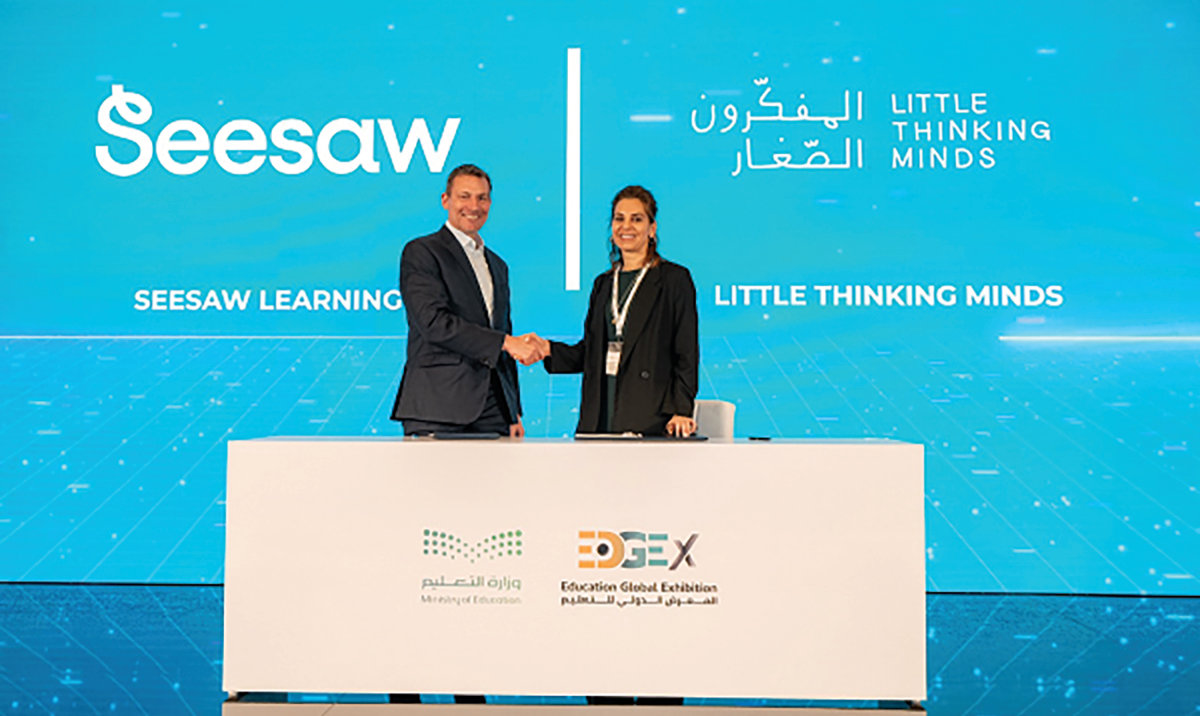


Seesaw, established in 2007, develops AI-powered learning tools and digital curricula. (Supplied)

TruBuild secures $1m to fuel AI-powered contech expansion 

Saudi construction tech startup TruBuild has raised $1 million in a seed round led by Wa’ed Ventures and Dar Ventures, with support from Plug & Play Ventures, OQAL, Taz Investment, and several angel investors. 

Founded in 2023 by Bisrat Degefa and Sari Sabban, TruBuild uses AI to reduce inefficiencies and improve collaboration in construction projects. The funding will support product development and expansion within and beyond Saudi Arabia.

Seesaw acquires Little Thinking Minds  

US-based edtech company Seesaw has acquired Jordan’s Little Thinking Minds for an undisclosed sum. 

Founded in 2004 by Lamia Tabbaa and Rama Kayyali, Little Thinking Minds specializes in Arabic literacy tools and is one of the region’s prominent female-founded edtech startups. 

Seesaw, established in 2007, develops AI-powered learning tools and digital curricula. The acquisition will integrate Seesaw’s interactive tech with Little Thinking Minds’ Arabic language expertise.

Dubizzle Group acquires Property Monitor  

 Dubai-based classifieds platform Dubizzle Group has acquired UAE’s Property Monitor, a real estate analytics firm, for an undisclosed amount. 

Founded in 2014, Property Monitor provides valuation and market intelligence services for real estate stakeholders. The acquisition supports Dubizzle’s strategy to expand offerings across its platforms Bayut and dubizzle. It follows Dubizzle’s February acquisition of Egypt’s online car marketplace Hatla2ee. 

DPI takes over Egypt’s Nclude fintech fund management 

UK-based private equity firm Development Partners International has assumed management of Egypt’s fintech fund Nclude, previously overseen by Global Ventures. 

Launched in 2022, Nclude closed a $110 million round that September and has invested $28 million across nine startups, including Partment, Khazna, and Paymob. 

DPI will advise through a dedicated Egypt-based team. With nearly $850 million invested in Egypt over the past decade, the firm brings significant experience in supporting digital transformation.

AIREV receives strategic backing from Venturewave Capital 

UAE-based artificial intelligence firm AIREV has secured investment from Ireland’s Venturewave Capital to accelerate the growth of its AI operating system ‘On-Demand.’ 

The capital will enable AIREV to expand beyond the UAE and Ireland and explore new markets. The investment reinforces its ambition to scale as a leading AI player in the Gulf.   

The investment reinforces AIREV’s position to scale as an AI company in the Gulf region.

viAct raises $7.3m Series A to advance industrial AI 

 Hong Kong-based AI startup viAct has closed a $7.3 million Series A round led by Venturewave Capital, with participation from Singtel Innov8, Korea Investment Partners, and the PolyU Entrepreneurship Investment Fund. 

The firm develops AI models for hazard prediction and workforce safety in high-risk sectors. viAct plans to expand its presence in the Middle East, especially Saudi Arabia, and grow its engineering and sustainability teams globally.


World must prioritize resilience over disruption, economic experts warn

Saudi Arabia’s Finance Minister Mohammed Al-Jadaan urged policymakers and investors to “mute the noise” and focus on resilience.
Updated 23 January 2026
Follow

World must prioritize resilience over disruption, economic experts warn

  • Al-Jadaan said that much of the anxiety dominating markets reflected a world that had already been shifting for years
  • Pointing to Asia and the Gulf, Al-Jadaan said that some countries had already built models based on diversification and resilience

DAVOS: Saudi Arabia’s Finance Minister Mohammed Al-Jadaan urged policymakers and investors to “mute the noise” and focus on resilience, as global leaders gathered in Davos on Friday against a backdrop of trade tensions, geopolitical uncertainty and rapid technological change.

Speaking on the final day of the World Economic Forum in Davos, Al-Jadaan said that much of the anxiety dominating markets reflected a world that had already been shifting for years.

“We need to define who ‘we’ are in this so-called new world order,” he said, arguing that many emerging economies had been adapting to a more fragmented global system for decades.

Pointing to Asia and the Gulf, Al-Jadaan said that some countries had already built models based on diversification and resilience. In energy markets, he pointed out that the focus should remain on balancing supply and demand in a way that incentivized investment without harming the global economy.

“Our role in OPEC is to stabilize the market,” he said.

His remarks were echoed by Saudi Arabia’s Minister of Economy and Planning Faisal Alibrahim, who said that uncertainty had weighed heavily on growth, investment and geopolitical risk, but that reality had proven more resilient.

“The economy has adjusted and continues to move forward,” Alibrahim said.

Alibrahim warned that pragmatism had become scarce, trust increasingly transactional, and collaboration more fragile. “Stability cannot be quickly built or bought,” he said.

Alibrahim called for a shift away from preserving the status quo towards the practical ingredients that made cooperation work, stressing discipline and long-term thinking even when views diverged.

Quoting Saudi Arabia’s founding King Abdulaziz Al-Saud, he added: “Facing challenges requires strength and confidence, there is no virtue in weakness. We cannot sit idle.”

President of the European Central Bank Christine Lagarde stressed the importance of distinguishing meaningful data from headline noise, saying: “Our duty as central bankers is to separate the signal from the noise. The real numbers are growth numbers not nominal ones.”

Managing Director of the IMF Kristalina Georgieva echoed Lagarde’s sentiments, saying that the world had entered a more “shock prone” environment shaped by technology and geopolitics.

Director General of the World Trade Organization Ngozi Okonjo-Iweala said that the global trade systems currently in place were remarkably resilient, pointing out that 72 percent of global trade continued despite disruptions.

She urged governments and businesses, however, to avoid overreacting.

Okonjo Iweala said that a return to the old order was unlikely, but trade would remain essential. Georgieva agreed, saying global trade would continue, albeit in a different form.

Georgieva warned that AI would accelerate economic transformation at an unprecedented speed. The IMF expects 60 percent of jobs to be affected by AI, either enhanced or displaced, with entry-level roles and middle-class workers facing the greatest pressure.

Lagarde warned that without cooperation, capital and data flows would suffer, undermining productivity and growth.

Al-Jadaan said that power dynamics had always shaped global relations, but dialogue remained essential. “The fact that thousands of leaders came here says something,” he said. “Some things cannot be done alone.”

In another session titled Geopolitical Risks Outlook for 2026, former US Democratic representative Jane Harman said that because of AI, the world was safer in some ways but worse off in others.

“I think AI can make the world riskier if it gets in the wrong hands and is used without guardrails to kill all of us. But AI also has enormous promise. AI may be a development tool that moves the third world ahead faster than our world, which has pretty messy politics,” she said.

American economist Eswar Prasad said that currently the world was in a “doom loop.”

Prasad said that the global economy was stuck in a negative-feedback loop and economics, domestic politics and geopolitics were only bringing out the worst in each other.

“Technology could lead to shared prosperity but what we are seeing is much more concentration of economic and financial power within and between countries, potentially making it a destabilizing force,” he said.

Prasad predicted that AI and tech development would impact growing economies the most. But he said that there was uncertainty about whether these developments would create job opportunities and growth in developing countries.

Professor of international political economy at the University of New South Wales in Australia, Elizabeth Thurbon, said that China was driving a Green Energy transition in a way that should be modeled by the rest of the world.

“The Chinese government is using the Green Energy Transition to boost energy security and is manufacturing its own energy to reduce reliance on fossil fuel imports,” she explained.

Thurbon said that China was using this transition to boost economic security, social security and geostrategic security. She viewed this as a huge security-enhancing opportunity and every country had the ability to use the energy transition as a national security multiplier. 

“We are seeing an enormous dynamism across emerging market economies driven by China. This boom loop is being driven by enormous investments in green energy. Two-thirds of global investment flowing into renewable energy is driven largely by China,” she said.

Thurbon said that China was taking an interesting approach to building relationships with countries by putting economic engagement on the forefront of what they had to offer.

“China is doing all it can to ensure economic partnership with emerging economies are productive. It’s important to approach alliances as not just political alliances but investment in economy, future and the flourishment of a state,” she said.

The panel criticized global economic treaties and laws, and expressed the need for immediate reforms in economic governing bodies.

“If you are a developing economy, the rules of the WTO, for example, are not helpful for you to develop. A lot of the rules make it difficult to pursue an economic development agenda. These regulations are not allowing the economies to grow,” Thurbon said.

“Serious reform must be made in international trade agreements, economic bodies and rules and guidelines,” she added.

Prasad echoed this sentiment and said there was a need for national and international reform in global economic institutions.

“These institutions are not working very well so we can reconfigure them or rebuild them from scratch. But unfortunately the task of rebuilding falls into the hands of those who are shredding them,” he said.

WEF attendees were invited to join the Global Collaboration and Growth meeting to be held in Saudi Arabia in April 2026 to continue addressing the complex global challenges and engage in dialogue.