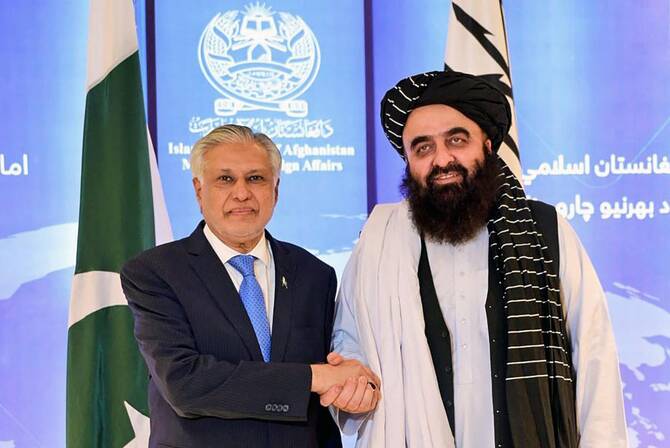

ISLAMABAD: Ishaq Dar, Pakistan’s deputy prime minister and foreign minister, held discussions on Saturday with Afghanistan’s Foreign Minister Amir Khan Muttaqi on security, border management and regional trade, Pakistan’s Foreign Office reported.
Dar arrived in Kabul on Saturday morning for a day-long visit to discuss Islamabad’s security concerns and trade and investment opportunities with Afghanistan amid strained ties between the neighbors.
His visit was taking place amid surging militancy in Pakistan, which Islamabad blames on the Tehreek-e-Taliban Pakistan. The Afghan Taliban are accused of providing the group with sanctuaries, allegations that Kabul has repeatedly denied.
HIGHLIGHT
Dar’s visit is seen as a continuation of Pakistan’s efforts to engage with Afghanistan despite frosty ties.
Dar’s visit also takes place as Pakistan intensifies its campaign to deport what it says are “illegal immigrants,” mostly Afghan nationals, which it has blamed without evidence for being involved in suicide attacks and militancy in the country. Pakistan’s deportation drive has further soured ties between the two nations.
“The discussions encompassed a comprehensive range of topics pertaining to bilateral relations, underscoring the need to devise strategies for enhancing cooperation across diverse areas of mutual interest, including security, trade, transit, connectivity, and people-to-people contacts,” the foreign office said.
Dar stressed the importance of addressing all issues between the two countries, particularly those related to security and border management, to fully realize the potential for regional trade and connectivity, the foreign office added.
“Both parties reaffirmed their commitment to fostering mutually beneficial relations and agreed on the importance of maintaining high-level engagement,” its statement said.
The deputy prime minister was also scheduled to meet Afghanistan’s Prime Minister Mullah Muhammad Hassan Akhund.
Speaking to the state-run Pakistan Television before leaving for Kabul, Dar acknowledged there had been “coldness” in ties between the countries in recent years.
“I believe the security of Pakistan, its people, their lives and properties, is very important,” Dar said. “So one of our concerns is regarding terrorism, which we will discuss.”
He said there was also immense potential for economic, trade and investment opportunities between Pakistan and Afghanistan.
“Our connection with Central Asian states can be established through rail links, but that’s not possible unless Afghanistan becomes a partner in this,” he said.
Dar’s visit is seen as a continuation of Pakistan’s efforts to engage with Afghanistan despite frosty ties, and its aim to address mutual concerns and explore avenues for cooperation with the country.