Refugee brothers worry about future in unknown Afghanistan after expulsion from Pakistan

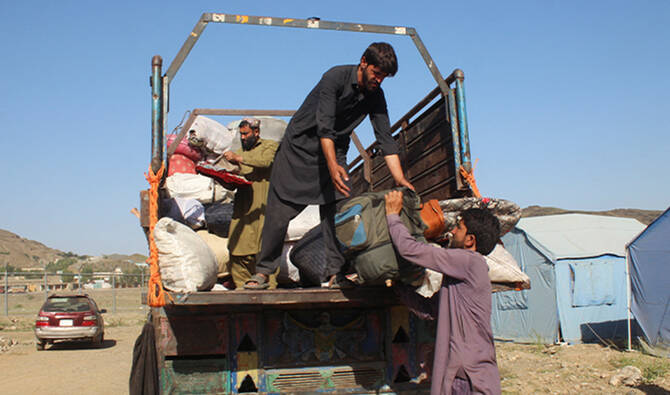
Afghan brothers, Mir Ali and Asal Mir, who were expelled from Pakistan, unload their belongings from a truck upon their arrival at the Omari refugee camp, in Mohmand Dara, Torkham border, Nangarhar province Afghanistan, April 15, 2025. (Reuters)
Short Url
Updated 17 April 2025
Follow

Refugee brothers worry about future in unknown Afghanistan after expulsion from Pakistan

  • Mir Ali and Asal Mir expect Afghan government to provide them with land, homes and employment
  • Over 63,000 undocumented or refugee Afghans have returned from Pakistan in the first 12 days of April

ISLAMABAD: Many Afghans refugees are returning to a homeland that is completely unknown to them, as neighboring Pakistan launched a large-scale crackdown on undocumented Afghan nationals.
Earlier this year, Pakistan’s interior ministry asked all “illegal foreigners” and holders of Afghan Citizen Cards (ACC) — a document launched in 2017 to grant temporary legal status to Afghan refugees — to leave the country before Mar. 31, warning they would otherwise be deported from April.
But for many of these refugees, this means uprooting from the only homes they’ve ever known.
Mir Ali was born in Murree, a mountain resort city in Pakistan’s Punjab region, where he spent his childhood and formative years. But he has no official Pakistani identity.
Standing at Pakistan’s Torkham border crossing point with Afghanistan, Mir Ali was reluctant to leave.
“I was not willing to come here (to the checkpoint) and leave but it was mandatory. My brother persuaded me to go back there (Afghanistan) and get the documents for my nationality. It will be a problem if I lose both nationalities,” the 23-year-old said, as he loaded his boxed-up-life into the back of a government-paid truck.
Over 63,000 undocumented or refugee Afghans had returned from Pakistan in the first 12 days of April, according to a joint UNHCR and International Organization for Migration (IOM) report published on Thursday.
It added that fear of arrest was the most common reason to return. Ali and his elder brother Asal Mir said they were leaving voluntarily.
“We were born in Pakistan, so why didn’t we get citizenship? So, maybe there is welfare in this (being expelled to Afghanistan) too,” said the younger brother.
The brothers were just two of hundreds of thousands of refugees who spent decades in Pakistan and were never granted citizenship, despite raising families and contributing to local communities.
Asal lived all four decades of his life in Pakistan and he said the way the government’s deportation order was issued affected him deeply.
With nowhere else to go, he could only now look toward Afghanistan for support — a country still reeling from economic collapse and political instability.
“The situation is worrying,” Asal said, uncertain about the future and his children’s education. “We’ll try to ensure they complete their education there (in Afghanistan).”
The brothers’ decision to relocate to Afghanistan comes as Pakistan resumed its deportation campaign targeting “illegal foreigners,” primarily Afghans, after a March 31 deadline passed, according to the UNHCR.
Islamabad said the expulsions were due to past militant attacks and crimes that it blamed on Afghan citizens, who form the largest portion of migrants in the country.
Afghanistan has rejected the accusations and has termed the repatriation as forced deportation.
Now with both brothers in Afghanistan, they can only remain hopeful despite an uncertain future.
“They have set up a program for us in Kabul and they will help us there,” Mir Ali said, switching to Pashto from Urdu language after arriving in Nangarhar. “We have nothing and ask for the government to provide us with land, houses and employment.”


Qatar, Pakistan resolve to boost strategic, economic cooperation at Doha talks

Updated 24 February 2026
Follow

Qatar, Pakistan resolve to boost strategic, economic cooperation at Doha talks

  • Both countries urge dialogue on Afghanistan amid renewed border tensions between Islamabad and Kabul
  • Discussions focus on bilateral trade and investment, energy, defense, manpower and labor and culture

ISLAMABAD: Pakistan and Qatar on Tuesday agreed to deepen their strategic and economic cooperation during high-level talks between Prime Minister Shehbaz Sharif and his Qatari counterpart Sheikh Mohammed bin Abdulrahman bin Jassim Al Thani, Sharif’s office said.

Sharif visited Qatar along with a high-level delegation on the invitation of Qatari emir Sheikh Tamim bin Hamad Al Thani. The Pakistani premier also held meetings with Qatar’s trade and defense ministers to discuss cooperation in various domains.

The visit came at a time when Pakistan is seeking closer economic engagement with Gulf partners amid its broader push to stabilize the economy and attract investment, while maintaining security and defense cooperation with key regional states.

During their meeting in Doha, PM Sharif and Qatar’s Sheikh Mohammed discussed bilateral relations and exchanged views on regional and international developments, according to the Pakistan prime minister’s office.

“They reaffirmed the strong brotherly relations between Pakistan and Qatar and expressed satisfaction at the growing momentum in political, economic and institutional ties,” Sharif’s office said.

“Discussions focused on enhancing cooperation in the fields of trade and investment, energy, defense, manpower and labor and culture, with both sides stressing the importance of their task force to accelerate cooperation in all these areas.”

Pakistan and Qatar maintain strong trade and investment ties. In 2022, the office of Qatar’s emir said the Qatar Investment Authority planned to invest $3 billion in Pakistan, targeting sectors including transport, aviation, education, health, media, technology and labor.

Nearly 300,000 Pakistanis live and work in Qatar, according to Pakistan’s foreign office, with many employed in health, education, engineering and public services, as well as construction and transport. The two countries engage through forums such as the Bilateral Political Consultations and the Joint Ministerial Commission.

Sharif said he had productive discussions with Qatar’s emir, Sheikh Tamim bin Hamad Al Thani, on how the two sides could transform their brotherly ties into mutually beneficial economic relationships. 

“We also took stock of the regional situation,” he said on X. “Pakistan and Qatar will continue to work together for peace and stability in the region and beyond.”

Prime Minister Shehbaz Sharif (second right) meets the Qatari Emir Qatar’s emir Sheikh Tamim bin Hamad Al Thani (left) in Doha, Qatar, on February 24, 2026. (PID)

DIALOGUE WITH AFGHANISTAN

Earlier, Sharif and Qatar’s Deputy PM Sheikh Saoud Al-Thani discussed the situation in Afghanistan and called for dialogue to support regional stability.

The meeting took place amid renewed tensions after Islamabad carried out airstrikes last week on what it described as Tehreek-e-Taliban Pakistan (TTP) targets inside Afghanistan. Kabul said the strikes killed civilians and vowed to respond to what it called a violation of its sovereignty.

“Regional developments were also discussed, in particular the situation in Iran and Afghanistan,” Sharif’s office said in a statement. “Both sides emphasized the importance of dialogue, de-escalation and collective efforts to promote peace and stability in the region.”

This was the second time in less than six months that Pakistan conducted airstrikes in Afghanistan. The last strikes triggered heavy, weeklong clashes between the neighbors along their border before Qatar and Turkiye mediated a ceasefire between them in Oct. last year.

Separately, Sharif held meetings with Qatar’s State Minister for Trade Dr. Ahmed bin Mohammed Al-Sayed and a delegation of the Qatar Businessmen Association (QBA), highlighting Pakistan’s investment-friendly reforms.

He invited QBA members to explore opportunities in infrastructure, logistics, energy, agriculture, technology and export-oriented manufacturing, his office said.