

Pakistan deputy PM discusses security, trade cooperation with Afghan FM in Kabul

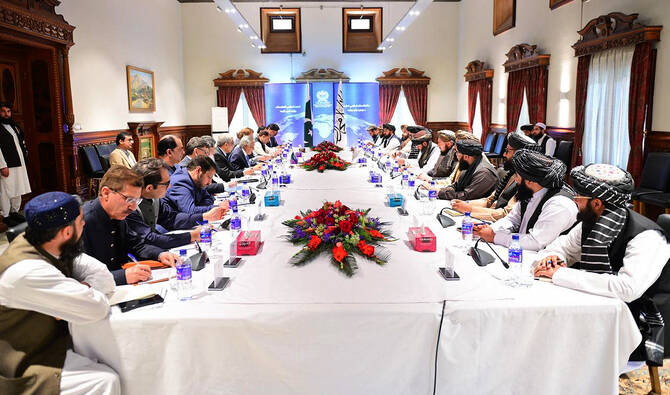
This handout photograph taken on April 19, 2025 and released by the Pakistan’s Ministry of Foreign Affairs shows the country’s Foreign Minister and Deputy Prime Minister Ishaq Dar (9L) speaks during a meeting with Acting Afghan Foreign Minister Amir Khan Muttaqi (8R) and other Taliban government officials in Kabul. Dar arrived in Afghanistan on April 19 for a one-day visit to meet senior Afghan Taliban officials, including Prime Minister Hasan Akhund, after Pakistan expelled more than 85,000 Afghans in just over two weeks. (Photo courtesy: Handout/MOFA)
Short Url
Updated 19 April 2025
Follow

Pakistan deputy PM discusses security, trade cooperation with Afghan FM in Kabul

  • Ishaq Dar’s visit comes at a time when Pakistan has blamed Afghan officials for ‘facilitating’ cross-border militancy
  • Dar stresses importance of resolving issues such as security, border management between both countries, says FO

ISLAMABAD: Pakistan’s Deputy Prime Minister and Foreign Minister Ishaq Dar on Saturday held discussions involving security, border management and regional trade with Afghanistan’s Foreign Minister Amir Khan Muttaqi, Pakistan’s foreign office said.
Dar arrived in Kabul on Saturday morning for a day-long visit to discuss Islamabad’s security concerns, trade and investment opportunities with Afghanistan amid strained ties between the neighbors. 
His visit takes place amid surging militancy in Pakistan, which Islamabad blames on the Tehreek-e-Taliban Pakistan (TTP) militant outfit. Pakistan accuses the Afghan Taliban of providing them sanctuaries, allegations that Kabul has repeatedly denied. 
Dar’s visit to Kabul also takes place as Pakistan intensifies its campaign to deport what it says are “illegal immigrants,” mostly Afghan nationals, which it has blamed without evidence for being involved in suicide attacks and militancy in the country. Pakistan’s deportation drive has further soured ties between the two nations. 
“The discussions encompassed a comprehensive range of topics pertaining to bilateral relations, underscoring the need to devise strategies for enhancing cooperation across diverse areas of mutual interest, including security, trade, transit, connectivity, and people-to-people contacts,” the foreign office said. 
Dar stressed the importance of addressing all issues between the two countries, particularly those related to security and border management to fully realize the potential for regional trade and connectivity, the foreign office said. 
“Both parties reaffirmed their commitment to fostering mutually beneficial relations and agreed on the importance of maintaining high-level engagement,” the statement said. 
The deputy prime minister will meet Afghanistan’s Prime Minister Mullah Muhammad Hassan Akhund, the foreign office said in an earlier statement. 


This handout photograph taken on April 19, 2025 and released by the Pakistan’s Ministry of Foreign Affairs shows the country’s Foreign Minister and Deputy Prime Minister Ishaq Dar (4R) shaking hands with Afghan government officials upon his arrival in Kabul. (Photo courtesy: Handout/MOFA)

Speaking to the state-run Pakistan Television before leaving for Kabul, Dar acknowledged there has been “coldness” in Pakistan’s and Afghanistan’s ties in recent years. 
“I believe the security of Pakistan, its people, their lives and properties, is very important,” Dar said. “So one of our concerns is regarding terrorism, which we will discuss.”
He said there is also immense potential for economic, trade and investment opportunities between Pakistan and Afghanistan. 
“Our connection with Central Asian states can be established through rail links but that’s not possible unless Afghanistan becomes a partner in this,” he said. 
Dar’s visit is seen as a continuation of Pakistan’s efforts to engage with Afghanistan despite frosty ties, and its aim to address mutual concerns and explore avenues for cooperation with the country. 


Pakistan, UK sign £35 million Green Compact to strengthen climate resilience

Updated 21 December 2025
Follow

Pakistan, UK sign £35 million Green Compact to strengthen climate resilience

  • Pakistan ranks among nations most vulnerable to climate change and has seen erratic changes in its weather patterns
  • UK will help Pakistan mobilize climate finance, strengthen regulatory frameworks and develop bankable climate projects

ISLAMABAD: Pakistan and the United Kingdom (UK) have formalized a comprehensive climate partnership with the launch of a Green Compact that aims to enhance climate resilience, accelerate clean energy transition and scale up nature-based solutions, including mangrove conservation, Pakistani state media reported on Sunday.

The agreement, signed in Islamabad by Federal Minister for Climate Change and Environmental Coordination Dr. Musadik Malik and UK Minister for International Development Jennifer Chapman, unlocks £35 million in targeted support for green development and long-term climate action, according to Radio Pakistan broadcaster.

Pakistan ranks among nations most vulnerable to climate change and has seen erratic changes in its weather patterns that have led to frequent heatwaves, untimely rains, storms, cyclones, floods and droughts in recent years. In 2022, monsoon floods killed over 1,700 people, displaced another 33 million and caused over $30 billion losses, while another 1,037 people were killed in floods this year.

Mohammad Saleem Shaikh, a spokesperson for Pakistan’s Ministry of Climate Change, described the compact as a “decisive move toward action-oriented climate cooperation,” noting that its implementation over the next decade will be critical for Pakistan which regularly faces floods, heatwaves and water stress.

“The Compact is structured around five core pillars: climate finance and investment, clean energy transition, nature-based solutions, innovation and youth empowerment, and adaptation and resilience,” the report read.

“Under the agreement, the UK will work with Pakistan to mobilize public and private climate finance, strengthen regulatory frameworks for green investment, and develop bankable climate projects.”

Clean energy forms a central component of Pakistan’s transition, with Islamabad planning to expand solar and wind generation to reduce fossil fuel dependence, improve energy security and stabilize power costs, according to Shaikh.

“Renewable energy is now economically competitive, making the transition both environmentally and financially viable,” he was quoted as saying.

“Nature-based solutions, particularly large-scale mangrove restoration, will protect coastal communities from storm surges and erosion while enhancing biodiversity and carbon sequestration.”

Under the Compact, technical support, mentoring and access to investors will be provided to climate-smart startups and young innovators, reflecting Pakistan’s recognition of youth-led initiatives as central to future climate solutions.

On the occasion, Chapman, on her first official visit to Pakistan, underscored the urgency of climate action, highlighting the UK’s support for renewable energy, mangrove and ecosystem restoration, early-warning systems, climate budgeting and international investment flows into Pakistan.

Shaikh described the Green Compact as “a strategic turning point” in Pakistan–UK relations on climate change, saying its effective implementation is essential for Pakistan to meet its national climate targets.