

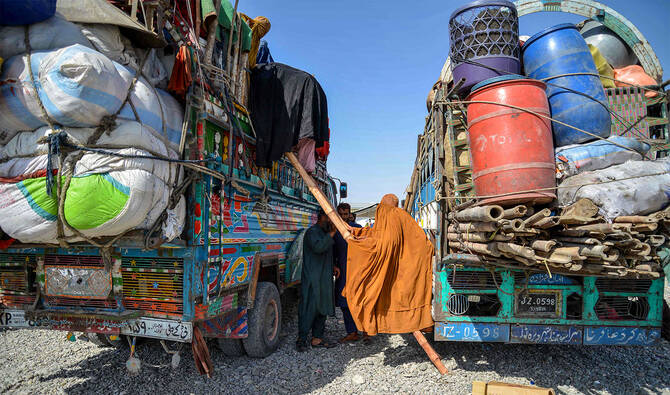

Torkham, Pakistan: Muhammad Rasool stood waiting at the Torkham border crossing in northwestern Pakistan earlier this month, set to return to his homeland of Afghanistan after 45 years with only a few belongings on his back.
The journey is not one Rasool, an Afghan refugee, is making by choice.
Earlier this year, Pakistan’s interior ministry asked all “illegal foreigners” and holders of Afghan Citizen Cards — a document launched in 2017 to grant temporary legal status to Afghan refugees — to leave the country before Mar. 31, warning that they would otherwise be deported from Apr. 1. The move is part of a larger repatriation drive of “illegal” foreign citizens that began in November 2023, with over 948,870 Afghans repatriated since, as per figures published on state broadcaster Radio Pakistan on Monday.
The campaign was launched after a spike in militant attacks in recent years that Islamabad says is partly to blame on Afghan nationals residing in the country without offering proof. The drive is also taking place amid worsening relations with Afghanistan, whose Taliban-led government Pakistan has accused of providing sanctuary to militants who carry out cross-border attacks. Kabul denies the accusations.
Millions of Afghans have sought refuge in Pakistan over the past four decades, fleeing successive conflicts including the Soviet invasion, a civil war and the post-9/11 US-led takeover of Kabul by the hard-line Taliban government. Thousands were born in Pakistan or left Afghanistan while they were children, and many have never even visited the country they are now forced to return to.
Rasool, 55, is one such refugee.
“We have lived in Pakistan for 45 years,” Rasool, a daily wage laborer most of his life, told Arab News on Saturday at the Torkham Border Crossing just to the west of the historic Khyber Pass in the northwestern Khyber Pakhtunkhwa (KP) province that borders Afghanistan.
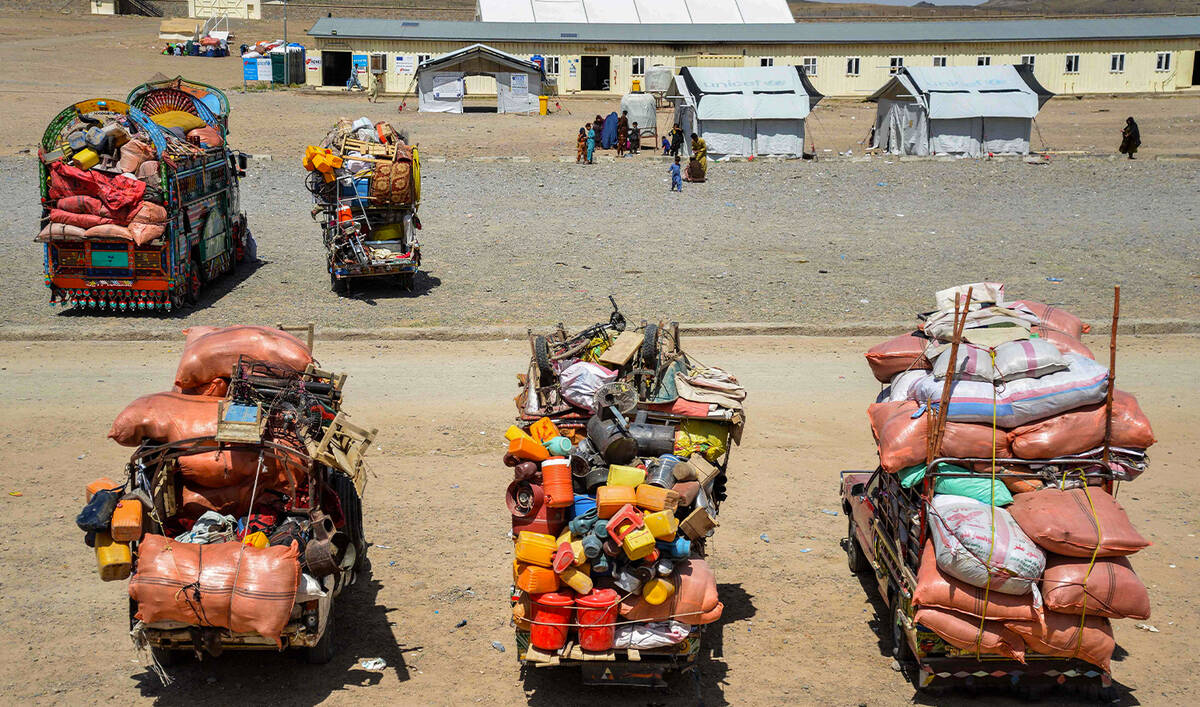
Afghan refugees with their belongings arrive on trucks from Pakistan at a registration centre in Takhta Pul district of Kandahar province on April 13, 2025. (AFP)
He was leaving the country with his wife, three daughters and two sons.
“We were so happy here. We are so sad that one can’t imagine.”
Rasool complained of harassment of Afghans by authorities in the days leading up to his departure for Torkham from Taxila in the eastern Punjab province where he was based in Pakistan.
“Afghan refugees were disrespected and harassed by the police. Some of the Afghans living near me were picked up from home,” he said. “I was worried that the police would also come to my home so to save my honor, I packed my belongings and left.”
A short distance away, Muhammad Islam, a man in his mid-thirties who was waiting with his family of five for a transport vehicle to take them to Jalalabad in Afghanistan, also spoke about the fear of harassment.
“Due to the fear that our female family members would be picked up by the police, we rushed to leave for Afghanistan,” he told Arab News.
The Pakistan government says it is ensuring the “dignified” repatriation of all illegal aliens.
“MY HEART ACHES”
As per latest figures obtained from the KP Tribal and Home Affairs Department, 500,040 illegal foreigners, mostly Afghan nationals, have been repatriated through various border crossings in the province since September 2023. Between Apr. 1-11, at least 16,242 ACC holders and 17,689 ‘illegal’ Afghan nationals have been repatriated through the Torkham border, according to the home department’s data.
Among them are many like Rasool, whose children can’t even speak the official languages of Afghanistan, Dari and Pashto, and who don’t know what lies ahead.
“They don’t know a word of Pashto, they are all worried as they don’t know the language and the place is new for them,” he said. “Where should we go? What should we do? We are worried about this.”
Sakhi Gul, a 57-year-old Afghan refugee who has worked as a bread maker in Pakistan’s Attock district for over 35 years, said he was barely ten years old when he left his homeland.
“How should we know now where we are being sent? People are saying that a camp has been established,” Gul said. “We don’t know any place or home to go to.”
When asked what he would do in Afghanistan, he said, “I will see once I cross the border … We worked hard in Pakistan and will try to work harder in Afghanistan. At first, I will try to find work as a laborer to feed my family.”
Muhammad Islam, a man in his mid-thirties, also said his professional and personal future in Afghanistan was uncertain.
“I don’t know what I will be doing in Afghanistan. I have never seen Afghanistan. I will see what to do once I cross my family over.”
What most of the refugees do know is that they will miss the life they are leaving behind.
Gul said his Pakistani friends and neighbors, with whom he had spent most of his life, were pained to see him leave.
“Yesterday, they were also weeping and asking why are we going.”
Islam too said he would miss the Pakistani community he was leaving behind in the eastern Chakwal district where he had lived for several years and worked at a junkyard. His spouse and four children, one of them a baby in his wife’s lap, were accompanying him to Afghanistan.
“I miss my friends, my heart aches for them,” Islam said. “They wept with us when I was getting on the vehicle, and I also wept. My heart says that I shouldn’t go.”


