



RIYADH: What if the answer to wastewater treatment was in the water itself? At King Abdullah University of Science and Technology, a team led by Professor Pascal Saikaly is harnessing the natural power of microbes found in wastewater — not just to clean it, but to generate energy and create valuable resources.
Rather than relying on outdated, energy-intensive systems, Saikaly’s team is developing innovative, nature-based solutions that turn waste into a tool for sustainability. Their key technology? A microbial electrochemical system that takes advantage of how certain microbes “breathe.”

Some microbes are capable of a process called extracellular electron transfer — moving electrons outside their cells to solid surfaces. Under the right conditions, this creates a small but useful electric current.
“At the anode, think about oxidation, you basically release electrons. At the cathode, it’s more like uptaking the electrons,” Saikaly told Arab News. “You have organisms that release the electrons at the anode side. At the cathode side, you have organisms that can capture these electrons.”
This process — using natural microbial activity and controlled conditions such as pH, electrode potential and substrate type — helps to treat wastewater while recovering energy and chemicals such as methane.
“You’re not adding any more energy to the whole process, so we reduce energy consumption,” Saikaly said.
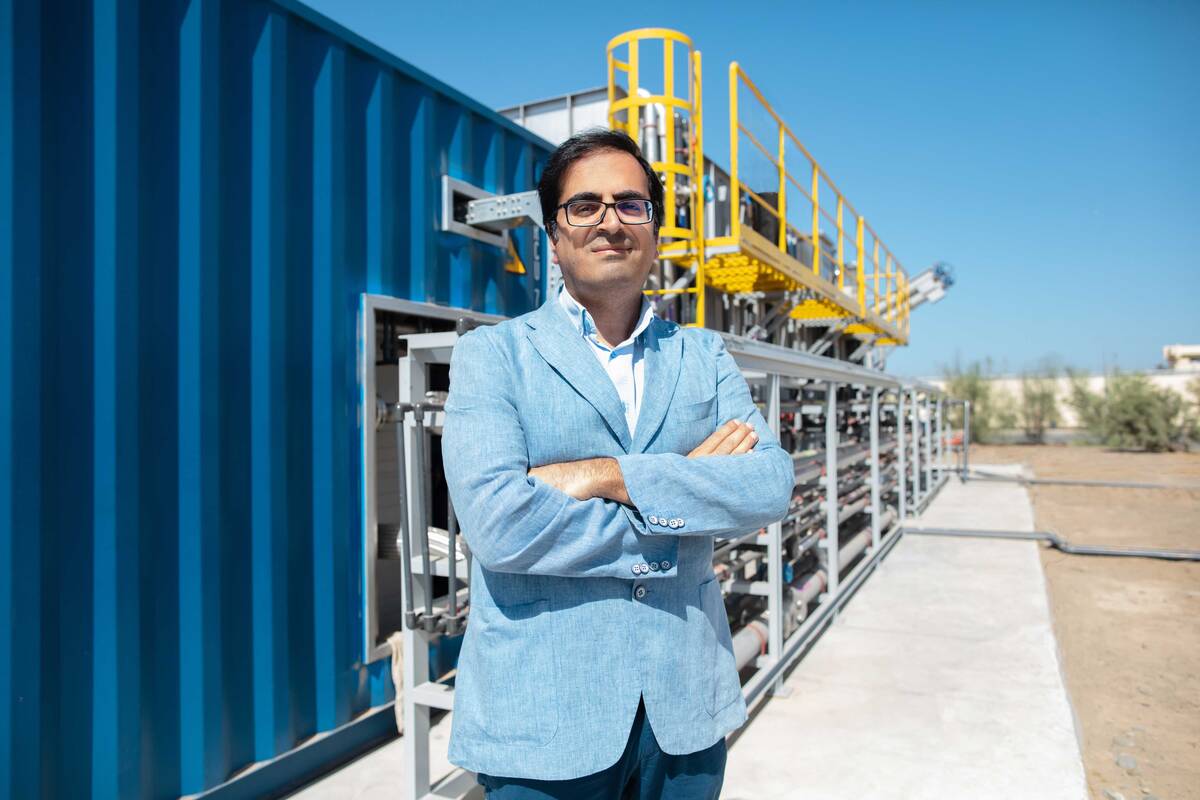
Professor Pascal Saikaly at the KAUST Water Desalination and Reuse Center. (KAUST photo)
Unlike conventional wastewater treatment methods, which were developed more than a century ago and rely heavily on aeration, these new systems are far more efficient. According to Saikaly, current methods require 0.6 kilowatt-hours of energy per cubic meter of treated water and produce large amounts of residual sludge.
“The technology that we are currently using generates a lot of residual solids,” he said. “In any biological treatment process, you produce waste. And this waste, we call it residual waste or waste activated sludge, we need to dispose of it.
“This means there is an additional cost that we have to pay for in the treatment process. So, it is energy intensive and generates a lot of residual solids.”
Opinion
This section contains relevant reference points, placed in (Opinion field)
The KAUST team’s microbial system not only removes pollutants but, under the right operation, can also fix carbon dioxide — transforming it into methane gas or acetate, both of which can be used as renewable fuels.
“You can operate it without microorganisms and there you produce hydrogen, or you operate it with microorganisms and you can generate methane gas or other types of substrates,” Saikaly said.

The goal is to move from simply treating waste to recovering valuable resources from it. “All the biotechnology that we developed falls under this principle,” Saikaly said. “Treat the waste with simultaneous recovery of resources. That’s our principle.”
Another innovation Saikaly’s team has developed is a technology called microbial chain elongation. Designed as an alternative to landfilling organic waste, this process converts food and dairy waste into high-value chemicals rather than low-value methane.
“According to Vision 2030, all of these landfills will be shut down and waste should be diverted away from landfills by 2030 or 2035,” Saikaly said. “This means there is an urgent need for an alternative solution for this huge amount of organic waste that is being generated.”

Existing wastewater treatment plants use a technology that was invented more than 100 years ago. The Activated Sludge Process utilizes aerobic bacteria to break down organic matter in wastewater. (iStock images)
Among the byproducts of this process is casaene — a protein-rich substance containing 16 essential amino acids — suitable for use in aquaculture and poultry feed.
“We’re in discussions with the aquaculture program at KAUST,” Saikaly said. “And also we are in discussion with Sipchem, which is a petroleum chemistry company. They also want to use our products to produce polymers. There’s a big window of applications that is much, much broader and has a higher value than methane gas.”
By producing methane, wastewater can be treated by generating enough energy to make the whole process energy neutral. (iStock images)
The team is also behind a compact, mobile wastewater treatment plant — the aerobic granular sludge gravity-driven membrane system — developed in partnership with former KAUST scientist Mohammed Ali. It treats domestic wastewater without the need for energy-intensive aeration or pumping, making it ideal for rural or remote locations.
The system, already in use in Rabigh, Saudi Arabia, serves up to 2,000 people and is designed to process 150 cubic meters of wastewater per day.
At the anode, pollutants such as chemical oxygen demand, biological oxygen demand, nitrogen compounds, and phosphorus are removed. (iStock images)
These innovations are part of a broader push by Saikaly and his team to rethink how we deal with waste — not as something to dispose of, but as something to transform. And while many of these technologies are still a few steps from commercial deployment, they are already showing how science and sustainability can go hand in hand.
“We want to think about waste not only as to treat and dispose, but as a waste that we can use to recover resources,” Saikaly said.


