


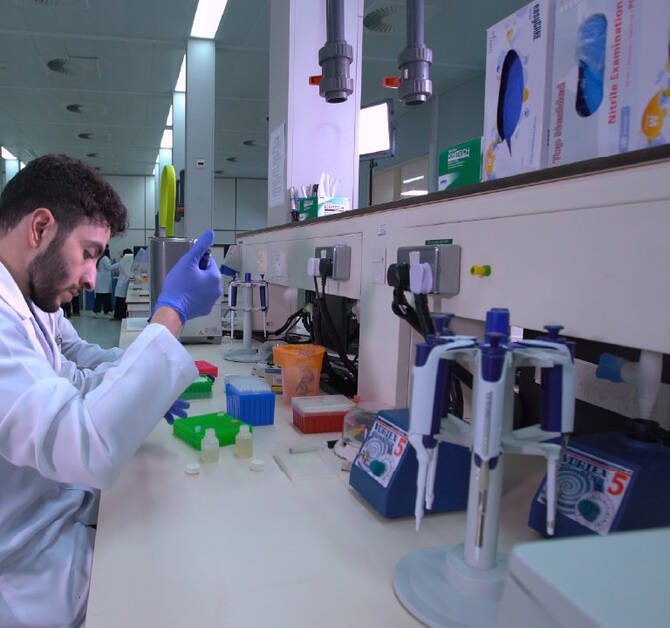

RIYADH: Saudi Arabia is embracing the future of healthcare by integrating artificial intelligence and omics-based diagnostics to deliver personalized, preventive care. This is part of a broader transformation that frames longevity not just as an individual aspiration but a national priority.
Central to this transformation is the integration of genomics, proteomics, metabolomics, and other omics disciplines into clinical practice — powered by AI. Leading the charge is Rewind, a Saudi Arabia-based company using the technology to pioneer proactive, individualized care.

“At Rewind, we harness the power of AI and omics technologies to shift healthcare from a generalized, reactive model to one that is deeply personalized and proactive,” Dr. Walid Zaher, the founder of Rewind, told Arab News.
“AI is the engine that makes this vast data actionable. It identifies patterns, predicts health risks, and recommends the most effective interventions for each individual.”
He said that “such a dynamic, data-driven approach” enables healthcare to be “as unique as the patient it serves.”
DID YOU KNOW?
• Integrating AI with omics-based diagnostics supports early disease detection and predicts health risks.
• In cancer care, AI and genomics are used together to match patients with the most effective targeted therapies.
• Saudi Arabia, the US, and the UK are making major investments in the integration of AI and omics.
Omics refers to a group of biological fields ending with the suffix “-omics,” each examining a different layer of biological data on a system-wide scale. Together, they offer a comprehensive view of how the body functions.
Transitioning from this broad understanding to actionable insights requires AI’s ability to analyze trillions of variables across DNA, protein expression, metabolic changes, and epigenetic shifts. This capability allows practitioners to intervene earlier and more accurately than ever.

Dr. Walid Zaher, the founder of Rewind. (Supplied)
“Omics-based diagnostics have already begun to make a profound impact on patient outcomes,” said Zaher.
“The precision enabled by genomics and multi-omics technologies allows us to detect diseases at their earliest molecular stages — often well before any clinical symptoms appear.
“Beyond disease detection, multi-omics approaches help in monitoring disease progression and response to treatments. The result has been an increase in patient satisfaction, as they experience better health outcomes and more personalized care.”
Saudi Arabia’s commitment to health innovation is evident in both its infrastructure and ambition. National initiatives like the Saudi Genome Program and investments through the Hevolution Foundation are driving the development of a knowledge-based healthcare system aligned with Vision 2030.
“Saudi Arabia’s Vision 2030 has made healthcare innovation a strategic priority,” said Zaher. “The government has invested heavily in infrastructure that supports cutting-edge research, particularly in AI, genomics, and biotechnology.”
This focus is positioning Saudi Arabia as a major player in the global longevity economy, according to Dmitry Kaminskiy, a co-founder and managing partner of Deep Knowledge Group.

Dmitry Kaminskiy, a co-founder and managing partner of Deep Knowledge Group, speaking about longevity in Spain in June 2022. (Supplied)
“Saudi Arabia and its GCC counterparts are strategically positioned to be not just participants but global pioneers in the longevity economy,” Kaminskiy told Arab News.
“With Vision 2030, the Kingdom has set the foundation for integrating economic diversification, healthcare innovation, and AI governance — all key components of a national longevity strategy.”
Kaminskiy, who has authored multiple books on AI and healthspan, believes that AI has shifted from a supporting role to something far more central to the field.
“We are now witnessing a paradigm shift where AI is not just an assistant but the architect of next-generation healthcare platforms,” he said. “Just as fintech redefined personal finance, AI will redefine personal health.”
Despite these advancements, significant challenges remain in mainstreaming AI and omics-based care into national systems. Zaher of Rewind noted that overcoming these hurdles will require both technological and cultural shifts.
“Integrating AI and precision medicine into a national healthcare system comes with several challenges, the most pressing of which is the need for a robust data infrastructure,” he said.
“Healthcare data is often fragmented or siloed, making it difficult to create a cohesive system that AI can utilize effectively.”
Opinion
This section contains relevant reference points, placed in (Opinion field)
Another critical challenge is training healthcare providers to engage with this new era of medicine.
Zaher said the integration of AI and precision medicine into clinical practice demands “a level of technological literacy that has yet to become widespread across the healthcare workforce.
“We need targeted training programs that equip providers with the skills to interpret AI-generated insights and translate them into actionable, patient-centered care,” he added.
Looking ahead, Kaminskiy said establishing ethical data governance will be vital to ensuring progress.
“Data is the lifeblood of AI-powered longevity,” he said. “But it is not just the amount of data that matters — it is the ownership, security, and ethical governance of that data that will define the winners in this domain.”
The Hevolution Foundation is playing a key role in funding and shaping the longevity research agenda in the region.

According to Zaher, it is “poised to play a pivotal role in accelerating global healthspan science by providing the funding and resources necessary to drive innovation in aging research.
“Through supporting projects that focus on extending healthspan and preventing age-related diseases, Hevolution is helping to set a global standard for longevity science,” he added.
As Saudi Arabia expands its investment in AI-driven healthcare and global collaborations deepen, the boundaries between technology, biology, and medicine are blurring — bringing the goal of healthy aging closer to reality.


