


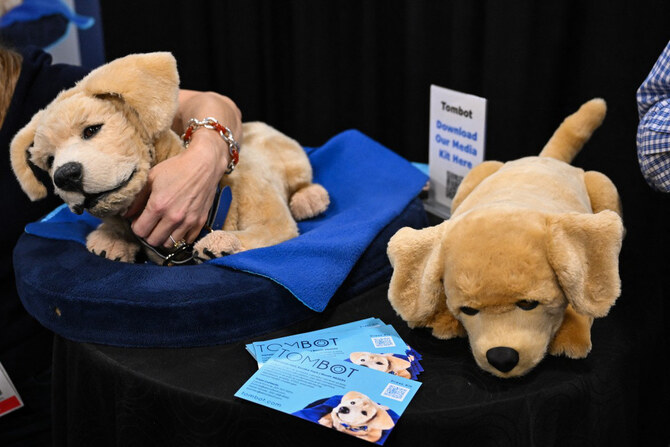

RIYADH: Pet ownership has long been associated with positive mental well-being, from the company and affection animals provide their owners to the health and social benefits offered by regular walks and interactions.
Domesticated animals like cats and dogs are routinely used to comfort people in distressing situations, including those being treated in hospital or suffering anxiety on commercial flights.
In fact, pet ownership and interactions with animals are regularly touted by doctors to help address a range of mental health issues and improve a patient’s social, emotional, or cognitive function.
A 2024 review in the Journal of Medical Internet Research highlighted animal-assisted therapy’s measurable impact on reducing stress and promoting good mental health across diverse demographics and settings.

However, for those who suffer from allergies or who for whatever reason are unable to keep a pet at home, this may not be an option.
Now, thanks to new advances in robotics and artificial intelligence, a synthetic form of animal-assisted therapy has emerged with the potential to transform the healthcare landscape.
“The future of using pet-like AI-driven robots for therapy has great potential,” Imed Gallouzi, chair of the Center of Excellence for Smart Health at King Abdullah University of Science and Technology, told Arab News.
“For individuals dealing with mental health issues, AI therapy pets could provide privacy, immediate reactions to crises, and even companionship to alleviate loneliness.”
Opinion
This section contains relevant reference points, placed in (Opinion field)
AI therapy pets could also be integrated with other smart health solutions. “These devices could link with wearable technology and remote monitoring tools to offer personalized treatment plans,” said Gallouzi.
For example, an AI pet could sync with a wearable device to monitor a patient’s heart rate and alert healthcare providers to any irregularities.
Such AI advancements in the diagnosis, treatment, and management of mental health conditions have come at a critical time.
The World Health Organization recently warned that mental health disorders are a major contributor to the global disease burden, with depression being the leading cause of disability worldwide.

Illustration from the WHO's "world mental health report"
Mental health issues among young people are a growing concern in Saudi Arabia. A 2023 study based on the Saudi National Mental Health Survey revealed that at least 40.1 percent of young Saudis had experienced a mental health condition at some point in their life.
Despite the prevalence of these issues, the study, published in the Scientific Reports journal, found that just 14.47 percent of young people with mental health issues had received treatment for their condition.
The Kingdom has sought to prioritize the well-being of its citizens as part of the Vision 2030 reform agenda. In 2022, it allocated 4 percent of its healthcare budget to mental health issues — far above the global average.
But for AI-programmed robotic pets to catch on as an effective therapy tool, Noor Al-Faraj, a data AI and automation expert at IBM, says the technology must exhibit sufficient emotional intelligence and offer the right response.
“For these pets to really work, they need to understand human emotions on a deeper level,” Al-Faraj told Arab News.

Despite their potential, the adoption of AI therapy pets faces significant challenges, particularly in the Middle East. (AFP)
“Imagine an AI pet that notices your heart rate increasing and reacts with a calming purring sound or a soft nudge. It’s about combining emotional intelligence with physical presence to feel real.”
Despite their potential, the adoption of AI therapy pets faces significant challenges, particularly in the Middle East.
One of the main hurdles is cultural perceptions. Indeed, the very concept of pet ownership — particularly of dogs — differs significantly in Arab cultures compared to Western norms.
“In our Arab culture, imagining that pets — let alone robotic pets — could contribute to health is a relatively new idea,” said Gallouzi.

Domesticated animals like cats and dogs are routinely used to comfort people in distressing situations. (AN Photo/Huda Bashatah)
Another challenge to the adoption of AI pet therapy is technical infrastructure, as their effectiveness will likely depend on a reliable cloud-driven system or one that requires advanced internet connectivity.
Cost and accessibility also pose significant barriers. The technology would likely be prohibitively expensive for the average user. Indeed, research published in Emerging Technologies Quarterly in 2021 highlighted the high cost of advanced AI solutions in emerging markets.
Data privacy is also a critical issue, as AI therapy pets require the collection of sensitive personal information to function effectively.
DID YOUKNOW?
• Equipped with sensors, AI, and machine learning, robotic pets can respond to touch, voice, and movement.
• Research shows AI-powered pets can reduce stress and anxiety, improving mental well-being.
• Studies estimate one in two people will develop a mental health disorder in their lifetime.
• The global market for robotic pets was valued at $1.2 billion in 2022 and is projected to grow 9.5 percent annually (Grand View Research).
Al-Faraj says strict privacy measures are needed to ensure public trust, as concerns over data protection could hinder the technology’s uptake.
Similarly, ethical concerns surrounding AI therapy pets require attention. “If someone starts relying on an AI pet too much, it could make them pull away from real relationships, which would defeat the purpose of emotional support,” said Al-Faraj.

World Health Organization illustration
Given these drawbacks, it seems unlikely these AI companions will replace human therapists altogether — at least not any time soon. But mental health practitioners would be wise to keep up with developments.
“AI will never replace doctors, but professionals who don’t understand AI might find themselves out of work in the future,” said Gallouzi.
Creating a market for AI therapy pets in Saudi Arabia will require significant investments in education and infrastructure.

“We need to train professionals in AI and smart health technologies to prepare the next generation of experts,” Gallouzi added.
Although impressed by these developments, Al-Faraj is not yet convinced that real animals can be substituted by AI therapy pets, no matter their sophistication.
She said: “They’re unpredictable, warm, and have this way of connecting with us that feels almost magical.”


