Lebanon says one killed in Israeli strike in south

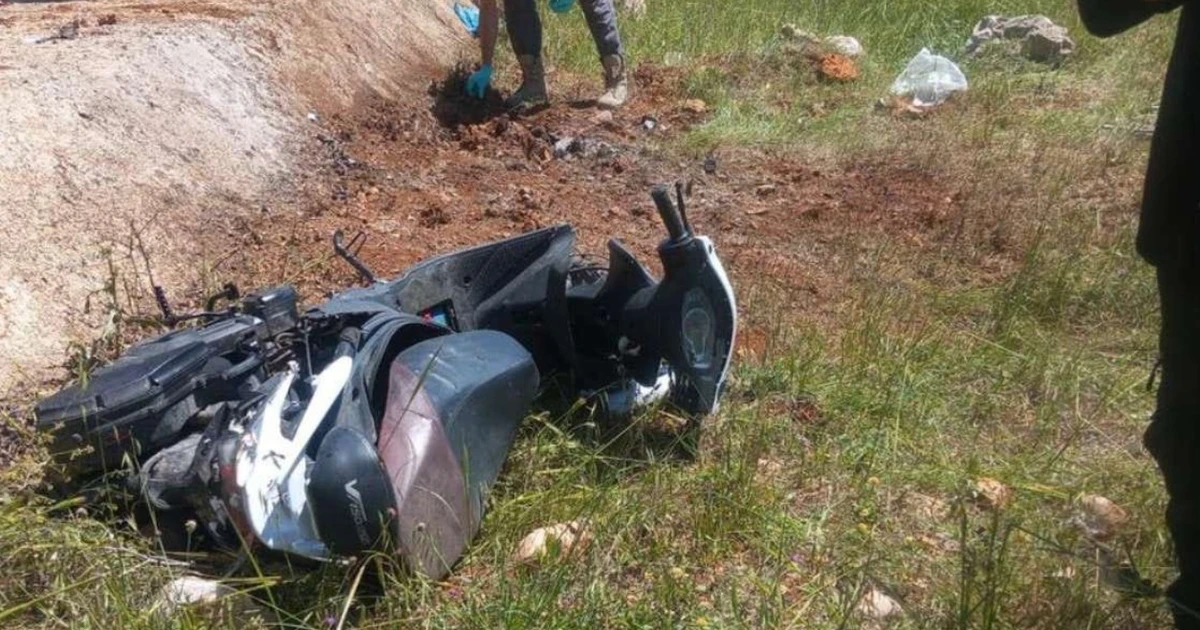
Lebanon reported Thursday that one person was killed by an Israeli air strike on a motorcycle in the country's south, hours after Israel said it had attacked sites there belonging to Hezbollah. (X/@MajaletAzhar_)
Short Url
Updated 17 April 2025
Follow

Lebanon says one killed in Israeli strike in south

  • The health ministry said: “the raid carried out by the Israeli enemy on the locality of Aitaroun left one dead“
  • Hezbollah, significantly weakened by the war, insists it is adhering to the ceasefire

BEIRUI: Lebanon reported Thursday that one person was killed by an Israeli air strike in the country’s south, hours after Israel said it had attacked sites there belonging to Hezbollah.
The health ministry said: “the raid carried out by the Israeli enemy on the locality of Aitaroun left one dead,” a day after Israeli strikes in the same region killed two people.
The Israeli military said earlier that it had struck “Hezbollah terrorist infrastructure sites” in southern Lebanon overnight, without offering details.
The military added that it would “operate against any attempts by Hezbollah to rebuild or establish a military presence under the guise of civilian cover.”
Despite a November 27 ceasefire that sought to halt more than a year of hostilities between Israel and Hezbollah, Israel has continued to carry out near-daily strikes in Lebanon.
Hezbollah, significantly weakened by the war, insists it is adhering to the ceasefire, even as Israeli attacks persist.
Rocket fire from Lebanon into Israel has also been reported since the truce was struck, although no group has claimed responsibility for the launches.
On Wednesday, the Lebanese army said it had arrested several people suspected of firing rockets at Israel from Lebanon.
A security official told AFP that three of those detained were members of Hezbollah’s Palestinian ally Hamas.
Israel spied on US forces at Gaza aid base: Sources

Updated 11 sec ago
Follow

Israel spied on US forces at Gaza aid base: Sources

  • US commander summoned Israeli counterpart to say: ‘Recording has to stop here’
  • Staff, visitors from other partner countries have also raised concerns about Israeli surveillance

LONDON: Israel conducted widespread surveillance of US forces involved in an aid mechanism for Gaza, The Guardian reported.

The Civil-Military Coordination Center in southern Israel was launched in October as a joint body to monitor the ceasefire and oversee the entry of aid into the war-torn Palestinian enclave.

But sources with knowledge of internal disputes told The Guardian that open and covert recordings of meetings at the CMCC had prompted disputes between the two partners.

Lt. Gen. Patrick Frank, the US commander of the center, summoned his Israeli counterpart to explain that “recording has to stop here.”

Other countries, including the UK and UAE, are also involved in the CMCC. Staff and visitors from partner countries have likewise raised concerns about Israeli surveillance activities at the center.

When the CMCC began operations, media in the US and Israel reported that the latter was handing over authority to American forces.

Yet Israel still retains effective control over what enters the territory despite Washington’s considerable leverage, according to one US official.

US forces who arrived at the CMCC, including logistics experts, were keen to increase the flow of aid into Gaza.

But they soon discovered that Israel had implemented a wide range of controls on purported “dual-use” goods, creating a larger impediment than any engineering challenge relating to aid delivery. These included basic goods such as tent poles and chemicals used for water purification.

Dutch Foreign Minister David van Weel has said he was briefed at the center on “one of the dual-use barriers that was being lifted as a result of the conversations (there).”

It came in response to growing awareness that Israeli restrictions on deliveries stood as the biggest barrier to the entry of aid into Gaza.

Israeli authorities had also restricted basic items such as pencils and paper — required by Palestinian students for school — without explanation.

There is widespread hesitancy among aid organizations and diplomats over joining the CMCC’s efforts, despite being invited to do so.

The center lacks any Palestinian representation, and even US efforts to schedule video calls with Palestinian officials were vetoed by Israeli staff there.