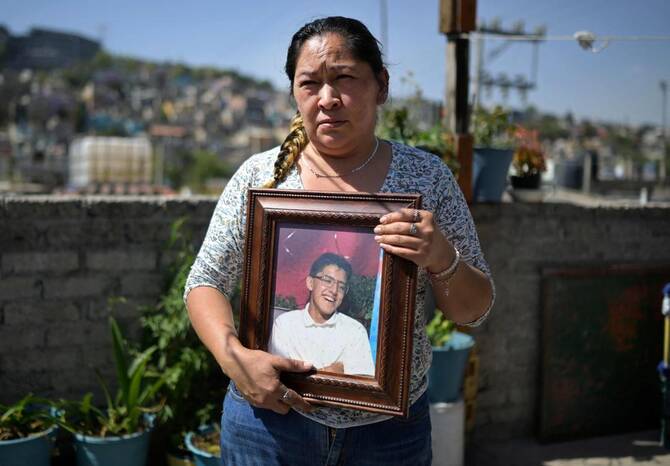
GUADALAJARA, Mexico: When Rubi Cruz recognized her husband’s belongings among personal items found at a suspected Mexican drug cartel training camp, she feared the worst – that he had become a victim of forced recruitment.
The discovery of bones, shoes and clothing at a ranch in the western state of Jalisco has shone a spotlight on the ruthless tactics of violent criminal groups in a country where more than 120,000 people are missing.
Cruz’s husband Fermin Hernandez, then 33, was kidnapped in 2021 from his home in the town of Tala near the Izaguirre ranch by gunmen who shot him in the leg.
She spotted what she believes are his personal items, including a wallet and T-shirt, in images released by a civil society group that went to look for the remains of missing persons at the site last month.
“I felt a lot of pain, a lot of sadness,” the 31-year-old restaurant worker told AFP, her husband’s image and the words “your wife is looking for you” printed on her long-sleeved T-shirt.
According to the government, the Jalisco New Generation Cartel, one of the drug trafficking groups designated terrorist organizations by US President Donald Trump, lured recruits with fake job adverts.
They were given firearms and other training at the Izaguirre ranch, Security Minister Omar Garcia Harfuch said last month, based on the testimony of an alleged cartel recruiter who was arrested.
“They even took the lives of people who resisted the training or tried to escape,” he said.
Disappearances have soared in Mexico since the government declared war on drug trafficking groups in 2006.
Around 480,000 people have been murdered in a spiral of violence since then.
Veronica Cruz – of no relation to Rubi Cruz – fears her son Robert Reyes is also a victim of forced recruitment by a drug cartel.
The teenager disappeared a year ago after traveling to Jalisco, lured by an offer of work painting houses.
Robert’s mother, 42, believes he was also at the Izaguirre ranch because he once sent a message from the area.
She had tried to keep him away from the neighborhood’s gangs and drugs, but said she never imagined her son would be forced to join a cartel.
At the age of 16, the high school dropout traveled from his home in a suburb near Mexico City to Jalisco a year ago to earn money to buy a motorcycle, disobeying his mother.
Weeks later, he called his sister, crying.
“I’m a hitman. My friend was just killed... If I don’t get out of here, I’ll watch over you from heaven,” he said, according to his mother.
Later, a man who said he was Robert’s friend wrote to his sister via social media to tell her that he had died in a shootout.
“I thought hitmen wanted to do that work. I never thought cartels were taking people away,” his mother said.
The government says it has taken down dozens of social media pages recruiting for criminal groups.
But on video-sharing app TikTok, jobs are still offered in Jalisco with “meals and lodging,” featuring nicknames for the Jalisco New Generation Cartel.
Jalisco state accounts for 12 percent of the roughly 127,000 missing people in Mexico, mainly young men.
Many disappearances are linked to forced recruitment because gangs need armies to control their territory and to generate illicit income, according to Jorge Ramirez, a researcher at the University of Guadalajara.
The victims are often poor young people without access to education, he said.
In 2024, around 30 young people were reported to have disappeared after attending what they believed would be job interviews in the Jalisco state capital Guadalajara.
Despite her fears, Rubi Cruz still hopes to find her husband alive.
Veronica Cruz’s optimism has waned, but she still wants answers.
“Maybe I’m not looking for justice, but I want to know where my son is – whatever it takes,” she said.


Cartel recruitment at heart of Mexico’s missing persons crisis
https://arab.news/px3de
Cartel recruitment at heart of Mexico’s missing persons crisis

- Jalisco New Generation Cartel lures recruits with fake job adverts, according to the government
- Disappearances have soared in Mexico since the government declared war on drug trafficking


France’s Le Pen insists party acted in ‘good faith’ at EU fraud appeal
- Le Pen said on her second day of questioning that even if her party broke the law, it was unintentional
- She also argued that the passage of time made it “extremely difficult” for her to prove her innocence
PARIS: French far-right leader Marine Le Pen told an appeals trial on Wednesday that her party acted in “good faith,” denying an effort to embezzle European Parliament funds as she fights to keep her 2027 presidential bid alive.
A French court last year barred Le Pen, a three-time presidential candidate from the far-right National Rally (RN), from running for office for five years over a fake jobs scam at the European institution.
It found her, along with 24 former European Parliament lawmakers, assistants and accountants as well as the party itself, guilty of operating a “system” from 2004 to 2016 using European Parliament funds to employ party staff in France.
Le Pen — who on Tuesday rejected the idea of an organized scheme — said on her second day of questioning that even if her party broke the law, it was unintentional.
“We were acting in complete good faith,” she said in the dock on Wednesday.
“We can undoubtedly be criticized,” the 57-year-old said, shifting instead the blame to the legislature’s alleged lack of information and oversight.
“The European Parliament’s administration was much more lenient than it is today,” she said.
Le Pen also argued that the passage of time made it “extremely difficult” for her to prove her innocence.
“I don’t know how to prove to you what I can’t prove to you, what I have to prove to you,” she told the court.
Eleven others and the party are also appealing in a trial to last until mid-February, with a decision expected this summer.
- Rules were ‘clear’ -
Le Pen was also handed a four-year prison sentence, with two years suspended, and fined 100,000 euros ($116,000) in the initial trial.
She now again risks the maximum sentence of 10 years in prison and a one-million-euro ($1.16 million) fine if the appeal fails.
Le Pen is hoping to be acquitted — or at least for a shorter election ban and no time under house arrest.
On Tuesday, Le Pen pushed back against the argument that there was an organized operation to funnel EU funds to the far-right party.
“The term ‘system’ bothers me because it gives the impression of manipulation,” she said.
EU Parliament official Didier Klethi last week said the legislature’s rules were “clear.”
EU lawmakers could employ assistants, who were allowed to engage in political activism, but this was forbidden “during working hours,” he said.
If the court upholds the first ruling, Le Pen will be prevented from running in the 2027 election, widely seen as her best chance to win the country’s top job.
She made it to the second round in the 2017 and 2022 presidential polls, before losing to Emmanuel Macron. But he cannot run this time after two consecutive terms in office.


