Hungarian FM arrives in Islamabad with high-level delegation to explore business opportunities

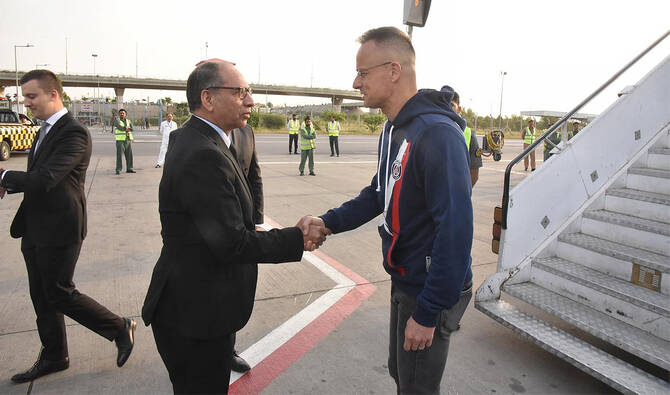
Hungary's Foreign and Trade Minister Peter Szijjarto arrives in Islamabad, Pakistan, on April 17, 2025. (Pakistan's foreign affairs ministry)
Short Url
Updated 17 April 2025
Follow

Hungarian FM arrives in Islamabad with high-level delegation to explore business opportunities

  • Pakistan and Hungary are expected to sign agreements on culture, heritage and visas during the visit
  • Pakistan says the two governments want enhanced economic, trade, energy and investment relations

ISLAMABAD: Hungary’s Minister for Foreign Affairs and Trade, Péter Szijjártó, arrived in Islamabad on Thursday with a high-level delegation to explore business opportunities in the country, Pakistan’s foreign office said.
Szijjártó is touring the country on Deputy Prime Minister Ishaq Dar’s invitation, with the two officials scheduled to hold delegation-level talks after one-on-one discussions.
“Hungary’s Minister of Foreign Affairs and Trade, Peter Szijjarto has arrived in Islamabad,” the foreign office said. “He was received at the airport by Muhammad Ayyub, Additional Secretary Europe, Ambassador of Hungary, and other senior officials.”
The foreign office said a day earlier the focus of the two governments was to deepen collaboration in the economic, trade, energy and investment sectors.
It also informed that a number of memoranda of understanding (MoUs) and an agreement on cooperation in the fields of culture (2025–2027), archaeology and cultural heritage, and the abolition of visas for holders of diplomatic passports will be signed between the two countries on the occasion.
“This would be FM Szijjártó’s second visit to Pakistan, aimed at lending positive impetus to enhanced bilateral cooperation and mutually rewarding economic partnership,” the statement said.
Pakistan enjoys cordial relations with Hungary, and this year Islamabad will mark 60 years since the establishment of diplomatic relations with the country.
The two countries enjoy cooperation in energy, with Hungarian oil and gas company MOL Group actively investing in Pakistan’s oil and gas exploration sector since the early 2000s.
MOL Pakistan has invested heavily in exploration and production, especially in Pakistan’s northwestern Khyber Pakhtunkhwa province.
Pakistan has pursued agreements in trade, energy, tourism, livestock, mining and minerals, and other priority sectors with regional allies and Gulf countries in recent months. Islamabad hopes to attract foreign investment in its priority sectors to achieve sustainable growth.
Pakistan formed the Special Investment Facilitation Council (SIFC) in June 2023 to attract international investment in these sectors, mainly from Gulf countries. The SIFC says it aims to fast-track decisions related to investments.



Pakistan alleges India behind Balochistan attacks that killed 18 civilians, 15 troops

Updated 6 sec ago
Follow

Pakistan alleges India behind Balochistan attacks that killed 18 civilians, 15 troops

  • Interior Minister Mohsin Naqvi accuses India of planning coordinated attacks across Balochistan this week 
  • Military says it killed 133 militants on Friday and Saturday in separate operations across various areas in Balochistan

ISLAMABAD: Pakistan’s Interior Minister Mohsin Naqvi this week alleged that India was behind the recent coordinated attacks in the southwestern Balochistan province that the military says killed 18 civilians and 15 troops, vowing to go after those responsible for the violence. 

Pakistan’s military said on Saturday that it had killed 133 militants in the past two days in separate operations in Balochistan. The Inter-Services Public Relations (ISPR) said 41 militants were killed in operations in Panjgur and Harnai areas on Friday while 92 militants, including three suicide bombers, were killed on Saturday as security forces repelled coordinated attacks on civilians and law enforcement personnel in Quetta, Gwadar, Mastung, Nushki, Dalbandin, Kharan, Panjgur, Tump and Pasni areas. 

It added that 18 civilians, including women, children, elderly people and laborers, were killed in the attacks in Gwadar and Kharan, while 15 security personnel were also killed during clearance operations and armed standoffs.

“India is behind these attacks,” Naqvi said during a joint press conference in Quetta late Saturday night with Balochistan Chief Minister Sarfraz Bugti. “I can tell you for sure that India planned these attacks along with these terrorists.”

He vowed that Islamabad would go after the militants who carried out these attacks and their “masters.”

“At this time it is very necessary that the world knows that the main country that is behind terrorism is India, who not only financially supports terrorists but also supports them in their planning and strategy as well,” the minister said. 

In its statement on Saturday, the ISPR said the attacks were launched by “Indian sponsored Fitna al Hindustan,” a reference the military frequently uses for the separatist Balochistan Liberation Army (BLA) militant group. 

The BLA also issued a statement on Saturday, saying it had launched what it called “Operation Herof 2.0,” claiming responsibility for attacks in multiple locations across Balochistan. 

The military had said intelligence reports have confirmed the attacks were orchestrated and directed by militant leaders operating from outside Pakistan who were in direct communication with attackers during the assaults.

Pakistan has frequently blamed India for supporting militant attacks in Balochistan and its northwestern Khyber Pakhtunkhwa (KP) provinces, charges that New Delhi has vehemently denied. 

Balochistan, which borders Iran and Afghanistan, has faced a decades-long insurgency by separatist militant groups, with Pakistani authorities frequently accusing foreign actors of backing the violence. India has repeatedly denied such allegations.