NEW YORK: Harvey Weinstein’s lawyers asked a judge on Wednesday to allow the ailing ex-studio boss to spend his nights at a New York City hospital instead of jail for the duration of his #MeToo rape retrial.
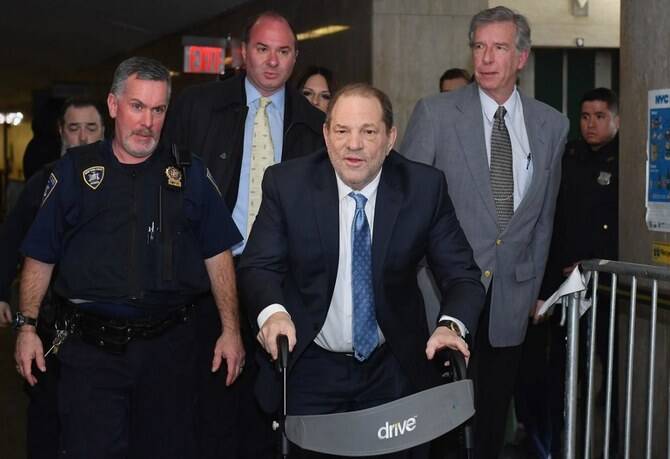
Weinstein’s lawyers made the request as jury selection resumed for a second day. The 73-year-old disgraced movie mogul arrived in court in a wheelchair, as he has at all of his recent court appearances.
In court papers, his lawyers argued that Weinstein’s stay at New York City’s notorious Rikers Island jail complex is exacerbating his health issues and that he’d be better off in the prison ward at Bellevue Hospital.
He been back and forth to Bellevue several times in recent months for treatment of various maladies.
Weinstein has numerous health conditions, including chronic myeloid leukemia, heart issues, diabetes, obstructive sleep apnea, sciatica and severe limitations on his ability to walk. A recent tongue infection was misdiagnosed at Rikers, requiring hospitalization, and he has gained nearly 20 pounds (9 kilograms) in the past month, his lawyer Imran Ansari said.
In a statement, Ansari said Weinstein is also subjected to freezing temperatures at Rikers and isn’t provided with clean clothing.
“Because of this mistreatment, he has been worn down considerably health wise, and now faces the stress of trial in this condition, which may very well lead to serious health complications, even death,” Ansari said.
Weinstein’s lawyers filed a legal claim against New York City last November, alleging he was receiving substandard medical treatment in unhygienic conditions at Rikers. The claim, which seeks $5 million in damages, argues that Weinstein has been returned to Rikers each time before fully recovering at the hospital.
The troubled jail complex has faced growing scrutiny for its mistreatment of detainees and dangerous conditions. Last year, a federal judge cleared the way for a possible federal takeover, finding the city had placed inmates in “unconstitutional danger.”
Judge Curtis Farber has yet to rule on the transfer request, and the issue wasn’t discussed in court before jury selection resumed on Wednesday morning.
The first day ended on Tuesday with no one chosen for the panel of 12 jurors and six alternates. Wednesday kicked off with two dozen prospective jurors being brought to the courtroom for more questioning after making it through an initial round a day earlier.
Weinstein is being tried again after New York’s highest court, the Court of Appeals, last year overturned his 2020 conviction and 23-year prison sentence and ordered a new trial, finding that improper rulings and prejudicial testimony tainted the original one.
Weinstein is being retried on two charges from his original trial. He’s accused of raping an aspiring actor in a Manhattan hotel room in 2013 and a criminal sex act on a movie and TV production assistant in 2006.
He is also charged with one count of criminal sex act based on an allegation from a woman who was not a part of the original trial. That woman, who has asked not to be named publicly, alleges that Weinstein forced himself on her at a Manhattan hotel.
Weinstein has pleaded not guilty and denies raping or sexually assaulting anyone.

Weinstein’s lawyers want him hospitalized instead of in jail during #MeToo retrial
https://arab.news/wmmsa
Weinstein’s lawyers want him hospitalized instead of in jail during #MeToo retrial
- Weinstein’s lawyers made the request as jury selection resumed for a second day
- The 73-year-old disgraced movie mogul arrived in court in a wheelchair
Ugandan voters face soldiers in the street and an Internet shutdown before presidential election
KAMPALA: Ugandans are set to vote Thursday in an election that is likely to extend the rule of the long-term president while raising concerns about transparency, hereditary rule, military interference and an opposition strategy to prevent vote tampering at polling stations.
President Yoweri Museveni, who has held power since 1986, seeks a seventh term that would bring him closer to five decades in power. But he faces a strong challenge from the musician-turned-politician best known as Bobi Wine, a 43-year-old who represents those yearning for political change.
Six other candidates are running for president in the East African nation of roughly 45 million people. Electoral authorities say there are 21.6 million registered voters.
Analysts say Museveni will almost certainly retain power, but at 81 he has become even more reliant on the nation’s security forces to enforce his authority. His son and presumptive heir, Gen. Muhoozi Kainerugaba, is the top commander of the military, which Wine accuses of interfering in the electoral process.
Here is what to know about the issues dominating the election.
Internet shutdown is a blow to activists
On Tuesday, less than 48 hours before the start of voting, the Uganda Communications Commission directed Internet service providers to temporarily suspend the general public’s access to the Internet, as well as the sale and registration of new SIM cards.
The government agency said the measure was “necessary to mitigate the rapid spread of online misinformation, disinformation, electoral fraud, and related risks.” It also cited a risk to national security stemming from possible violence.
The Internet shutdown was a blow to pro-democracy activists and others who use the Internet to share information about alleged electoral malpractices including ballot stuffing and other offenses that routinely plague Uganda’s elections.
‘Protecting the vote’ strategy
Wine’s party, the National Unity Platform, has urged followers to stay near polling stations and remain watchful after voting as part of an effort to prevent rigging.
Ugandan law allows voters to gather 20 meters (65 feet) from polling stations. Electoral officials are urging Ugandans to cast a ballot and then go home, perhaps returning later to witness vote counting.
The argument over whether voters should stay at polling stations as witnesses has animated public commentary and raised fears that the election could turn violent if security forces choose to enforce the electoral body’s guidance.
“The first step is for all of us to stay at the polling stations (while observing the 20-meter distance) and ensure that nothing criminal happens,” Wine wrote Tuesday on X. “We implore everyone to use their cameras and record anything irregular.”
Soldiers deployed in the streets
In a New Year’s Eve address, the president said he recommended security forces use tear gas to break up crowds of what he called “the criminal opposition.”
Wine faced similar setbacks when he first ran for president in 2021. He often was roughed up by the police, clothes ripped from his body, and dozens of his supporters were jailed.
Wine told The Associated Press in a recent interview that at least three of his supporters have been killed in violent campaign events, claiming “the military has largely taken over the election.”
The Office of the United Nations High Commissioner for Human Rights in Geneva has cited “widespread repression,” including the abduction and disappearance of opposition supporters.
Ugandan authorities say the presidential campaigns have been mostly peaceful. Ugandan authorities began deploying troops on Saturday in parts of the capital, Kampala, with armored trucks spreading into different parts of the city and soldiers patrolling the streets.
Military spokesman Col. Chris Magezi said the deployment was meant to deter violence, rejecting concerns that the mobilization was anti-democratic.
Son’s ambition raises hereditary rule concerns
Museveni has ruled Uganda for nearly 40 years by repeatedly rewriting the rules to stay in power. Term and age limits have been scrapped and rivals jailed or sidelined. But he has no recognizable successor in the upper ranks of the ruling party, the National Resistance Movement.
Kainerugaba, the president’s son, has asserted a wish to succeed his father, raising fears of hereditary rule.
Kainerugaba is a four-star general who sparked controversy by writing social media messages widely seen as offensive including comments about beheading Wine. He also wrote about hanging Kizza Besigye, an opposition figure who has been jailed over treason charges that he says are politically motivated.


