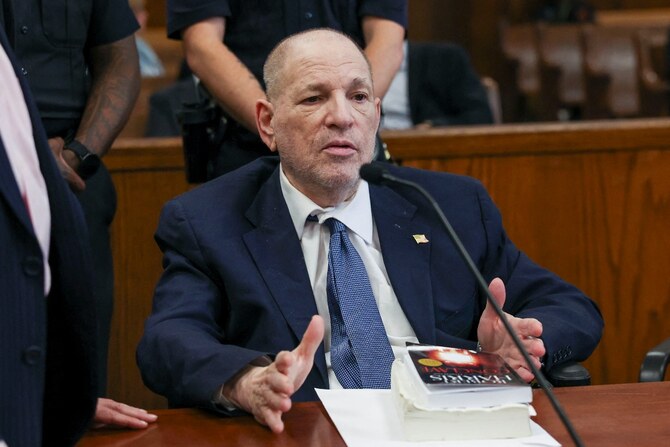
NEW YORK: Harvey Weinstein is due back in court Wednesday as a judge is set to decide when the disgraced movie mogul’s #MeToo retrial will start and whether it will include an allegation involving a woman who wasn’t in the original case.
Weinstein, 72, wants the extra charge thrown out, arguing through lawyers that Manhattan prosecutors only brought it to bolster their case with a third accuser after New York’s highest court overturned his 2020 conviction on rape and sexual assault charges involving two women.
Judge Curtis Farber is expected to rule on that and other matters, including the trial date — a task that’s been complicated by an increasingly crowded court calendar.
Weinstein’s lawyer, Arthur Aidala, is representing conservative strategist Steve Bannon in a border wall fraud trial that’s set to start March 4 before a different Manhattan judge. Meanwhile, Farber has a murder trial in March.
Before Bannon’s trial date was set last week, Aidala had suggested that Weinstein’s trial go first in “the interest of humanity,” citing the ex-studio boss’ declining health.
Weinstein is being treated for numerous medical conditions, including chronic myeloid leukemia and diabetes.
“They know that Mr. Weinstein is dying of cancer and is an innocent man right now in the state of New York,” Aidala argued in court last week. He pleaded to prosecutors: “Can I try this dying man’s case first?”
Weinstein is being retried on charges that he forcibly performed oral sex on a movie and TV production assistant in 2006 and raped an aspiring actor in 2013. The additional charge, filed last September, alleges he forced oral sex on a different woman at a Manhattan hotel in 2006.
The Manhattan district attorney’s office said in court papers that the woman, who has not been identified publicly, came forward to prosecutors just days before the start of Weinstein’s first trial but was not part of that case.
Prosecutors said they did not pursue the women’s allegations after Weinstein was convicted and sentenced to 23 years in prison, but they revisited them and secured a new indictment after the state’s Court of Appeals threw out his conviction last April.
Farber ruled in October to combine the new indictment and existing charges into one trial.
Weinstein’s lawyers contend that prosecutors prejudiced him by waiting nearly five years to bring the additional charge, suggesting they had elected not to include the allegation in his first trial so they could use it later if his conviction were reversed.
Prosecutors called that thinking “absurd,” countering that Weinstein’s lawyers would have also been outraged if he had been charged based on the third woman’s allegation either during his first trial or immediately after his conviction.
Weinstein “would likely have characterized that timing as a vindictive and gratuitous pile-on,” prosecutors wrote in a court filing last month.
Manhattan District Attorney Alvin Bragg’s office said the previously uncharged allegation “required a sensitive investigation” and serious contemplation before seeking an indictment, in part because there are no eyewitnesses to the alleged assault and no scientific or other physical evidence.
Weinstein co-founded the film and television production companies Miramax and The Weinstein Company and was once one of the most powerful people in Hollywood, having produced films such as “Pulp Fiction” and “The Crying Game.”
In 2017, he became the most prominent villain of the #MeToo movement, which erupted when women began going public with accounts of his behavior.
He has long maintained that any sexual activity was consensual.
In vacating Weinstein’s conviction, the Court of Appeals ruled that the trial judge, James M. Burke, unfairly allowed testimony against him based on allegations from other women that were not part of the case. Burke is no longer on the bench.
Weinstein was convicted in Los Angeles in 2022 of another rape. His 16-year prison sentence in that case still stands, but his lawyers appealed in June, arguing he did not get a fair trial.
Weinstein has remained in custody in New York’s Rikers Island jail complex, with occasional trips to a hospital for medical treatment, while awaiting the retrial.
The Associated Press does not generally identify people alleging sexual assault unless they consent to be named.


![]()

Harvey Weinstein due in court as judge weighs scope of his #MeToo retrial and when it will start
Short Url
https://arab.news/9zcrs
Harvey Weinstein due in court as judge weighs scope of his #MeToo retrial and when it will start
- Judge Curtis Farber is expected to decide Wednesday when the disgraced movie mogul’s #MeToo retrial will start
- He will also decide whether it will include an allegation involving a woman who wasn’t in the original case


Latest updates


© 2026 SAUDI RESEARCH & PUBLISHING COMPANY, All Rights Reserved And subject to Terms of Use Agreement.