Iraq proposes sea link between Karachi and Basra to strengthen trade routes

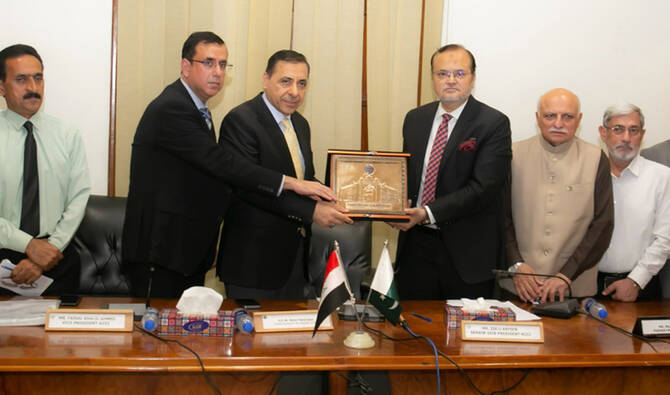
In this handout photo taken and released by the Karachi Chamber of Commerce & Industry on April 16, 2025, Iraq’s Consul General Maher Mjhid Jejan (3L) receives a souvenir from officials during his visit to the KCCI office in Karachi. (Photo courtesy: Handout/KCCI)
Short Url
Updated 16 April 2025
Follow

Iraq proposes sea link between Karachi and Basra to strengthen trade routes

  • Iraqi Consul General Maher Mjhid Jejan visits Karachi Chamber of Commerce and Industry’s office to meet its leadership
  • Jejan hoped Pakistani exporters, investors take advantage of Iraq’s opportunities, explore its market more actively, says KCCI

ISLAMABAD: Iraq’s Consul General Maher Mjhid Jejan has proposed a sea link between Pakistan’s southern port city of Karachi and Basra in a bid to improve logistics and strengthen trade routes, the Karachi Chamber of Commerce and Industry (KCCI) said on Wednesday.
Relations between Pakistan and Iraq have received a boost with a number of ministerial-level exchanges in recent years. The two countries have held discussions on enhancing defense and law enforcement cooperation, focusing on counterterrorism, counternarcotics and intelligence-sharing. Pakistan has attempted to strengthen trade, investment and cooperation in priority sectors with regional allies in recent months as it attempts to attract international investment to achieve sustainable economic growth.
Jejan visited the KCCI’s office on Wednesday during which he met the organization’s leadership. Talks between the two sides focused on strengthening business relations between and encouraging investment.
“He also proposed that a sea link between Basra and Karachi could play a key role in bringing the business communities of both countries closer together,” the KCCI said in a statement. “This connection could improve logistics and strengthen trade routes.”
Jejan said Iraq has introduced new investment laws designed to attract foreign investors, adding that these laws will be shared with the KCCI to help Pakistani businesses understand the opportunities available.
“He recognized the high quality of Pakistani products and expressed hope that Pakistani exporters and investors will explore the Iraqi market more actively,” the statement said.
The Iraqi consul general said his country is witnessing rapid development and offers immense potential for trade and investment. He encouraged Pakistani businessmen to visit Iraq and see first-hand the “peaceful and stable environment” in the country.
KCCI Senior Vice President Zia ul Arfeen told Jejan that Pakistan’s exports to Iraq stood at $54.29 million in FY24 while its imports from Iraq amounted to $145.46 million. 
“He said that this trade volume is far below the actual potential and emphasized the need for both countries to simplify customs procedures, promote ease of doing business, and expand the range of tradable goods and services,” the KCCI said. 
Arfeen said establishing an oil pipeline between Basra and Pakistan’s southwestern coastal city of Gwadar could create an important trade corridor for Iraq to access other Asian markets.


Pakistan, Iraq agree on tighter coordination over pilgrims under new regulated travel system

Updated 4 sec ago
Follow

Pakistan, Iraq agree on tighter coordination over pilgrims under new regulated travel system

  • New system requires all Iraq-Iran pilgrimages to be organized by licensed groups under state oversight
  • Long-running “Salar” model relied on informal caravan leaders, leading to overstays and missing pilgrims

ISLAMABAD: Pakistan and Iraq this week agreed to closely coordinate on the management and security of Pakistani pilgrims, as Islamabad rolls out a new, tightly regulated travel system aimed at preventing overstays, undocumented migration and security breaches during religious visits to Iraq and Iran.

The understanding was reached during a meeting between Pakistan’s Interior and Narcotics Control Minister Mohsin Naqvi and Iraq’s Interior Minister General Abdul Amir Al-Shammari on Thursday evening, where both sides discussed measures to facilitate pilgrims while strengthening oversight, Pakistan’s interior ministry said.

The agreement comes as Pakistan dismantles its decades-old pilgrim travel model and replaces it with a centralized, licensed system after authorities confirmed that tens of thousands of Pakistani pilgrims had overstayed or gone missing abroad over the past decade, triggering concerns from host governments.

“You have, for the first time during your tenure, taken effective measures to organize pilgrim groups, which are commendable,” Al-Shammari told Naqvi, according to Pakistan’s interior ministry.

“All pilgrims included in the list provided by Pakistan’s Ministry of Interior will be allowed to enter Iraq,” he added, making clear that only travelers cleared under the new system would be permitted.

Naqvi said Pakistan would strictly enforce return timelines under the revised framework.

“Pilgrims traveling to Iraq will not be allowed to stay beyond the designated period,” he said, adding that relevant authorities in both countries would remain in close coordination.

Both interior ministers also agreed to strengthen information-sharing and joint mechanisms on security cooperation, counterterrorism and the prevention of human smuggling, officials said.

“The safety, dignity, and facilitation of Pakistani pilgrims is the top priority of the Government of Pakistan,” Naqvi said.

Al-Shammari said he would visit Pakistan soon to finalize a joint roadmap to further improve pilgrim facilitation, security coordination and broader bilateral cooperation, according to the interior ministry.

Pakistan’s government has overhauled its pilgrim travel regime this year, abolishing the long-running “Salar” system under which informal caravan leaders managed pilgrimages. The move followed official confirmation that around 40,000 Pakistani pilgrims had overstayed or disappeared in Iran, Iraq and Syria over the past ten years.

Under the new Ziyarat Management Policy, only licensed Ziyarat Group Organizers (ZGOs) are allowed to arrange pilgrimages, with companies held directly responsible for ensuring pilgrims return on time. Authorities have completed security clearance for 585 companies seeking registration, while scrutiny of applications remains ongoing.

Islamabad has also barred overland travel for major pilgrimages, including Arbaeen, citing security risks in Pakistan’s southwestern Balochistan province, meaning all travel to Iraq and Iran is now restricted to regulated air routes.

Tens of thousands of Pakistani pilgrims travel each year to Iraq and Iran to visit some of the most revered shrines in Shia Islam, including the mausoleums of Imam Ali in Najaf and Imam Hussain in Karbala in Iraq, and major religious sites in Mashhad and Qom in Iran. Pilgrimages peak during religious occasions such as Arbaeen, when millions of worshippers converge on Karbala from across the region. The scale of travel, often involving long stays and cross-border movements, has long posed logistical, security and migration-management challenges for Pakistani authorities and host governments alike.